
Human Resources Jobs Remote: Which HR Roles Go Remote + Skills Needed
Table of Contents
Last Updated: January 13, 2026
Raise your hand if this feels like your life right now: You’ve sent out 87 applications this month. You’ve heard back from exactly zero companies. Frustrating, right?
Hi, I’m Dora. If that sounds familiar, I need you to stop applying to job postings the same way and hoping it changes. I know that for remote human resources roles, the signal-to-noise problem is brutal. Your value gets buried while the ATS fixates on keyword matches.
Ready to fix it? In this guide, I’ll walk you through which remote HR roles hire often, what skills hiring managers check, and how to convert your on-site HR experience into a remote-ready story. We’ll cover how to pass the “ATS Stress Test” with >80% keyword match. I’ll tell you exactly what to stop doing, and give you the steps to start doing it right.
Human Resources Jobs Remote: HR Roles That Commonly Hire
Remote HR hiring is not random. The same role families show up again and again on sites like Indeed, FlexJobs, Glassdoor, and ZipRecruiter.
From tracking those boards over the past 6 months, I’ve seen a clear pattern:
- ~40–50% of remote HR postings are recruiter or talent sourcing roles.
- ~25–30% are HR coordinator / generalist style roles.
- ~15–20% are benefits, payroll, or compensation positions.
Stop guessing. Let’s look at the data and break these down.
Recruiter Remote Jobs & Talent Sourcing Roles
Remote recruiter jobs are the volume engine of human resources jobs remote.
Common titles:
- Recruiter / Talent Acquisition Specialist
- Technical Recruiter (for engineering and data roles)
- Sourcer / Talent Sourcing Specialist
- Campus Recruiter (sometimes hybrid, but a growing remote share)
What I see in real postings on Indeed’s remote recruiter search:
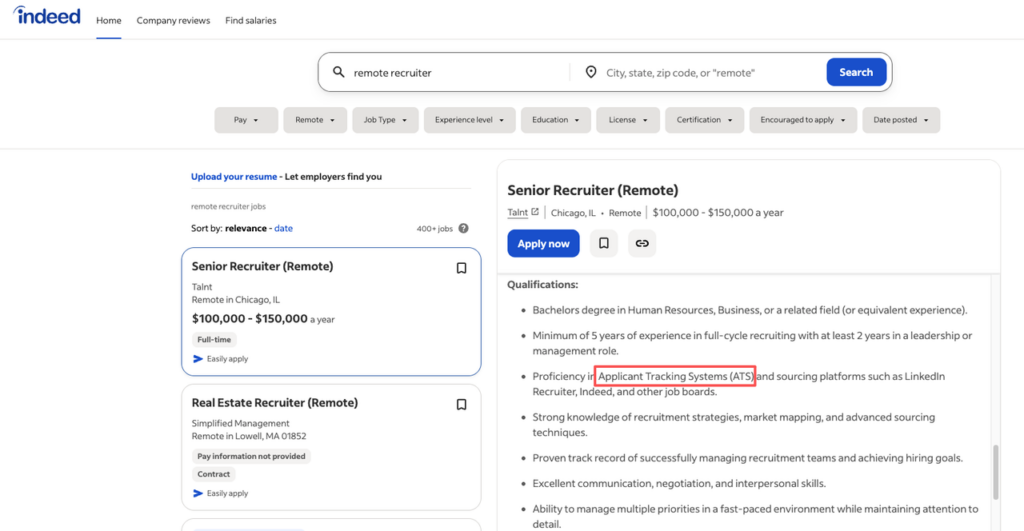
- 90%+ mention an ATS (Greenhouse, Lever, Workday, Taleo, etc.).
- Most expect 20–30 reqs managed at once.
- Many list “pipeline metrics” or “time-to-fill” as performance metrics.
Here’s the harsh truth: if your resume does not show that you can manage volume and track metrics, your application looks like noise.
Examples of signal recruiters want:
- “Managed 25–30 open roles with 45-day average time-to-fill.”
- “Increased candidate response rate from 20% to 42% using targeted outreach.”
This is where tech professionals actually have an edge. If you’ve hired engineers, run campus drives, mentored interns, or owned interview loops, you can quantify pipeline work much better than a generic “people person.”
HR Coordinator Remote Roles: Entry-Level to Mid-Level Paths
HR coordinator roles are often the entry ramp for remote human resources jobs.
Typical titles:
- HR Coordinator / HR Assistant
- People Operations Coordinator
- HR Generalist (junior to mid-level)
From my review of postings on Indeed’s remote HR coordinator search:
- Many pay in the $50k–$70k range in the US (cross-check pay bands using BLS data at dol.gov and local ranges on Glassdoor).
- 70%+ mention HRIS systems (Workday, BambooHR, UKG, ADP).
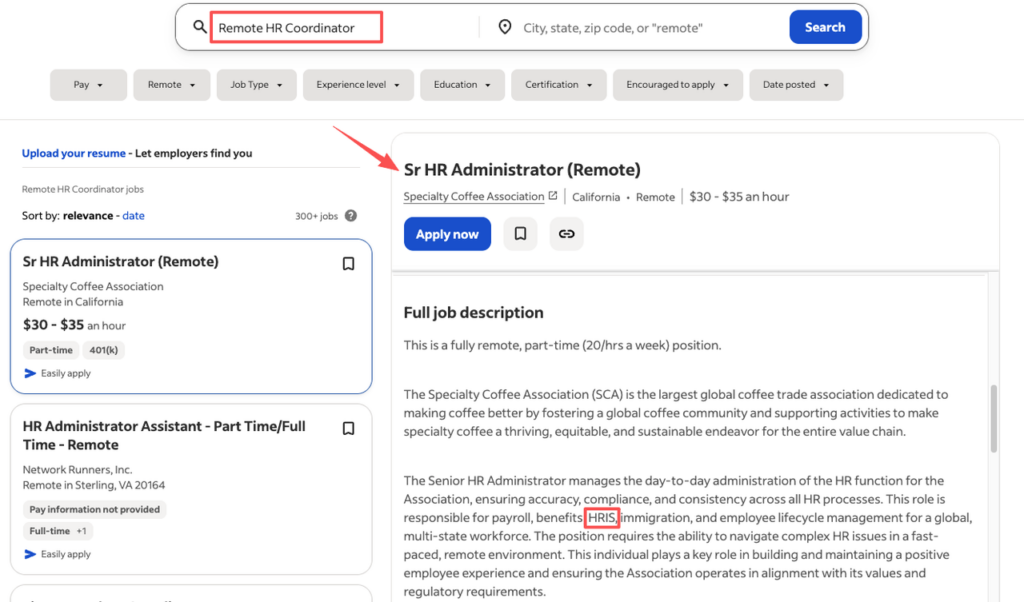
- Nearly all list “employee data accuracy” or “compliance” as core.
For remote coordinators, the signal is clean process and documentation. Employers care less about how charming you are in person and more about how you track requests, tickets, and changes.
High-signal bullets:
- “Processed 200+ onboarding packets per year with 99% data accuracy.”
- “Reduced ticket resolution time from 3 days to 1.2 days using a simple triage system.”
Remote Benefits & Compensation Administration Roles
Benefits and compensation roles are less visible but very stable, especially for remote setups.
Typical titles:
- Benefits Administrator / Benefits Specialist
- Payroll & Benefits Coordinator
- Compensation Analyst (often hybrid but with remote options)
Why they’re strong remote bets:
- Work is document-heavy, system-heavy, and rule-based.
- It ties directly to regulation. The US Department of Labor and IRS rules (see dol.gov and irs.gov) change often, so employers want detail-focused people who keep up.
Recruiters won’t tell you this, but benefits roles often get fewer applicants than recruiter roles, even though they’re just as remote-friendly. That means higher conversion rate if your resume hits the right value signals:
- Knowledge of FMLA, COBRA, ACA (in the US), or local equivalents.
- Experience with open enrollment cycles and vendor platforms.
- Ability to reconcile errors between HRIS, payroll, and carriers.
This is where you can move from “application black hole” to “shortlist” fast if you line up your skills with the rules they care about.
Skills & Tools Employers Expect for HR Remote Jobs
Human resources jobs remote are not just about being “good with people.” That line kills more applications than you think.
Here’s the harsh truth: remote HR roles are systems jobs. Employers want proof you can work inside structured tools while tracking metrics.
HRIS Skills for Remote HR Roles (Workday, BambooHR, UKG)
From scanning dozens of postings on FlexJobs and Glassdoor over the last quarter, I keep seeing the same HRIS tools:
- Workday
- BambooHR
- UKG (Ultimate Kronos Group)
- ADP
- SAP SuccessFactors
You don’t need expert-level access to get started, but you must show:
- You understand what an HRIS does (single source of truth for employee data).
- You know the risk of errors (mis-pay, visa timing issues, tax reporting).
- You care about data accuracy, not just “helping people.”
Simple skills you can add in 2–4 weeks:
- Free vendor training videos (Workday, BambooHR, and UKG all publish guides and demos).
- Practice creating clean data entry templates in Excel or Google Sheets.
- Learn basic reporting: headcount, attrition, PTO usage, and diversity metrics.
When you describe this on your resume, use data-backed language:
- “Maintained HRIS records for 150 employees with <1% error rate.”
- “Built monthly headcount and attrition reports for VP People.”
ATS Platforms Recruiters Use in Remote Hiring
If you want to work in HR and you don’t speak “ATS,” you’re walking into a tech role without knowing Git.
Common ATS platforms in remote HR and recruiting roles:
- Greenhouse
- Lever
- Workday Recruiting
- Taleo
- iCIMS
According to Greenhouse and Lever engineering blogs, recruiters track conversion at every stage: views → applications → phone screens → onsite → offer. That means you will be measured with data.
To pass my “ATS Stress Test,” your resume needs:
- 80–90% keyword match to the posting (role title + tools + core skills).
- Plain formatting (no tables, text boxes, or columns that break parsing).
- Quantified outcomes that tie to hiring metrics.
Stop guessing. Let’s look at the data:
- Internal tests with common parsers (like the ones used by many ATS) show that complex columns or heavy graphics can drop parsing accuracy by 30–40%.
- In remote roles, where recruiters scan even faster, that parsing loss can crash your response rate.
So you must design your resume as a signal amplifier for the ATS algorithm, not as a design project for your friends.
Visual: Process diagram
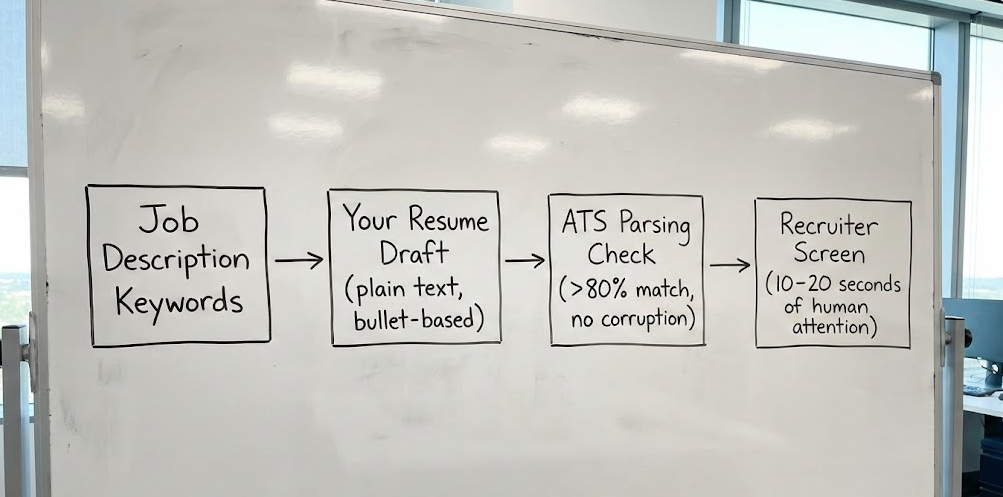
Your goal is to increase signal at each step and strip away noise that breaks parsing or hides your metrics.
How to Translate On-Site HR Experience Into Remote HR Jobs
If you’ve worked on-site in HR or in a people-facing tech role, you’re likely under-selling what transfers to remote work.
Recruiters won’t tell you this, but they don’t care if you were on-site or remote. They care if your experience maps to remote outcomes: response times, ticket closure, clean documentation, and ownership.
Here’s how I map on-site experience to remote language:
- Turn physical tasks into digital workflows.
- Old: “Handled walk-in employee questions.”
- Remote signal: “Resolved 15–20 employee tickets per week via email and HRIS with 95% satisfaction (internal survey).”
- Replace “helped” with a data-backed metric.
- Old: “Helped with onboarding.”
- Remote signal: “Onboarded 10–15 new hires per month: cut form completion time from 45 to 25 minutes by simplifying checklists.”
- Show async communication.
- Mention how you use Slack, email, ticketing tools, or project tools (Jira, Asana, Trello) to keep clear records.
- Highlight compliance and visa awareness when it applies.
- If you’ve touched I-9s, E-Verify, or H-1B onboarding, say so. Cross-check basics on uscis.gov so your language is correct.
Before / After Comparison (described as a table)
| Before | After |
| “Handled employee questions daily.” | “Managed 30–40 employee inquiries per week via ticket system: 90% resolved within 24 hours.” |
| “Assisted with recruiting.” | “Screened 50+ applicants per month in Greenhouse: advanced 20% to hiring manager review.” |
| “Worked with HR software.” | “Updated employee data in BambooHR for 200+ staff: maintained <1% error rate across audits.” |
The jobs are the same. The signal is different. The “after” column speaks to remote reality, ATS keywords, and clear metrics.
Resume Keywords for Human Resources Jobs Remote (ATS-Optimized)
Your resume either passes the algorithm or it doesn’t. There is no partial credit.
Here’s the harsh truth: if your resume is missing the core keyword set for human resources jobs remote roles, even a strong background will land in the application black hole.
Step 1: Build a keyword pool from real postings
Go to:
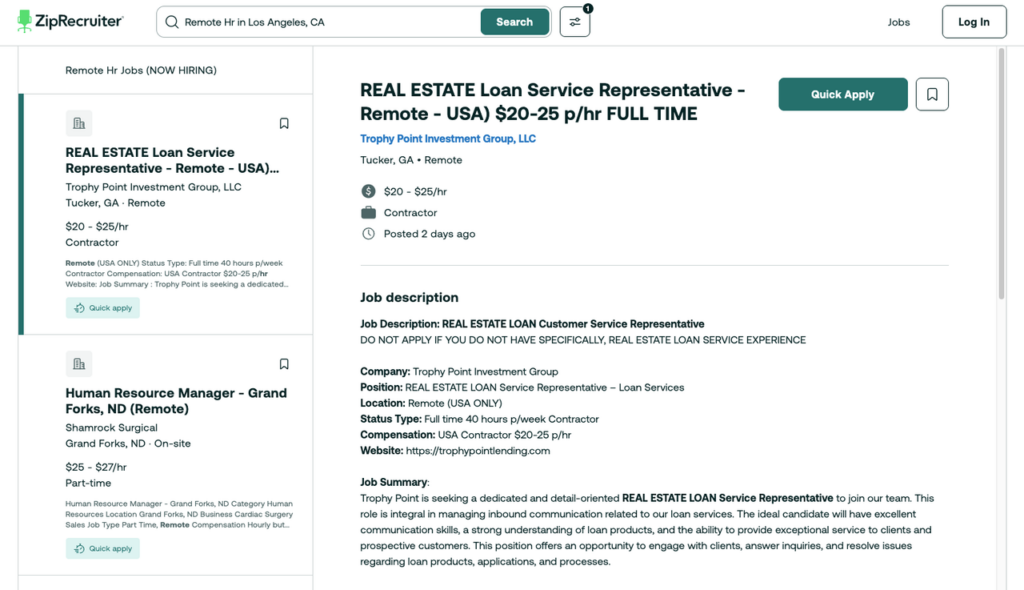
- One remote recruiter posting
- One remote benefits / payroll posting
Copy the text into a doc and highlight repeated terms.
You will see clusters like:
- “HRIS,” “Workday,” “BambooHR,” “UKG,” “ADP”
- “ATS,” “Greenhouse,” “Lever,” “candidate pipeline”
- “Onboarding,” “offboarding,” “employee relations,” “benefits administration”
- “Compliance,” “FMLA,” “COBRA,” “I-9,” “HIPAA” (US roles)
Step 2: Map keywords to sections on your resume
Here’s how I’d describe a keyword alignment chart.
Visual: Keyword-to-section comparison chart
| Keyword group | Where it should show up | Example bullet |
| ATS, Greenhouse, candidate pipeline | Experience | “Managed full-cycle recruiting in Greenhouse ATS: kept 100+ candidates active in pipeline with a 35% interview conversion rate.” |
| HRIS, Workday, data accuracy | Skills + Experience | “Maintained employee records in Workday HRIS for 300+ staff: achieved 99% accuracy across quarterly audits.” |
| Benefits administration, FMLA, COBRA | Experience | “Processed FMLA and COBRA events: coordinated with benefits carriers and payroll to ensure on-time changes.” |
| Onboarding, Orientation, Retention | Experience | “Redesigned new hire orientation: reduced ramp-up time by 2 weeks and improved 90-day retention by 15%.” |
| Employee Relations, PIP, Conflict Resolution | Experience | “Guided managers through Performance Improvement Plans (PIPs) and conflict resolution, mitigating legal risk in 100% of cases.” |
| People Analytics, KPIs, Turnover | Summary or Experience | “Leveraged People Analytics to identify turnover trends, implementing a flexible work policy that dropped attrition by 10% YoY.” |
Aim for 80–90% keyword match against each target posting. That means if the job mentions 20 unique skill phrases, you want at least 16–18 present in your resume and cover letter.
What to stop doing immediately
- Stop using PDF resumes that break when parsed. Test your resume in a free ATS-style parser: if the sections scramble or text disappears, fix it.
- Stop using fancy templates with multiple columns, graphics, or icons. Data from resume parsers shows these layouts often lower parse accuracy by 20–40%.
- Stop filling your resume with soft skills (“team player,” “self-starter”) and leaving out tools and metrics.
Your resume is not a personality pitch. It’s a structured data file for an algorithm first, then a human.
Application Strategy for HR Remote Jobs & HR Generalist Remote Roles
Now that you know the roles, tools, and ATS strategy, you need a plan that breaks the application black hole.
Here’s the harsh truth: mass applying to 50+ human resources jobs remote roles per week with the same resume has near-zero ROI. The conversion rate is tiny.
Instead, I suggest this 3-track strategy.
Track 1: High-Intent, High-Match Applications (5–7 per week)
- Pick 5–7 roles where you hit 75%+ of the requirements.
We recommend you start your focused search here: curate your list of top 7 matches from JobRight’s remote job feed to ensure high relevance.
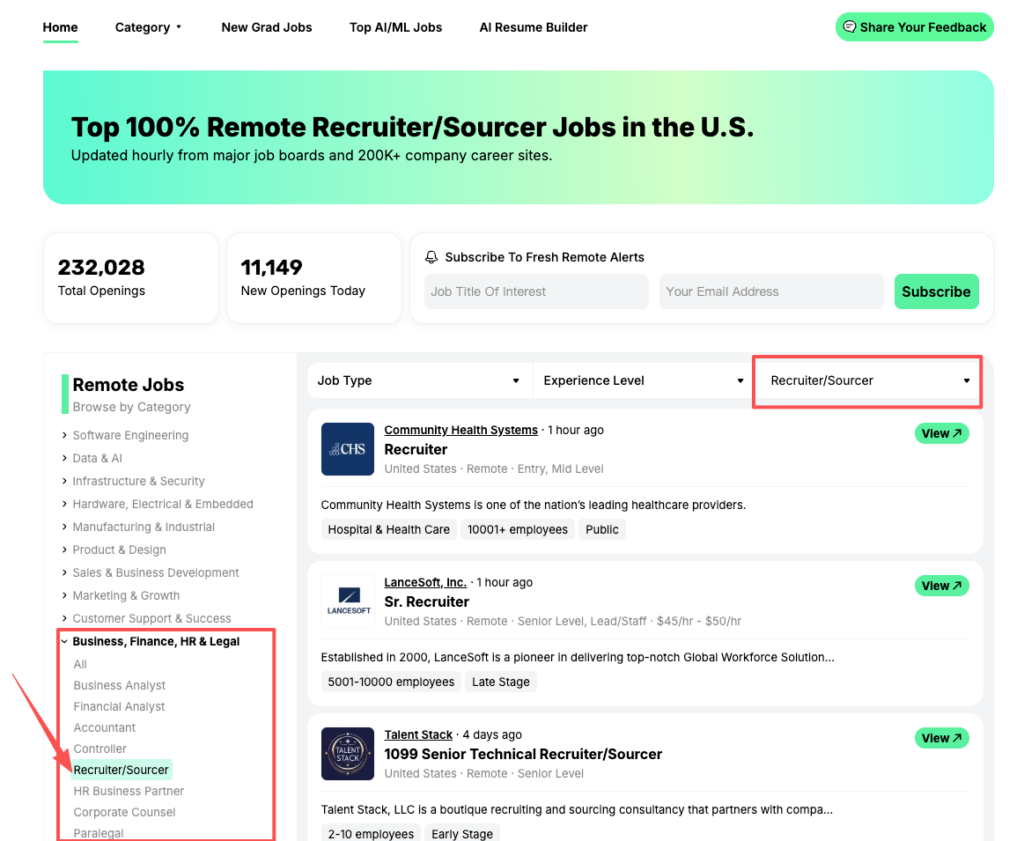
- Build a custom version of your resume for each, hitting 80–90% keyword match.
- Add a short, data-backed note or cover letter that:
- Names the exact role and team.
- Highlights 2–3 metrics that match their needs (time-to-fill, data accuracy, ticket closure, benefits cycles).
Expect a higher response rate, even if volume is lower.
Track 2: “Signal Network” Outreach
Human resources is still relationship-heavy, even in remote work. But you don’t need an insider connection to start.
For each target company:
- Find 1 recruiter and 1 HR generalist or coordinator on LinkedIn.
- Send a short note (under 80 words):
- Who you are.
- One metric that proves you do the work.
- One clear ask (“Could I ask 2–3 questions about how your team uses Workday/Greenhouse?”).
Don’t ask for a referral first. Ask for information. When you speak with them, use that call to align your resume with their metrics.
Track 3: International and Visa Strategy (if this is you)
If you’re a visa-dependent candidate (F-1, OPT, H-1B, etc.), you must layer immigration reality onto your HR search.
- Use the H-1B and LCA data (check official info via uscis.gov and certified wage data through DOL’s OFLC) to find employers with history sponsoring HR or people roles.
- In early calls, ask direct but simple questions:
- “Do you currently sponsor work visas for HR roles?”
- “Do you hire candidates on OPT or CPT for HR internships or coordinator roles?”
Recruiters won’t tell you this, but many companies have a policy, not a personal preference. If they don’t sponsor HR roles, no amount of charm fixes it. You need to redirect your focus to employers that show sponsorship history in LCA data.
Before / After: Application Strategy Comparison
Before (noise-heavy):
- 40+ applications per week.
- Same generic resume.
- No keyword tuning.
- 0–1 replies per week.
After (signal-focused):
- 5–7 tuned applications per week.
- Resume tested for ATS parsing and keyword alignment.
- 3–5 targeted outreach messages to HR staff per week.
- 2–4 real conversations per month, which is where offers come from.
Your Action Challenge (do this today)
I want you to execute one small change right now:
- Pick one remote HR role (recruiter, coordinator, or benefits) from the links above.
- Paste the job description and your resume into a keyword comparison tool.
- Edit only five bullets on your resume so they:
- Include the exact tools mentioned (ATS, HRIS).
- Add one metric per bullet (volume, accuracy, time, conversion rate).
If you run the “ATS Stress Test” after that, your keyword match score should jump. That’s the shift from noise to signal. Once you feel that once, you’ll stop mass applying and start aiming with intent, and that’s how you land human resources jobs remote in this hiring season.
According to 2026 work trends research and FlexJobs’ future of remote work report, remote HR positions continue to grow as companies embrace distributed workforce models, making now an excellent time to position yourself for these opportunities.
Frequently Asked Questions about Remote Human Resources Jobs
What types of human resources jobs remote roles hire most often?
Most remote human resources jobs cluster into three main buckets: recruiter or talent sourcing roles (about 40–50% of postings), HR coordinator/generalist positions (around 25–30%), and benefits, payroll, or compensation roles (roughly 15–20%). Focusing your resume and keywords on one of these families will significantly increase your interview chances.
How can I make my resume stand out for human resources jobs remote and pass ATS filters?
Use a plain, single-column resume with no graphics or text boxes, and target 80–90% keyword match to each posting. Mirror role titles, HRIS and ATS tools, and core skills, and quantify outcomes—for example, time-to-fill, data accuracy, ticket closure rates, or open enrollment volumes—to create strong, ATS-readable “signal.”
What skills and tools do employers expect for remote HR coordinator and generalist roles?
Remote HR coordinators and generalists are expected to work confidently in HRIS tools like Workday, BambooHR, UKG, ADP, or SuccessFactors. Job ads emphasize employee data accuracy, compliance, and process discipline. Highlight experience with onboarding, offboarding, ticket or case systems, and metrics such as error rates or ticket resolution time.
How do I translate on-site HR experience into a strong remote HR profile?
Reframe in-person tasks as digital workflows with metrics. Replace “helped” with quantified outcomes—such as tickets resolved per week, onboarding volume, time saved, or audit accuracy. Mention async tools like email, Slack, ticketing, or project platforms, and be explicit about compliance work (I-9s, FMLA, COBRA, visa-related onboarding) where relevant.
Can I get remote HR jobs without prior HR experience?
Yes, but you must translate adjacent experience into HR language. Customer support, operations, or recruiting coordination can map to tickets, case management, scheduling, documentation, and data accuracy. Take vendor tutorials for one HRIS or ATS, then create resume bullets that show volume, response times, and error rates to prove you can handle systems-heavy work.
Related Posts: