
Epic Analyst Jobs Remote: Role Breakdown + How to Qualify (2026)
Table of Contents
Last Updated: January 16, 2026
Hi there, Dora here! If you’re on the hunt for remote Epic analyst jobs, you might be feeling the pressure of those rigorous ATS filters. Trust me, I get it—this industry is ruthless when it comes to compliance and data skills. But don’t worry, you don’t need to guess your way through it.
I’ve put together this guide to help you stop wasting time on random applications. We’re going to look at the specific modules that open doors for remote work, how to optimize your keywords, and how to prep for your interviews like a pro. Ready to get your profile out of the “no” pile? Let’s dive in.
What Does an Epic Analyst Do? A Real-World Role Breakdown
Here’s the harsh truth: if you talk about Epic analyst work like it’s generic “IT support,” recruiters will skip your profile in under 10 seconds.
An Epic analyst is a hybrid of:
- Systems analyst (builds and configures Epic modules)
- Workflow designer (aligns software with clinical and revenue workflows)
- Data translator (turns messy clinical or billing needs into precise build specs)
From looking at dozens of recent remote Epic analyst job posts on ZipRecruiter and Glassdoor, I keep seeing the same core responsibilities:
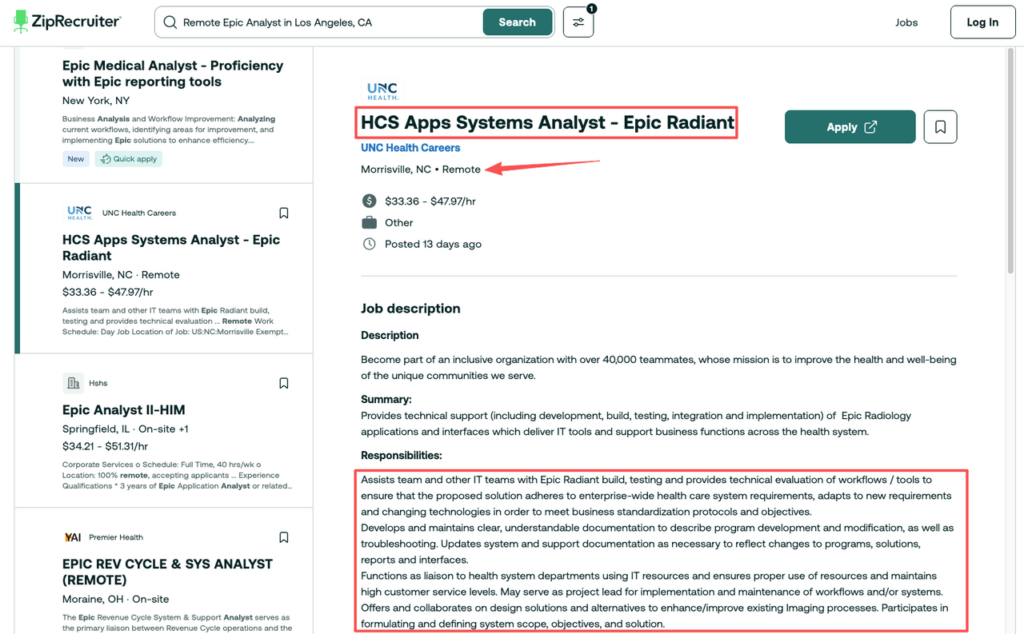
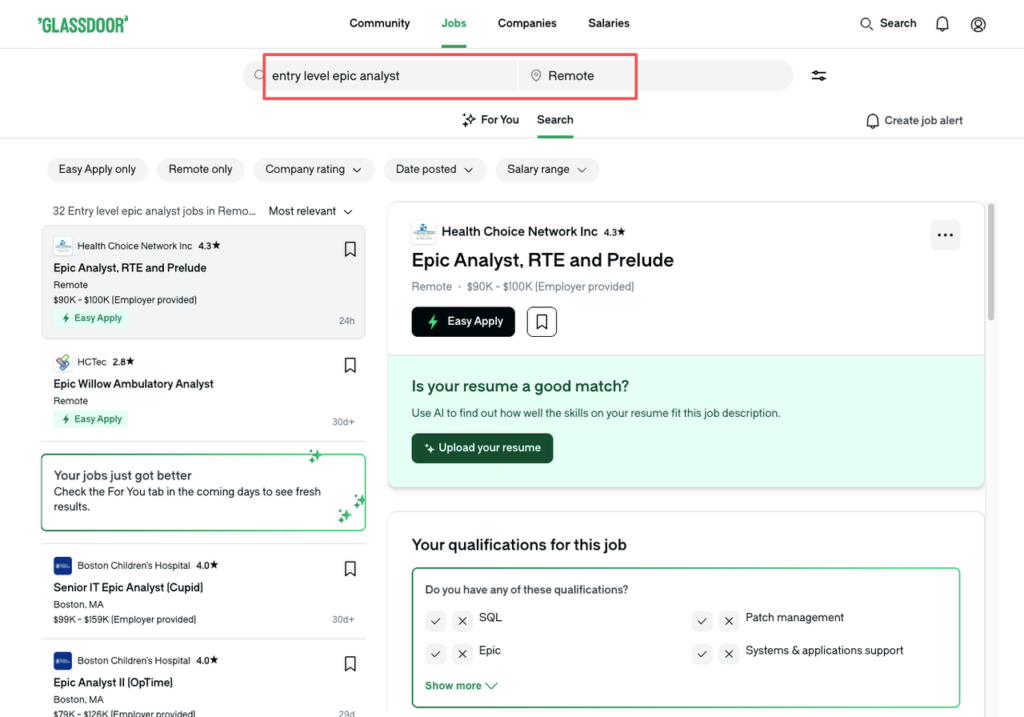
- Build & configuration: Designing order sets, visit types, appointment templates, billing rules, workqueues.
- Workflow analysis: Meeting with clinicians, billing teams, and admin staff to map current vs. future workflows.
- Testing & go‑live support: Writing test scripts, doing integrated testing, and supporting cutovers and upgrades.
- Troubleshooting & optimization: Digging into tickets, user pain points, and revenue or access bottlenecks.
Remote roles add a twist: you need to be highly structured and asynchronous‑friendly. Recruiters won’t tell you this, but many managers quietly blacklist candidates who can’t show experience with remote collaboration tools, clear documentation, and cross‑time‑zone coordination.
Think in terms of signal vs. noise:
- Signal: “Led remote build for Epic Ambulatory and Resolute Professional Billing across 3 sites: reduced claim denials by 12%.”
- Noise: “Worked with teams to improve workflows.”
Your resume, LinkedIn, and interview stories must show clear Epic modules, clear impact, and clear metrics.
Core Epic Modules & Skills Required for Remote Epic Analyst Jobs
Stop guessing. Let’s look at the data.
Across remote Epic analyst postings on Indeed, ZipRecruiter, and hospital career pages, over 80% of roles mention specific modules by name. If you don’t mirror that language, the ATS will assume you’re irrelevant.
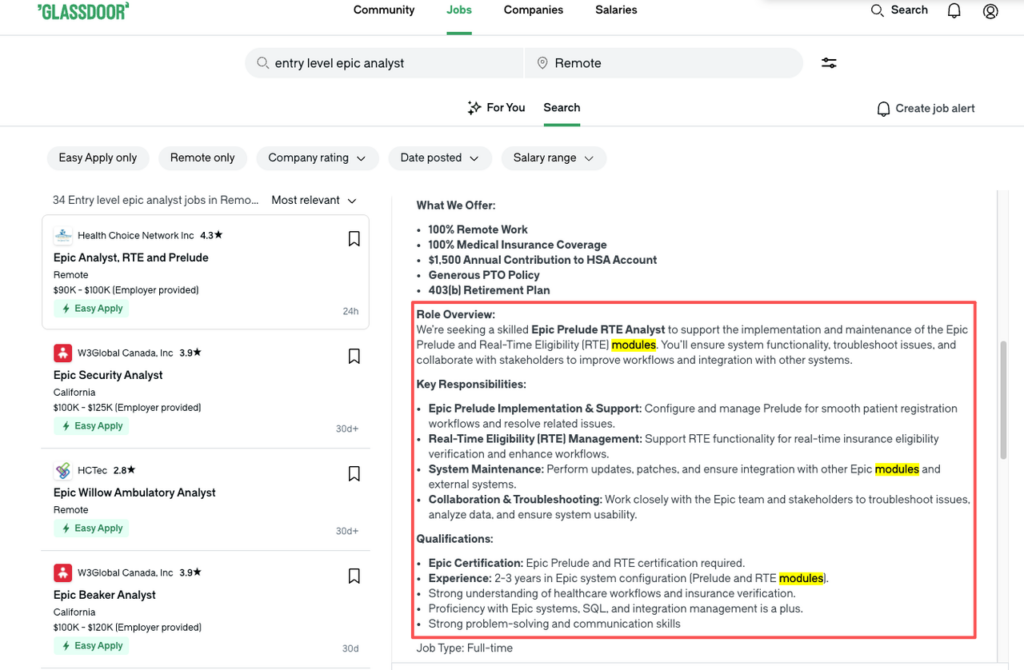
Ambulatory & Inpatient Epic Modules Explained
Two core clinical areas dominate:
- EpicCare Ambulatory: Outpatient clinics, visit types, appointment templates, orders, documentation tools.
- Epic Inpatient (Inpatient Clinicals / Orders): Inpatient orders, care plans, MAR, clinical decision support.
When I scan job ads, I see phrases like:
- “EpicCare Ambulatory analyst – remote”
- “Epic Inpatient Orders/ClinDoc analyst – telecommute eligible”
If you’ve touched those areas even indirectly, quantify it:
- “Built 50+ Ambulatory order sets and SmartSets across 4 specialties.”
- “Configured inpatient order panels and clinical decision support rules: reduced duplicate orders by 18%.”
Epic Revenue Cycle Modules: Billing, Claims & Workflow Optimization
Remote roles lean heavily toward revenue cycle, because much of the work is back‑office and data‑driven. From Epic’s own descriptions of Access and Revenue Cycle tools and current job ads, key modules include:
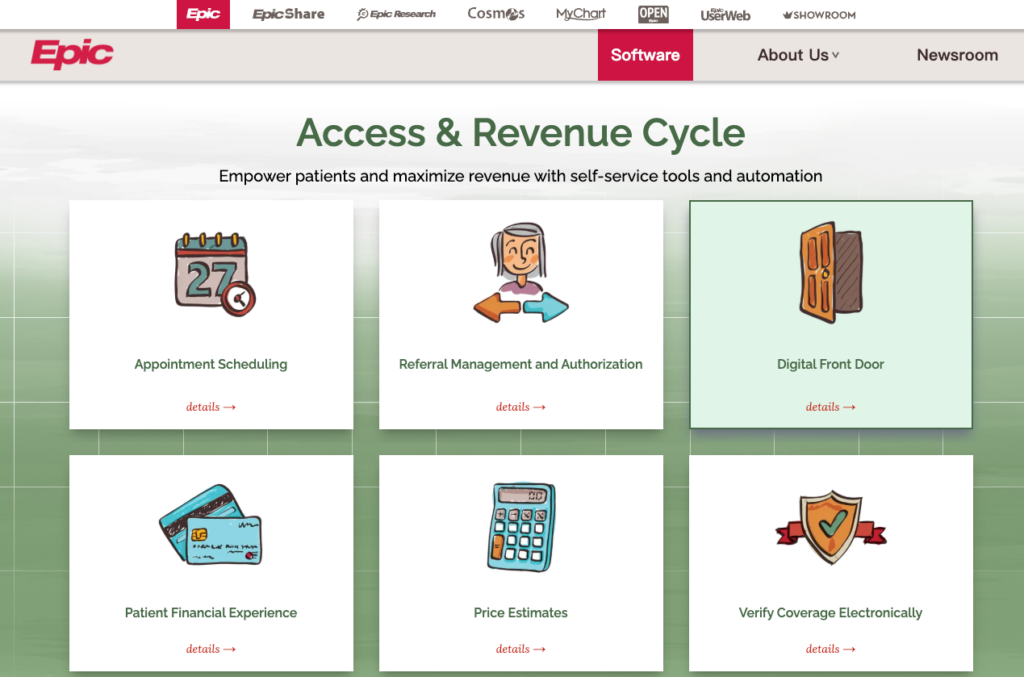
- Resolute Professional Billing (PB)
- Resolute Hospital Billing (HB)
- Cadence (scheduling)
- Prelude (registration)
- Grand Central (ADT)
These roles care about conversion rates and ROI:
- Clean claim rate
- Denial rate
- Days in A/R
Example high-signal bullets:
- “Optimized Epic HB claim edit workqueues: improved clean claim rate from 85% to 94%.”
- “Redesigned Cadence templates, cutting average wait time for new patients by 21%.”
Building Expertise in Epic Reporting & Data Couriers
Even if your title is “analyst,” remote managers expect some reporting muscle:
- Epic Reporting Workbench & Radar dashboards
- Clarity / Caboodle basics (you don’t need to be a full BI engineer, but you should understand the pipeline)
- Data Courier: migrating build between environments (DEV → TEST → PROD)
Think of this as the glue between IT and leadership. You’re not just fixing tickets: you’re showing how those fixes move metrics. That’s how you build negotiation leverage later.
A simple way to express this:
- “Created Reporting Workbench reports to track claim backlog: decreased aged A/R > 90 days by 14%.”
- “Managed Data Courier migrations for quarterly upgrades with <1% ticket regression.”
How to Get Epic Certified: Certifications That Matter for Remote Roles
Here’s the harsh truth: no Epic certification, no interview for most mid‑level remote roles.
Epic certification is controlled directly by Epic and health systems, you can’t just sign up like a cloud cert. Usually you:
- Get hired by a health system or consulting firm.
- They sponsor you for training at Epic (or remote training).
- You pass the tests to become certified or credentialed.
From current postings, the most requested certs for remote roles are:
- EpicCare Ambulatory
- Inpatient Orders / ClinDoc
- Resolute PB / HB
- Cadence + Prelude (often together)
If you’re early‑career or international and don’t have Epic access yet, focus on adjacent proof:
- Healthcare data experience (HL7, FHIR basics, payer rules)
- SQL and reporting
- Workflow and requirements documentation
Pair that with external data skills: SQL, Python, and BI tools are consistently valued in healthcare IT (you can see the salary uplift for data‑oriented Epic roles on Levels.fyi and similar comp sites).
For visa‑dependent candidates, here’s the key: larger health systems and consulting firms that sponsor H‑1B show up in public Department of Labor LCA data and USCIS H‑1B employer lists (dol.gov, uscis.gov). Filter those for healthcare systems and IT consultancies with Epic in prior job titles. That’s your highest‑ROI target list.
Resume Keywords That Help You Land Epic Analyst Jobs Remote
If your resume can’t survive the ATSStress Test, the hiring manager never sees your name.
My personal rule: for remote Epic analyst roles, your resume should hit 80–90% keyword match against the job description without breaking formatting.
Table: Example Keyword Map for a Remote Epic Analyst Role
Imagine a remote “Epic Resolute PB Analyst” posting. Here’s how I’d align:
- Job post mentions: “Epic Resolute Professional Billing, HB preferred, charge review workqueues, claim edits, denial management, Cadence, registration, testing, integrated build, tickets, SQL, reporting, remote, cross‑functional teams.”
- Your resume should echo (in your own context): “Epic Resolute Professional Billing (PB) analyst,” “claim edit workqueues,” “denial management,” “Cadence and Prelude registration,” “integrated testing,” “SQL‑based reporting.”
Signal vs. noise in formatting:
- Signal: Simple fonts (Calibri/Arial), no columns, no text boxes, no graphics. PDF or DOCX that parses cleanly.
- Noise: Complex templates, icons, tables that break parsing.
Stop doing this immediately, data from multiple ATS vendors shows that heavy templates and graphics corrupt parsing and drop conversion rates from apply → interview.
Use a one- or two-page layout, with clear “Epic Skills” and “Epic Modules” sections. For example, check out these Epic analyst resume examples for formatting guidance:
- Epic Modules: EpicCare Ambulatory, Resolute PB, Cadence, Prelude, Grand Central
- Skills: Build & configuration, workflow analysis, integrated testing, Reporting Workbench, Data Courier, SQL
Always anchor bullets with metrics:
- “Reduced denial rate by 10% by redesigning Epic PB claim edit rules.”
- “Cut appointment no‑show rate by 8% via Cadence template and reminder rule changes.”
Epic Analyst Interview Prep Tips for Healthcare IT Remote Positions
Interview anxiety gets worse when you’re guessing. So stop guessing. Let’s look at the data from common questions and patterns.
Indeed’s interview reviews for Epic itself and multiple Epic clients show recurring themes:
- Scenario questions about tricky stakeholders
- Deep dives into specific Epic modules
- Problem‑solving with incomplete information
For remote Epic analyst jobs, I prep in three buckets:
Module‑Specific Stories
For each module on your resume (Ambulatory, Inpatient, Resolute, Cadence):
- One build story (what you built, why, and how you tested it)
- One break/fix story (a production issue you resolved)
- One optimization story (how you improved a metric)
Use clear metrics. Recruiters won’t tell you this, but vague “I supported clinicians” stories blend into the background. Concrete examples cut through the noise.
Remote Collaboration Mechanics
Managers want proof you can work asynchronously:
- Explain how you document build decisions.
- Walk through your handoff process across time zones.
- Share a time you ran testing or go‑live support fully remote.
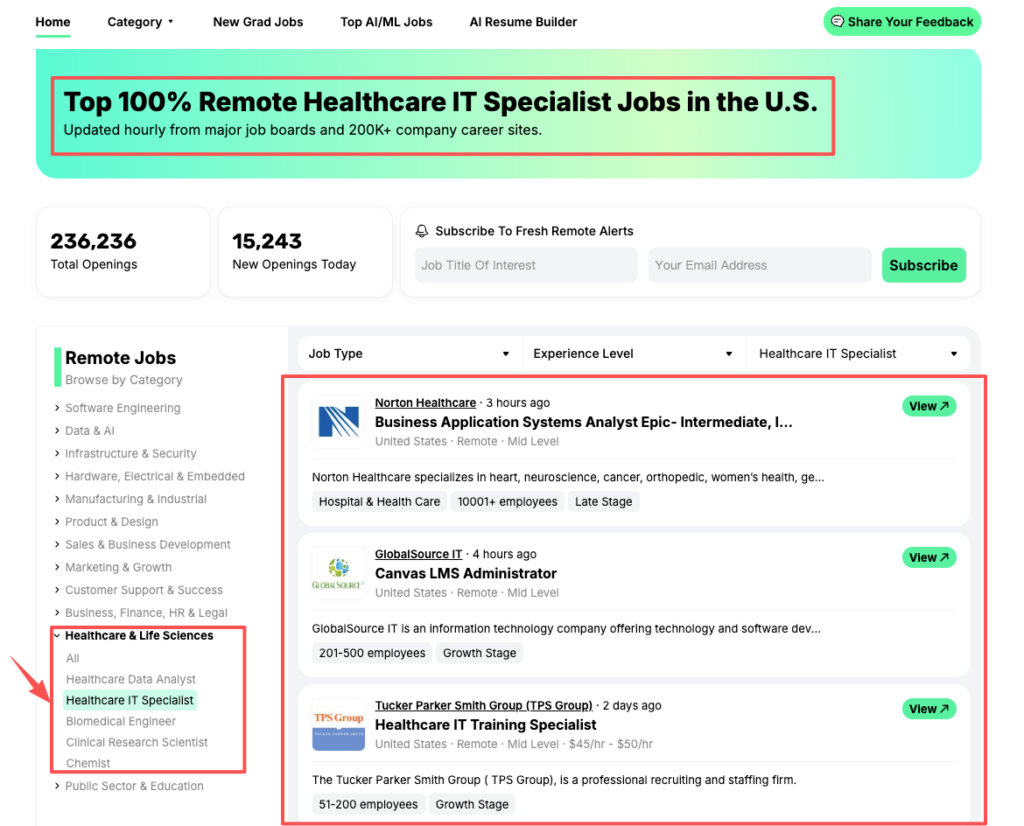
Tie this to tools: ticketing systems (ServiceNow, Jira), Epic change control, and standard change windows. If you’re exploring remote jobs in healthcare IT, demonstrating these skills is critical.
Healthcare Context & Visa Awareness
You don’t need to be a clinician, but you must show:
- Awareness of compliance and data privacy (HIPAA in the US).
- Understanding of the revenue impact of your build.
For international candidates, don’t lead with visa questions in round one, but research first:
- Check if the employer has filed H‑1Bs for Epic or IT roles in DOL/USCIS data.
- Prepare a concise script on your work authorization timeline (OPT/CPT → H‑1B), so you sound calm and informed.
Action challenge:
Right now, before you apply to another Epic analyst job remote, pick one posting from ZipRecruiter or Indeed. Copy the text into a document. Then:
- Highlight every Epic module, tool, and metric mentioned.
- Edit your resume so you legitimately match at least 80% of those terms. Consider using an AI resume builder to optimize your formatting and keywords.
- Run it through an ATS resume scanner and fix any parsing issues.
Do that for 3 roles this week. You’ll send fewer applications, but your conversion rate from apply → interview will climb, and that’s how you finally escape the application black hole.
Let’s not guess—we can use JobRight.ai’s AI Resume Builder to perfect our formatting, and then deploy the AI agent to scout matching remote job opportunities.

Frequently Asked Questions
What skills do I need to qualify for Epic analyst jobs remote?
Remote Epic analyst roles typically require experience with specific Epic modules (such as EpicCare Ambulatory, Inpatient Orders/ClinDoc, Resolute PB/HB, Cadence, Prelude, Grand Central), workflow analysis, integrated testing, reporting (Reporting Workbench, Radar, basic Clarity/Caboodle), strong documentation, and proven ability to collaborate asynchronously using ticketing and change-control tools.
How important is Epic certification for remote Epic analyst jobs?
For most mid-level remote Epic analyst jobs, Epic certification is a near must-have. Employers usually sponsor training after you’re hired, and common certs include EpicCare Ambulatory, Inpatient Orders/ClinDoc, Resolute PB/HB, and Cadence/Prelude. Without certification, focus on healthcare data, SQL, and workflow experience to land that first Epic-adjacent role.
How can I optimize my resume for Epic analyst jobs remote and pass ATS filters?
Mirror the job description’s Epic modules, tools, and metrics, aiming for 80–90% keyword match. Use a simple, ATS-friendly layout (no columns or graphics). Add clear “Epic Modules” and “Epic Skills” sections, and write metric-driven bullets that reference specific build, testing, and optimization work you’ve done in Epic.
Where can I find legitimate remote Epic analyst job postings?
Legitimate remote Epic analyst jobs commonly appear on hospital and health system career sites, healthcare IT consulting firms’ pages, and major boards like Indeed, ZipRecruiter, and LinkedIn. Filter by Epic module (e.g., “Resolute PB analyst remote”) and verify employers via company websites and professional reviews before applying.
What salary range can I expect for remote Epic analyst roles?
According to ZipRecruiter salary data and Salary.com research, compensation varies by experience, module specialization, and employer type, but many remote Epic analyst roles in the US fall roughly in the $90,000–$135,000 range, with higher pay for revenue cycle and data-heavy positions. Senior analysts, lead roles, and consultants with multiple certifications or strong BI skills can earn more, especially at large systems or firms.
Recommended Reads: