
Meta Technical Interview Questions: Complete 2026 Guide
Introduction
No matter which position you’re applying for at Meta (formerly Facebook), the interview questions are notoriously challenging. To land the job, your answers need to be exceptional. With success rates ranging from 5% to 20% depending on the role and level, the bar is high—but don’t let that discourage you.
If that sounds overwhelming, don’t worry—we’re here to help. We’ve helped thousands of candidates successfully break into Meta, and we know exactly what types of questions you’ll encounter in your interviews. Meta’s process has evolved significantly, especially with the introduction of groundbreaking innovations like AI-assisted coding interviews in 2025-2026, which fundamentally reshape how candidates demonstrate their technical abilities.
In this comprehensive guide, we’ll walk through the most common Meta interview questions and show you how to best answer each one. Drawing on insights from ex-Meta engineers, recent interview experiences, and verified question databases, we’ll give you everything you need to ace your Meta technical interview in 2026.
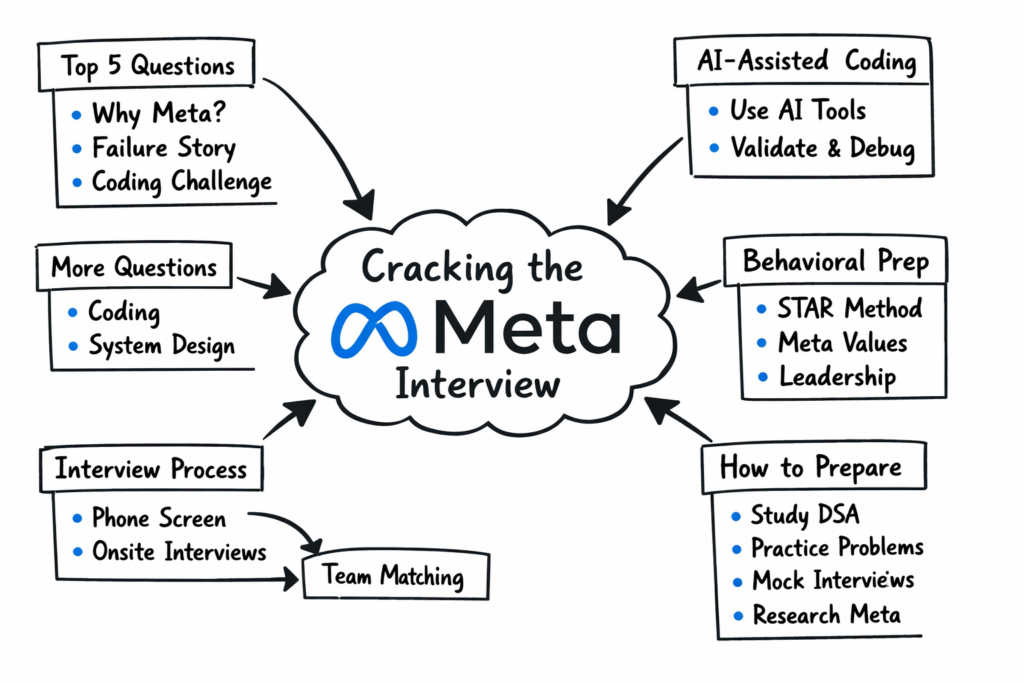
Here’s what we’ll cover:
- Top 5 Meta Technical Interview Questions
- More Meta Interview Questions by Category
- The New AI-Assisted Coding Interview (2026 Update)
- Meta Interview Process Overview
- How to Prepare for Meta Interviews
- Meta Interview FAQs
Let’s get started!
1. Top 5 Meta Technical Interview Questions
We host more than 100 Meta ex-interviewers on platforms and they have helped hundreds of candidates get job offers at Meta through our coaching services.
These five questions are typical for Meta interviews and you’ll need to be prepared for them. We’ll show you why interviewers ask them and how to answer them, with an example answer for each question.
1.1 “Why do you want to work at Meta?”
This is often one of the first questions you’ll be asked.
Why interviewers ask this
Interviewers ask “Why do you want to work at Meta?” to assess your motivation and whether you can thrive in Meta’s fast-paced, intense environment. The company needs engineers who can sustain high performance under pressure and remain energized by rapid iteration.
At Meta, you’ll be working on projects that impact billions of users across Facebook, Instagram, WhatsApp, and Reality Labs. The work environment is highly dynamic—things must be done well and fast. This isn’t a place for those who prefer slow, methodical processes; Meta values speed and quality simultaneously.
Meta is also deeply data-driven in its decision-making. They’re looking for candidates who know how to research, gather facts, and back up their choices with evidence. Your ability to articulate well-researched reasons for wanting to join demonstrates the analytical thinking they value.
Showing up on interview day with specific, authentic reasons why you want to work at Meta signals that you fit the profile they’re seeking. It proves you’ve done your homework and genuinely understand what makes Meta unique.
How to answer it
In answering this question, avoid giving unstructured, too broad, and too long answers. To prepare well, we recommend that you do these:
- Network: Connect with current Meta employees to understand the culture firsthand
- Personalize: Share genuine experiences with Meta products that shaped your perspective
- Research: Study Meta’s core values (Move Fast, Focus on Impact, Be Bold, Build Social Value, Be Open, Meta, Metamates, Me)
- Be specific: Your answer should apply uniquely to Meta, not generic tech companies
- Multiple reasons: Provide 2-3 concise, different reasons (mission, team, technical challenges)
- Team focus: Discuss the specific role and how it aligns with your career goals
- Keep sincere: While you want to show enthusiasm for working with Meta, give real reasons and not offer empty compliments.
Example answer structure
“I’m drawn to Meta for three key reasons. First, the scale and technical challenges are unmatched—building systems that serve 3+ billion users requires solving problems that don’t exist anywhere else. I’m particularly excited about [specific team]’s work on [specific technology/project].
Second, I deeply value Meta’s open culture and emphasis on transparency. Having followed Engineering at Meta blog, I’ve seen how teams openly share learnings and iterate rapidly. This aligns with my belief that the best solutions come from collaborative problem-solving.
Finally, Meta’s mission to build technologies that bring people together resonates with my personal experience. [Share authentic personal story about how Meta products impacted you]. I want to contribute to that mission by [specific technical contribution you can make].”
Detailed guidance on answering “Why Meta?” emphasizes authenticity and specificity.
1.2 “Tell me about a time you failed”
Meta typically asks this type of behavioral question during the initial screens or in the getting-to-know-you interview at onsite/full loop stage.
Why interviewers ask this
Meta’s culture values learning from failure and iterating quickly. This question tests your self-awareness, accountability, and growth mindset—critical traits for success in Meta’s bottom-up, fast-moving environment.
How to answer it
Use the STAR method (Situation, Task, Action, Result) enhanced with lessons learned:
- Situation: Set context briefly
- Task: Explain your responsibility
- Action: Describe what you did and why it failed
- Result: Share the concrete negative outcome (be honest!)
- Learning: Most important—what you learned and how you’ve applied it since
Example answer
Situation & Task:
“In my role as a software engineer at [Company], I was tasked with optimizing our API response times, which were causing customer complaints. I had three weeks to deliver a solution.”
Action:
“I decided to implement a caching layer without fully analyzing the data access patterns. I assumed that caching all responses would solve the problem and rushed to implementation because I wanted to show quick results. I didn’t involve senior engineers in the design review, thinking I could handle it independently.”
Result:
“The caching solution actually made things worse. We experienced cache invalidation issues that led to users seeing stale data, and our memory usage spiked unexpectedly, causing service degradation. We had to roll back the changes after two days in production, and I had to explain the failure to leadership. It was embarrassing and set our timeline back by two weeks.”
Learning:
“This failure taught me three critical lessons. First, premature optimization without data is dangerous—I now always start with profiling and metrics to identify actual bottlenecks. Second, collaboration makes solutions stronger—I now actively seek code reviews and design feedback, especially from senior engineers. Third, incremental rollouts catch issues early—I now advocate for feature flags and gradual deployments for any significant change.
Since then, I’ve applied these lessons successfully. In a similar optimization project six months later, I spent the first week analyzing metrics, involved the team in design decisions, and we rolled out changes gradually. The result was a 40% reduction in latency with zero incidents.”
Meta behavioral interviews specifically look for candidates who demonstrate growth through failure.
1.3 Product of Array Except Self
Question: Given an array nums of n integers where n > 1, return an array output such that output[i] is equal to the product of all the elements of nums except nums[i]. Solve it without using division and in O(n) time.
Why interviewers ask this
This classic array manipulation problem tests your ability to think creatively about space-time tradeoffs and implement efficient algorithms. Meta expects you to solve medium-level LeetCode problems in approximately 35 minutes, excluding pleasantries. This question assesses your understanding of array traversal patterns and optimization techniques.
How to answer it
Use a structured approach:
- Clarify: Ask about edge cases (empty array, arrays with zeros, negative numbers)
- Plan: Explain the two-pass solution using prefix and suffix products
- Implement: Write clean, bug-free code
- Test: Walk through test cases and discuss complexity
The optimal solution uses two passes: one forward pass to calculate prefix products and one backward pass to multiply by suffix products, achieving O(n) time with O(1) extra space (excluding output array).
Example approach
def productExceptSelf(nums):
    n = len(nums)
    output = [1] * n

    # Forward pass: calculate prefix products
    prefix = 1
    for i in range(n):
        output[i] = prefix
        prefix *= nums[i]

    # Backward pass: multiply by suffix products
    suffix = 1
    for i in range(n-1, -1, -1):
        output[i] *= suffix
        suffix *= nums[i]

    return output
Time Complexity: O(n), Space Complexity: O(1)
This problem frequently appears in Meta’s coding interview question bank.
1.4 Design Instagram News Feed
Question: Design a scalable system for Instagram’s news feed that shows users posts from accounts they follow, ranked by relevance and recency.
Why interviewers ask this
Meta’s products serve billions of users, requiring engineers who can design highly scalable, distributed systems. System design questions evaluate your ability to handle massive scale, understand tradeoffs, and think holistically about architecture, data storage, caching, and real-time updates.
How to answer it
Follow the RESHADED framework:
- Requirements: Clarify functional (viewing feed, posting content) and non-functional requirements (latency, consistency, availability)
- Estimation: Calculate scale (users, posts per day, storage needs, bandwidth)
- Storage Schema: Design database schema for users, posts, follows, and feed items
- High-level Design: Sketch out major components (API layer, application servers, databases, cache, CDN)
- Detailed Design: Dive deep into critical components like feed generation, ranking algorithm, and caching strategy
- Evaluation: Discuss bottlenecks, failure scenarios, and monitoring
- Distinctions: Explain how your design handles Meta-specific challenges
Key architectural components
Feed Generation Service:
- Pull model: Fetch posts from followed users on-demand (flexible but slower)
- Push model: Pre-compute feeds and push to cache (fast but storage-intensive)
- Hybrid model: Pre-compute for active users, pull for others
Ranking Algorithm:
- Consider factors: recency, engagement (likes, comments), user affinity, content type
- Use machine learning models for personalization
- Meta’s ML systems process real-time signals at massive scale
Data Storage:
- User data: Cassandra or DynamoDB for profile information
- Posts: Distributed storage with sharding by user_id
- Relationships: Graph database for follow relationships
- Feed cache: Redis for quick access to pre-computed feeds
CDN & Media Storage:
- Store images/videos in object storage (S3)
- Use CDN for global content delivery
- Implement adaptive bitrate streaming for videos
This question is among the most frequently asked Meta system design problems and tests your understanding of feed-based architectures.
1.5 AI-Assisted Coding Challenge (2026 Innovation)
Question: You’ll receive a coding problem and access to an AI assistant (similar to GitHub Copilot) integrated into the interview environment. Solve the problem while demonstrating effective collaboration with AI.
Why interviewers ask this
Meta introduced AI-assisted coding interviews in 2025-2026 to assess how candidates work with AI tools in realistic development scenarios. This tests your ability to:
- Prompt AI effectively
- Validate AI-generated code
- Debug and refine solutions
- Explain your reasoning while using AI assistance
How to approach it
Key strategies:
- Clarify requirements first: Don’t jump to prompting AI—understand the problem thoroughly
- Think before prompting: Explain your approach before asking AI for help
- Validate AI outputs: Always review and test AI-generated code
- Iterate intelligently: Use AI suggestions as starting points, not final solutions
- Demonstrate understanding: Explain why the AI’s solution works (or doesn’t)
Example workflow
Problem: “Find the longest substring without repeating characters”
Your approach:
- “Let me think about this… I’ll use a sliding window approach with a hash map to track character positions. Let me outline the algorithm first…”
- [Explain sliding window logic verbally]
- “Now I’ll ask the AI to help with the initial implementation…”
- [Prompt AI: “Implement sliding window solution for longest substring without repeating characters in Python”]
- [Review AI code] “The AI generated a solution, but I notice it doesn’t handle edge cases for empty strings. Let me fix that…”
- [Modify code and add edge case handling]
- “Let me trace through a test case to verify correctness…”
What evaluators look for:
- Problem-solving independence (AI is a tool, not a crutch)
- Code review skills when evaluating AI suggestions
- Ability to debug AI-generated code
- Clear communication about decision-making process
Meta’s AI-assisted interview format represents the future of technical interviews, requiring candidates to demonstrate both traditional coding skills and modern AI collaboration capabilities.
2. More Meta Interview Questions by Category
Here at IGotAnOffer, we believe in data-driven interview preparation.
We’ve analyzed 170+ software engineer interview questions reported by Meta candidates on Glassdoor, to identify the types of questions that are most frequently asked.
These are coding, system design, and behavioral/leadership types of questions.
2.1 Coding Interview Questions
Meta’s coding questions typically focus on arrays, strings, trees, graphs, and algorithms. Most problems are LeetCode Medium difficulty, with occasional Easy or Hard problems. Here are the most frequently asked:
Array & String Problems:
Minimum Remove to Make Valid Parentheses (Medium) – Stack-based string manipulation
Valid Palindrome II (Easy) – Two-pointer technique with one deletion allowed
Subarray Sum Equals K (Medium) – Prefix sum with hash map
Move Zeroes (Easy) – In-place array manipulation
Basic Calculator II (Medium) – String parsing with stack
Tree & Graph Problems:
Binary Tree Vertical Order Traversal (Medium) – BFS with column tracking
Lowest Common Ancestor of a Binary Tree (Medium) – Recursive tree traversal
Clone Graph (Medium) – DFS/BFS with hash map for visited nodes
Number of Islands (Medium) – DFS/BFS or Union-Find
Serialize and Deserialize Binary Tree (Hard) – Tree encoding/decoding
Algorithm & Data Structure Problems:
Merge Intervals (Medium) – Sorting and merging
K Closest Points to Origin (Medium) – Heap or QuickSelect
Add Binary (Easy) – Bit manipulation and carry handling
Interval List Intersections (Medium) – Two-pointer merge technique
LRU Cache (Medium) – Hash map + doubly linked list
Complete list of 73+ Meta coding questions provides comprehensive coverage of asked problems.
Important note: Meta generally doesn’t ask Dynamic Programming questions in recent interviews, preferring to test practical problem-solving skills instead.
2.2 System Design Questions
Meta system design interviews focus heavily on Meta’s own products and similar large-scale systems. These questions test your ability to design systems serving billions of users:
- Design Facebook News Feed – Most common question, tests ranking algorithms, caching, and personalization
- Design Instagram Stories – Real-time content delivery, ephemeral storage, and CDN strategies
- Design WhatsApp / Facebook Messenger – Message delivery, presence system, end-to-end encryption
- Design Facebook Live – Real-time video streaming, comment systems, scalability
- Design Instagram – Photo storage, feed generation, like/comment systems
- Design a Notification System – Push notifications, fan-out architecture, priority handling
- Design a URL Shortener – Hash functions, database design, analytics
- Design Facebook’s Search – Indexing, ranking, autocomplete, query processing
- Design a Content Moderation System – ML pipelines, queue processing, human-in-the-loop systems
- Design a Real-time Analytics System for Ads – Stream processing, aggregation, real-time dashboards
Meta system design interviews expect candidates to discuss:
- Scalability: Handling billions of users and petabytes of data
- Reliability: Fault tolerance, redundancy, disaster recovery
- Performance: Latency optimization, caching strategies, CDN usage
- Data consistency: CAP theorem tradeoffs, eventual vs. strong consistency
- Security & Privacy: Authentication, authorization, data protection
Meta interviewers particularly appreciate when candidates discuss Meta-specific architectural patterns like TAO (The Associations and Objects), Memcache architecture, and graph-based data models.
2.3 Behavioral & Leadership Questions
Meta behavioral interviews assess alignment with Meta’s core values and ability to thrive in its collaborative, fast-paced culture:
Cross-functional Collaboration:
- Tell me about a time you worked with a difficult stakeholder
- Describe a situation where you had to influence without authority
- How do you handle disagreements with team members?
Ownership & Impact:
- Tell me about a time you took initiative on a project
- Describe your most impactful contribution at your current company
- Tell me about a time you had to make a difficult tradeoff
Adaptability & Learning:
- Tell me about a time you had to learn something completely new quickly
- Describe a situation where project requirements changed mid-development
- How do you stay updated with new technologies?
Leadership:
- Tell me about a time you mentored someone
- Describe a situation where you had to give difficult feedback
- How do you motivate team members during challenging times?
Problem-Solving:
- Tell me about your most challenging technical problem and how you solved it
- Describe a time when you had to debug a complex production issue
- Tell me about a time you optimized system performance
Meta evaluates behavioral questions based on:
- Depth of ownership: Did you drive the outcome or just participate?
- Impact scale: Did your work affect users, team, or company?
- Self-awareness: Can you articulate what you learned?
- Collaboration: How did you work with others?
- Technical depth: Can you explain technical decisions clearly?
Prepare 5-10 diverse stories using the STAR method that showcase different competencies across various situations.
3. The New AI-Assisted Coding Interview (2026 Update)
Meta pioneered a revolutionary interview format in 2025-2026 that fundamentally changes how coding skills are evaluated. Instead of prohibiting AI tools, Meta now provides candidates with integrated AI assistance during interviews.
3.1 What’s Different
Traditional Meta Coding Interview (Pre-2025):
- Two algorithmic LeetCode-style questions
- 45 minutes per round
- Shared editor with no external help
- Focus: Can you recall patterns and implement solutions quickly?
AI-Assisted Meta Coding Interview (2026):
- Coding problems with built-in AI assistant
- Same time constraints
- Candidates collaborate with AI in a realistic IDE environment
- Focus: Can you leverage AI effectively while demonstrating deep understanding?
3.2 What This Means for Candidates
The AI-assisted format tests different skills:
- AI Collaboration: How well do you prompt and guide AI assistants?
- Code Review: Can you spot issues in AI-generated code?
- Problem Decomposition: Do you break problems down before using AI?
- Technical Judgment: Can you evaluate multiple AI-suggested approaches?
- Debugging Skills: How do you fix AI-generated bugs?
3.3 How to Prepare
Practice with AI coding assistants:
- Use GitHub Copilot, ChatGPT, or Claude for daily coding
- Practice explaining your reasoning while using AI
- Learn to critique and improve AI-generated solutions
Develop prompting skills:
- Write clear, specific prompts for coding problems
- Learn to iterate on prompts when initial results aren’t ideal
- Understand when to use AI vs. code manually
Strengthen fundamentals:
- AI assistance doesn’t replace core knowledge
- You must understand algorithms, data structures, and complexity analysis
- Interviewers expect you to explain why solutions work
Key mindset shift: Meta’s AI interviews assess partnership with AI, not replacement by AI. Show that you’re enhancing your capabilities with AI, not hiding behind it.
4. Meta Interview Process Overview
Understanding Meta’s interview process helps you prepare strategically for each stage.
4.1 Stage 1: Application & Resume Screen
- Submit application through Meta Careers
- Resume review by recruiters (1-2 weeks)
- Highlight: scalability projects, impact metrics, relevant technologies
4.2 Stage 2: Recruiter Phone Screen (30 minutes)
- Background discussion
- Role and team overview
- Basic technical questions or motivations
- Timeline and logistics discussion
Preparation tip: Research the specific team and prepare thoughtful questions about Meta’s culture and technical challenges.
4.3 Stage 3: Technical Phone Screen (45-60 minutes)
- 1-2 coding problems (typically LeetCode Medium)
- Use CoderPad or similar shared environment
- May include brief behavioral questions
What they evaluate:
- Problem-solving approach and communication
- Code quality and correctness
- Time/space complexity analysis
- Handling of edge cases
4.4 Stage 4: Onsite / Virtual Onsite (4-5 hours)
The final loop typically includes 4-5 interviews:
Two Coding Interviews (45 minutes each):
- More challenging than phone screen
- May include AI-assisted format
- Focus on arrays, strings, trees, graphs
One System Design Interview (45 minutes):
- Design a large-scale distributed system
- Often based on Meta products
- Starts at L4/E4 level and above
One or Two Behavioral Interviews (45 minutes each):
- Deep dive into past experiences
- Assessment of Meta’s core values
- Leadership and collaboration examples
Optional: Domain-Specific Interview
- For ML roles: ML system design or ML algorithms
- For specialized roles: relevant technical deep-dive
4.5 Stage 5: Team Matching & Offer
- Successful candidates enter team matching
- Interview with potential teams
- Offer negotiation and decision
Timeline: Entire process typically takes 4-8 weeks from application to offer.
5. How to Prepare for Meta Interviews
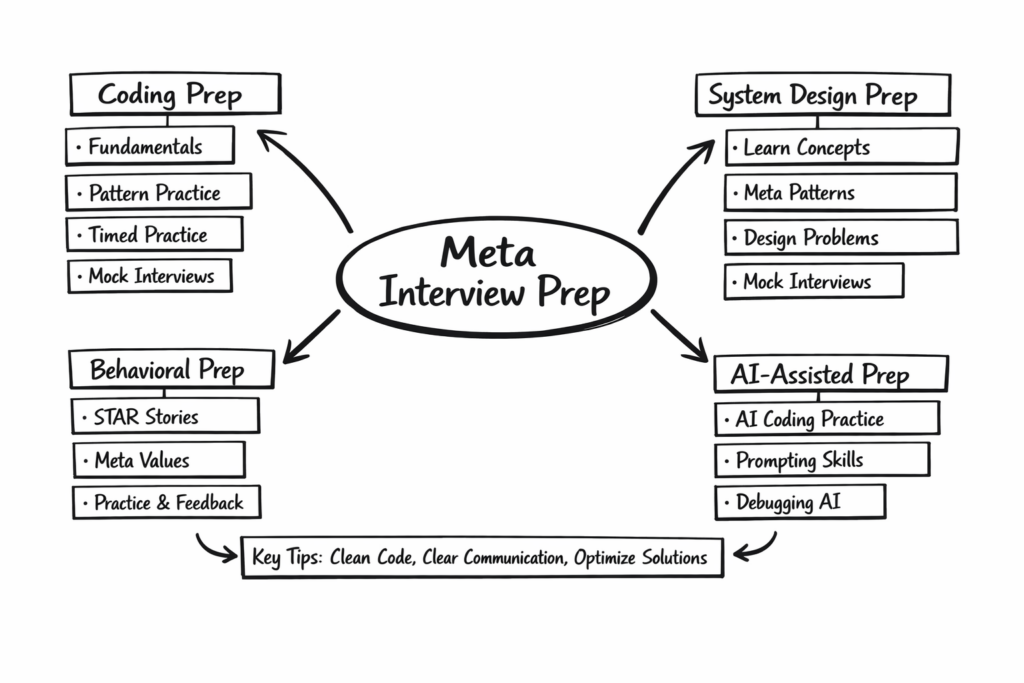
Structured preparation is essential for Meta interview success. Here’s a comprehensive preparation roadmap.
5.1 Coding Interview Preparation
Timeline: 8-12 weeks for thorough preparation
Week 1-2: Fundamentals Review
Data structures: Arrays, Strings, Hash Maps, Trees, Graphs, Heaps
Algorithms: Sorting, Searching, Two Pointers, Sliding Window, BFS/DFS
Complexity analysis: Big O notation mastery
Week 3-6: Pattern Practice
Focus on Meta’s most asked patterns:
Array/String manipulation (30% of questions)
Tree traversals and modifications (25%)
Graph algorithms (20%)
Interval problems (10%)
Design problems (10%)
Others (5%)
Recommended Problem Sets:
- NeetCode 150 for foundational patterns
- Blind 75 for core problems
Week 7-10: Timed Practice
Solve 2-3 problems daily with 35-minute time limits
Practice on CoderPad or similar plain editors
Code by hand or on whiteboard to build clarity
Week 11-12: Mock Interviews
Schedule mock interviews with peers or platforms
Practice explaining thought process verbally
Get feedback on communication and approach
Daily Practice Tips:
- Morning: Solve 1 new problem
- Evening: Review and optimize solutions
- Weekend: Mock interviews and weak area review
Critical Success Factors:
- Write bug-free code on the first try
- Communicate clearly while coding
- Optimize for both time and space complexity
- Handle edge cases proactively
5.2 System Design Preparation
Timeline: 6-8 weeks
Phase 1: Learn Fundamentals (2 weeks)
Study core concepts:
Scalability principles: horizontal vs. vertical scaling, load balancing
Database design: SQL vs. NoSQL, sharding, replication, indexing
Caching strategies: Cache invalidation, CDN, Redis patterns
Networking: DNS, HTTP/HTTPS, WebSockets, API design
Consistency models: CAP theorem, eventual vs. strong consistency
Recommended Resources:
- Designing Data-Intensive Applications by Martin Kleppmann
- System Design Interview by Alex Xu
Phase 2: Meta-Specific Patterns (2 weeks)
Study Meta’s architecture:
- TAO: The Associations and Objects (Meta’s graph data model)
- Memcache architecture and optimization
- Real-time feed generation and ranking
- Distributed storage systems
- Message queue architectures
Phase 3: Practice Problems (3-4 weeks)
Work through common Meta system design questions:
- Design Facebook News Feed
- Design Instagram
- Design WhatsApp
- Design YouTube/Video streaming
- Design Notification System
Practice Approach:
- Set 45-minute timer
- Follow RESHADED framework
- Draw diagrams on whiteboard or Excalidraw
- Record yourself and review
Phase 4: Mock Interviews (1-2 weeks)
- Practice with experienced engineers
- Get feedback on communication clarity
- Learn to handle unexpected follow-up questions
Key Success Factors:
- Estimate scale with back-of-envelope calculations
- Make explicit tradeoff discussions
- Think about failure scenarios and monitoring
- Discuss how design evolves over time
5.3 Behavioral Interview Preparation
Timeline: 3-4 weeks
Week 1: Story Development
Develop 8-10 stories covering:
- Technical challenges and solutions
- Cross-functional collaboration
- Conflict resolution
- Leadership and mentorship
- Failure and learning
- Impact and metrics
STAR Method Template:
- Situation: Context in 1-2 sentences
- Task: Your specific responsibility
- Action: What you did (be detailed, use “I” not “we”)
- Result: Quantifiable outcomes
- Learning: What you took away (crucial for Meta)
Week 2-3: Meta Values Alignment
Align stories with Meta’s core values:
- Move Fast: Show rapid iteration and quick decision-making
- Focus on Impact: Demonstrate measurable outcomes
- Be Bold: Display risk-taking and innovative thinking
- Build Social Value: Highlight user-centric approach
- Be Open: Show transparency and feedback receptiveness
Week 4: Practice and Refinement
- Practice each story until it flows naturally (2-3 minutes each)
- Anticipate follow-up questions
- Mock behavioral interviews with peers
- Get feedback on clarity and authenticity
Common Preparation Mistakes to Avoid:
- Using “we” instead of “I” (interviewers want YOUR contribution)
- Vague results without metrics
- Stories that are too long (>3 minutes)
- Not preparing questions to ask interviewers
- Memorizing word-for-word (sounds robotic)
Questions to Ask Interviewers:
- How does this team measure success?
- What are the biggest technical challenges facing the team?
- How does Meta support continuous learning and growth?
- What does excellent performance look like in this role?
Meta behavioral interviews are collaborative conversations, not interrogations. Be authentic, structured, and focused on demonstrating growth.
5.4 AI-Assisted Interview Preparation
New in 2026: Practice with AI coding assistants regularly:
Daily AI-paired programming (30 minutes)
- Solve LeetCode problems with GitHub Copilot or ChatGPT
- Practice explaining your approach before using AI
- Review and critique AI suggestions
Prompting practice
- Learn effective prompt engineering for code generation
- Practice iterative refinement of AI outputs
- Understand when AI suggestions are suboptimal
Debugging AI code
- Intentionally use AI to generate code, then find bugs
- Practice explaining why code is incorrect
- Learn common AI coding mistakes
6. Meta Interview FAQs
6.1 How difficult are Meta interviews?
Meta interviews are among the most challenging in tech. Coding questions typically range from LeetCode Medium to Hard difficulty, with most problems at Medium level. System design requires deep understanding of distributed systems at scale. Success rates range from 5-20% depending on role and level.
The difficulty stems from:
- Time pressure: 35 minutes to solve each coding problem
- Scale expectations: Designing for billions of users
- Behavioral depth: Deep dives into past experiences with many follow-ups
- No partial credit: Solutions must be bug-free and optimized
However, with structured preparation, candidates significantly improve their chances. Most successful hires report 2-3 months of dedicated preparation.
6.2 What is the success rate for Meta interviews?
Success rates vary by level and role:
- Entry-level (E3): ~15-20%
- Mid-level (E4-E5): ~10-15%
- Senior levels (E6+): ~5-10%
Meta aims for a 25% pass rate after the phone screen stage, meaning if you reach the onsite, you have roughly 1 in 4 chance of an offer.
Factors affecting success:
- Previous experience at similar-scale companies
- Quality of preparation (coached candidates perform better)
- Cultural fit with Meta’s values
- Level of role (higher levels have higher bars)
6.3 Does Meta ask Dynamic Programming questions?
Generally, no. Meta has moved away from DP questions in recent years. Multiple ex-Meta interviewers and recent candidates confirm that DP problems are now rare.
Focus instead on:
- Array and string manipulation
- Tree and graph algorithms
- Two-pointer and sliding window techniques
- Hash map applications
- BFS/DFS traversals
This shift reflects Meta’s preference for practical problem-solving over theoretical algorithm knowledge. However, don’t completely ignore DP—basic understanding is still valuable for system optimization discussions.
6.4 What makes Meta interviews unique?
Several factors distinguish Meta interviews:
- Product-focused system design: Questions often center on Meta’s own products (Facebook, Instagram, WhatsApp)
- AI-assisted coding: Meta pioneered AI-integrated interviews in 2026
- Scale expectations: Everything revolves around billion-user scale
- Bottom-up culture: Behavioral interviews emphasize influence over authority
- Rapid iteration: Candidates must demonstrate comfort with fast-paced change
- Engineering-driven decisions: Engineers make most technical decisions, not PMs
6.5 How long should I prepare for Meta interviews?
Recommended timelines:
- Beginner (new to interviewing): 3-4 months
- Intermediate (some interview experience): 2-3 months
- Advanced (recent interview experience): 4-8 weeks
Minimum preparation:
- Coding: 6-8 weeks
- System Design: 4-6 weeks
- Behavioral: 2-3 weeks
Quality matters more than quantity. Focused, deliberate practice with mock interviews yields better results than months of unfocused LeetCode grinding.
6.6 Should I work with an interview coach?
Interview coaching significantly improves success rates. Benefits include:
- Company-specific feedback: Coaches know exactly what Meta looks for
- Mock interviews: Simulate real pressure and timing
- Personalized gap analysis: Identify and fix weak areas
- Strategy optimization: Learn which areas to prioritize
- Confidence building: Reduce anxiety through practice
That said, self-study is possible with discipline. Many candidates succeed using free resources, peer practice, and structured preparation.
6.7 How does Meta evaluate interview performance?
Meta uses a structured evaluation framework:
Coding Interviews:
- Problem-solving approach and clarity
- Code correctness and quality
- Time/space complexity optimization
- Communication during problem-solving
- Handling of edge cases
System Design:
- Requirements gathering
- High-level architecture
- Deep-dive capabilities
- Tradeoff discussions
- Scalability and reliability considerations
Behavioral:
- Alignment with Meta values
- Impact and ownership
- Collaboration and influence
- Self-awareness and growth
- Technical depth in stories
Interviewers write detailed feedback and assign levels (Strong Hire, Hire, Lean Hire, Lean No Hire, No Hire). A hiring committee reviews all feedback to make the final decision, ensuring consistency and reducing individual bias.
7. Land Your Meta Role with JobRight.ai
While mastering interview skills is essential, finding and applying to the right Meta opportunities is equally critical to your success. Even the best-prepared candidate needs to discover roles that match their unique background and career goals.
JobRight.ai is an AI-powered job search copilot designed to streamline your Meta job search and maximize your chances of landing interviews. Here’s how JobRight.ai can complement your interview preparation:
7.1 Discover Hidden Opportunities
JobRight.ai‘s AI algorithms scan thousands of Meta job postings across all divisions—Facebook, Instagram, WhatsApp, Reality Labs, AI Research, and more—to surface roles that match your specific skills, experience level, and career interests. Many of these positions aren’t widely advertised on traditional job boards.
7.2 Get Personalized Job Recommendations
Instead of manually searching through hundreds of listings, JobRight.ai learns from your profile and preferences to deliver tailored Meta job recommendations. Whether you’re targeting SDE roles, ML Engineer positions, Research Scientist opportunities, or Product Engineer roles, the platform identifies the best-fit positions for your background.
7.3 Optimize Your Resume for Meta Roles
JobRight.ai‘s AI analyzes specific Meta job descriptions and provides actionable insights on how to tailor your resume to highlight the most relevant skills and experiences. This targeted approach significantly increases your chances of passing the initial resume screening.
7.4 Access Company and Team Insights
Get intelligence on specific Meta teams, their tech stacks, recent projects, and interview focus areas. Understanding the context of each role helps you prepare more effectively and ask informed questions during your interviews.
Visit JobRight.ai today to:
7.5 Ready to Accelerate Your Meta Job Search?
- Start your AI-powered job search for Meta roles
- Get matched with opportunities that fit your profile
- Receive personalized application and interview guidance
- Track your progress toward landing your dream Meta offer
Combine the interview preparation strategies in this guide with JobRight.ai‘s intelligent job search platform to maximize your chances of success. Your Meta career starts with finding the right opportunity—let JobRight.ai help you discover it.