
Virtual Assistant Jobs Remote: Tasks, Pay & How to Get Started (2026)
Table of Contents
Are you eyeing a remote virtual assistant job but feel like you’re shouting into the void? You aren’t alone. I’m Dora, and I see this happen too often: talented people throwing their resumes into an application black hole.
It’s time to switch gears. The goal isn’t to “apply more”—it’s signal over noise. I’m here to show you how to demonstrate clear value, pass ATS parsing cleanly, and align with what clients are actually willing to pay for. In this guide, we’ll cover the “what,” “how,” and “how much” of the remote VA world. I’ll teach you how to build a resume that hits an 80%+ keyword match and help you identify the low-ROI habits holding you back. Let’s turn that noise into a clear signal.
What Remote Virtual Assistants Really Do: Tasks & Responsibilities
Most people think “virtual assistant” means generic admin work. Here’s the harsh truth: clients pay for outcomes, not vague help. If you don’t position yourself around clear deliverables, your conversion rate from application to interview stays low.
A remote VA is a signal router. You reduce noise so founders, managers, and creators can focus. That can be operational, content, or data-heavy depending on your background.
Admin & Scheduling for Remote Assistant Jobs
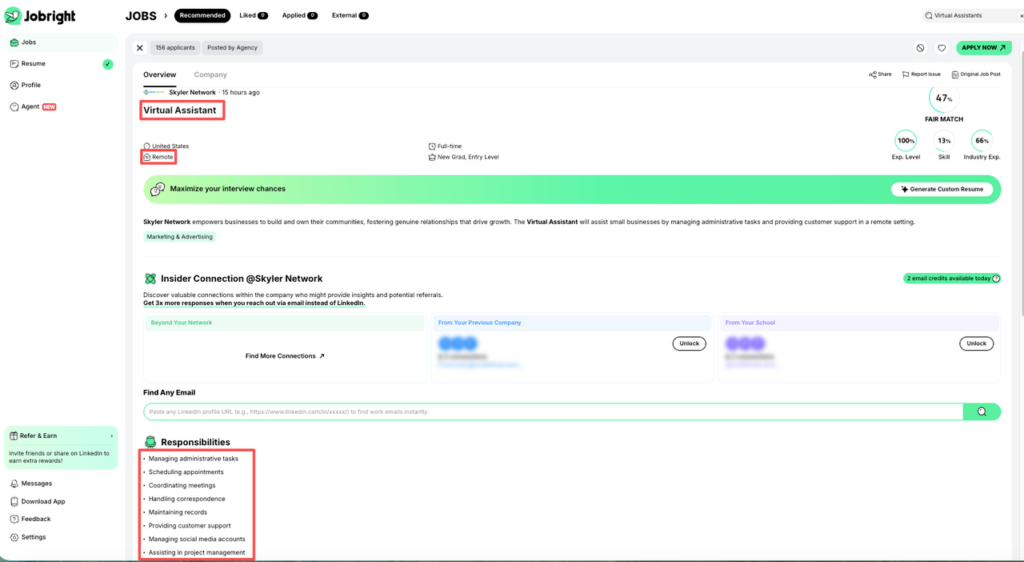
Admin tasks still matter, but they’re not random chores. They’re process optimization.
Common responsibilities include:
- Managing CEO calendars across time zones.
- Setting up recurring meetings with clear agendas.
- Preparing simple SOPs (checklists) for repetitive tasks.
- Keeping CRM or project boards up to date.
Recruiters won’t tell you this, but time-zone coverage is a hidden value prop. If you’re an international job seeker on OPT/CPT or remote-only, you can leverage off-hours support for US-based clients as a unique offer.
Stop guessing. Let’s look at the data: across VA job boards and marketplaces, clients often mention “calendar,” “scheduling,” and “meeting coordination” in 40–60% of postings. If those words aren’t in your resume, your keyword match score drops fast.
Email & Calendar Management: VA Jobs Remote Essentials
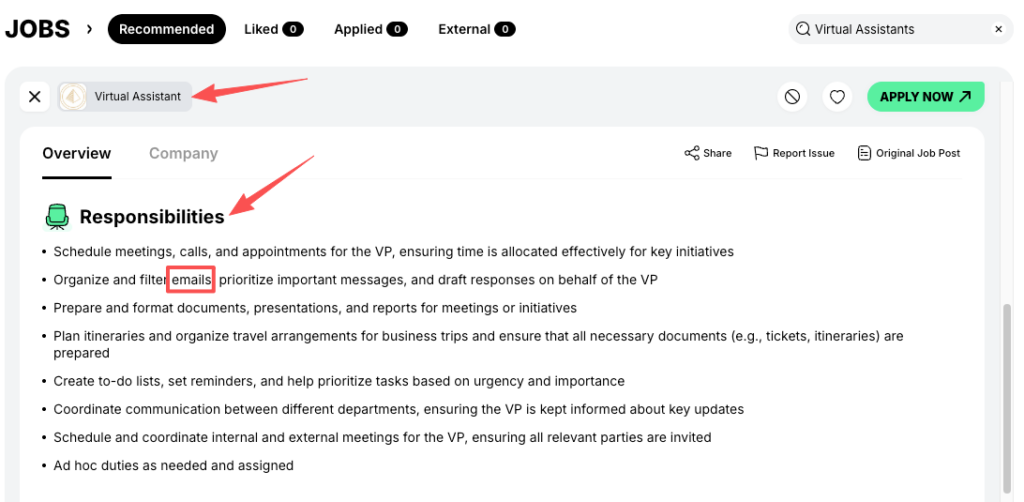
Inbox and calendar control are core to remote virtual assistant jobs.
Key tasks:
- Inbox triage: labeling, archiving, and routing.
- Drafting replies or templates for FAQs.
- Setting up filters and rules so the algorithm (Gmail/Outlook) auto-sorts low-priority emails.
- Blocking focus time on calendars and avoiding double-booking.
Your value prop here is measurable. You can quantify impact like:
- “Cut unread emails from 1,200 to 150 in 3 weeks.”
- “Reduced missed meetings to near zero by setting up reminders.”
When you put metrics like that into your resume bullets, you convert far better than with bland “helped manage emails.”
From an ATS perspective, make sure phrases like “email management,” “calendar management,” “inbox triage,” “scheduling,” and the tools you use (Gmail, Outlook, Google Calendar) are present. That’s simple optimization.
Social Media & Content Support for Online Assistant Jobs
Many remote VA roles now blend into content ops:
- Drafting social posts from blog articles or podcasts.
- Scheduling content in tools like Buffer or Hootsuite.
- Simple graphics updates in Canva or Figma.
- Pulling basic analytics (impressions, click-through rate, follower growth).
Here’s the harsh truth: “I like social media” doesn’t sell. “Increased LinkedIn post impressions by 30% in 60 days by consistent posting and repurposing content” does.
You don’t need to be a full-time marketer. But you do need to speak the language of metrics and ROI. That’s what separates a $15/hour generalist from a $25/hour specialized assistant.
If you have a background in tech (SWE, data, PM, UX), this is where you can stand out. You already think in experiments, dashboards, and optimization. Bring that mindset to VA work and highlight it.
Virtual Assistant Pay: Entry-Level vs Specialized Roles ($15–28/hr)
Stop guessing. Let’s look at the data.
Most US-based remote VA roles cluster in the $15–28/hour range as of late 2025–early 2026, based on:
- Public marketplace ranges (Upwork, Fiverr, specialized VA agencies).
- U.S. wage and remote work data from the Bureau of Labor Statistics (BLS) and related clerical roles.
| VA Role Level | US-Based Pay | Global/Offshore Pay | Key Rate Drivers |
| General Admin (Entry Level) | $15 – $18 /hr | $5 – $10 /hr | Fast response time, English fluency, Inbox Zero |
| Ops & Project Support (Mid Level) | $19 – $25 /hr | $12 – $18 /hr | Asana/Notion workflows, SOP creation, Calendar Management |
| Specialized VA (Tech / Content / Data) | $28 – $45+ /hr | $20 – $30+ /hr | SEO basics, simple code, video editing, analytics reporting |
Recruiters won’t tell you this, but your specialization is your pay lever. If you can talk about:
- Shopify or e-commerce support,
- Data tracking in Sheets, Notion, or simple dashboards,
- Structured support for engineering or product teams (following patterns from official blogs like the Google Engineering Blog),
…you immediately move out of the lowest band.
For international candidates, rates can shift by region, but US clients still benchmark against US ranges. Many remote-first companies now list “global” ranges anchored to US or Western Europe. You can cross-check your target rate with Levels.fyi to stay aligned with broader tech compensation trends, even if your title is “assistant” instead of “engineer.”
Essential Tools for Remote Virtual Assistant Jobs
Here’s the harsh truth: tools don’t make you qualified, but being slow or lost in them kills your conversion rate.
Think of your toolset as a signal amplifier. When you know the basics well, clients trust you faster and ATS keyword match scores jump because tool names count as high-value keywords.
Google Workspace & Microsoft 365: Must-Have for VA Roles
If you’re serious about virtual assistant jobs remote, you must be fluent in:
- Google Docs / Microsoft Word for clean documents and SOPs.
- Google Sheets / Excel for simple tracking, budgets, and reporting.
- Google Drive / OneDrive for organized file management.
- Gmail / Outlook and Google Calendar for core communication.
I treat these as the “standard library” of VA work. You don’t need advanced formulas, but you should:
- Create sortable task lists in Sheets.
- Use simple filters and conditional formatting to highlight deadlines.
- Maintain version history and naming conventions in Drive.
When you write your resume, don’t just list tools. Tie them to outcomes: “Tracked 50+ client tasks in Google Sheets: cut missed deadlines by 20%.” That simple metric changes how both ATS and humans read your profile.
Project Management Tools (Asana, Trello) for Remote Assistants
Many modern VA roles plug into existing workflows:
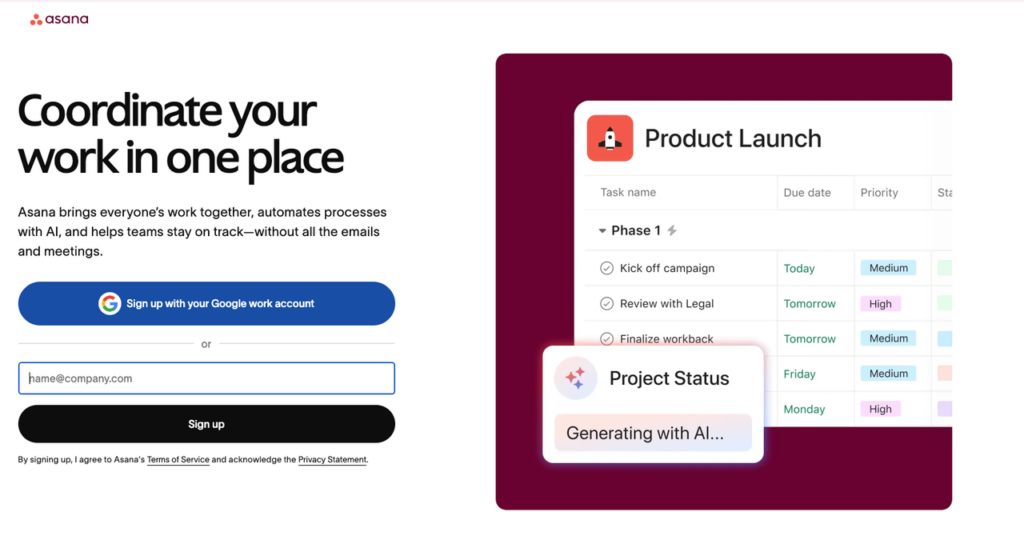
- Asana boards for tasks and subtasks.
- Trello cards for content calendars.
- ClickUp or Notion for docs plus tasks.
Recruiters won’t tell you this, but PM tools are screening shortcuts. If a client uses Asana and sees “Asana” in your resume, the perceived training cost drops. That increases your interview chances.
A useful mental diagram here is a simple funnel:
- Inbox/Requests (email, Slack, DMs).
- Task Capture (Asana/Trello).
- Execution (you + any collaborators).
- Reporting (short weekly summary: what got done, what’s blocked).
If you can show that you already work in this structure, you send a strong operational signal instead of vague “I’m organized.”
How to Get Your First Virtual Assistant Client: No Experience Needed
If you have zero paid VA experience, your instinct might be to mass-apply on big platforms. Here’s the harsh truth: that’s how you disappear into an application black hole.
You need signal over noise and a simple strategy.
Step 1: Pick a clear service bundle
Don’t say “I can help with anything.” Say: “I help solo founders manage email, scheduling, and simple content repurposing.” That alignment with a tight value prop makes you memorable.
Step 2: Run a mini “internship” project
Pick a creator, startup, or non-profit you like. Offer 2–3 weeks of tightly scoped help (5 hours a week):
- Inbox cleanup and filter setup.
- Calendar structure.
- Turning 1 long article into 5 short posts.
Your goal isn’t free labor forever. It’s proof: screenshots, before/after metrics, and a testimonial.
Step 3: Turn proof into a data-backed profile
Document your impact:
- “Cut response time from 3 days to same-day replies for top clients.”
- “Increased weekly social posts from 1 to 4 while keeping founder time flat.”
- “Reduced meeting conflicts to zero over 1 month.”
These become bullets on your resume and portfolio. Suddenly, you’re not “entry-level.” You’re someone with quantified results.
Step 4: Targeted outreach, not spam
Instead of applying to 100 random postings, pick 15–20 leads:
- Solo founders on LinkedIn.
- Busy consultants or coaches.
- Small agencies.
Send a short message with aligned value:
“I specialize in email, calendar, and simple content ops for solo founders. I noticed you’re posting weekly but likely managing your inbox alone. I can set up filters, manage scheduling, and repurpose your posts into a content calendar. If helpful, I can share a 2-week experiment plan.”
This beats generic “Do you need a VA?” messages, and your conversion rate from outreach to call improves dramatically.
If you’re ready to explore opportunities, check out remote job platforms that connect virtual assistants with clients actively hiring.
Resume & Template Tips for Remote VA Jobs
If your resume fails the ATS stress test, clients never even see your skills. Let’s ensure our resume beats the bots by using an AI platform designed to optimize our match score: jobright.ai. Your goal is >80% keyword match in common parsers, zero formatting corruption, and clear value signals.
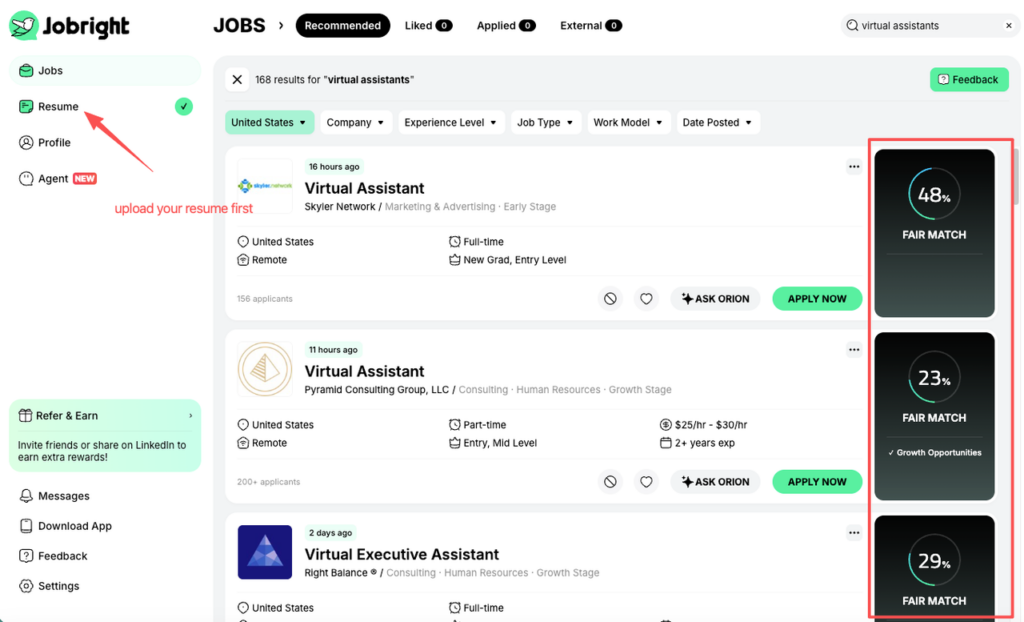
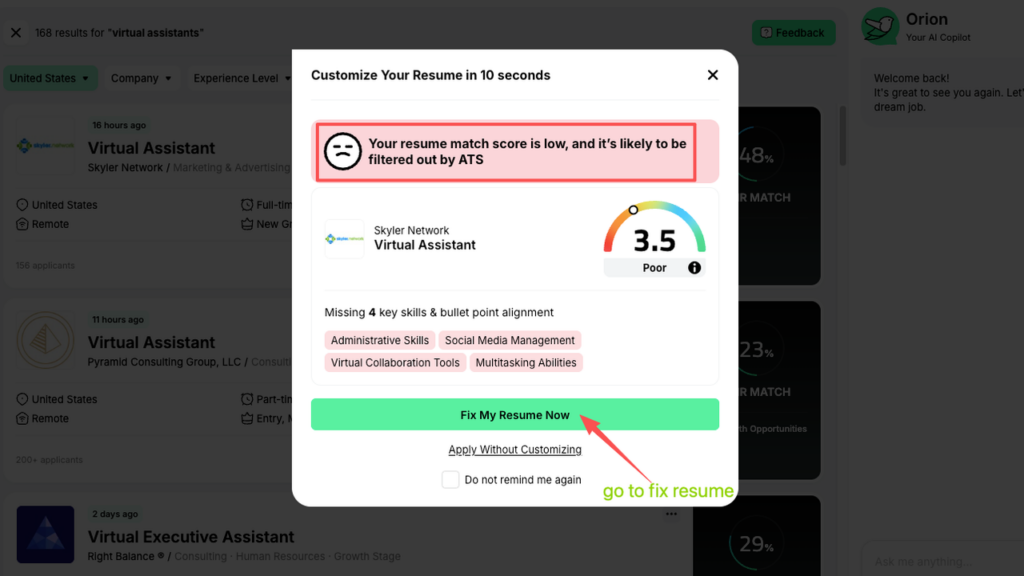
Here’s the harsh truth: fancy templates on design sites break ATS parsing all the time.
Strip formatting noise
Use a simple, single-column layout:
- No text boxes, tables, or columns.
- Standard fonts (Arial, Calibri).
- Clear section headings: Summary, Skills, Experience, Education.
Think of ATS as a strict parsing algorithm. If you wrap text in graphics, that algorithm can’t read it. That’s pure noise.
Match keywords to each job
Take the job description and highlight:
- Tools (“Google Workspace,” “Asana,” “Shopify”).
- Tasks (“email management,” “calendar coordination,” “content scheduling”).
- Soft skills that show reliability (“communication,” “time management”).
Then mirror those terms naturally in your resume. Don’t fake skills, but do match phrasing. This is how you optimize keyword match without stuffing.
Write metric-driven bullets
Turn vague bullets into data-backed ones.
Before / After examples:
- Before: “Helped with emails and scheduling.”
- After: “Managed 3 inboxes (2,000+ emails/month), set filters, and reduced unread count by 70% in 4 weeks.”
- Before: “Handled social media posts.”
- After: “Scheduled 20+ posts/month across LinkedIn and Instagram using Buffer, raising average impressions by 25% over 2 months.”
This is where your tech background shines. You already think in metrics: just apply that lens here.
Tailor for sponsorship and remote eligibility (international)
If you’re an international candidate:
- Clearly list your work status (e.g., “F-1 OPT valid until Aug 2027: open to H-1B sponsorship”).
- Stay current with USCIS rules for remote work and status.
- For wage alignment and compliance, cross-check prevailing wages and classifications with the U.S. Department of Labor.
Clarity here reduces risk in the client’s mind and increases your chances compared to another anonymous remote application.
For more guidance on becoming a virtual assistant and positioning yourself effectively, explore comprehensive resources from established platforms.
You can also reference detailed guides on starting a VA business to understand the full business model and client expectations.
Action Challenge:
Today, rewrite one experience section of your resume using this formula:
“[Action verb] [scope/volume] using [tool], and [quantified result: %, time saved, errors reduced].”
Then run your resume through an ATS-friendly parser (like the Indeed or LinkedIn resume upload) and check the keyword match vs. a specific remote VA job. Aim for 80%+. If you’re below that, adjust your keywords, not your worth.
Recruiters won’t tell you this, but once your resume clears parsing and shows clear value, your biggest problem won’t be silence. It will be deciding which opportunities to say no to.
Frequently Asked Questions
What do remote virtual assistants actually do in virtual assistant jobs remote?
Remote virtual assistants act as “signal routers” for busy founders and teams. They manage email and calendars, coordinate meetings, maintain CRMs or project boards, support social media and content, and improve processes so decision‑makers can focus—ideally tying their work to clear metrics like response time, impressions, or errors reduced.
How much do remote virtual assistant jobs pay in 2026?
Most US‑based virtual assistant jobs remote fall in the $15–28 per hour range. Entry‑level general admin roles cluster around $15–18, mid‑level ops and project VAs around $19–23, and specialized VAs with content ops, analytics, or e‑commerce skills typically earn $24–28+ per hour, sometimes higher with niche expertise.
What tools should I learn for virtual assistant jobs remote?
Start with Google Workspace or Microsoft 365 for documents, spreadsheets, file storage, email, and calendars. Then add project management tools such as Asana, Trello, ClickUp, or Notion. Many clients also value experience with scheduling tools, social media schedulers like Buffer or Hootsuite, and light design skills in Canva or Figma.
How can I get my first remote virtual assistant client with no experience?
Choose a narrow service bundle, such as email, calendar, and simple content repurposing for solo founders. Run a short, scoped “internship” project for a creator or small business, document before‑and‑after metrics, then use those results in your resume and targeted outreach instead of mass‑applying on crowded job platforms.
Are virtual assistant jobs remote in demand in 2026, and do I need a certification?
Demand remains strong as more founders, coaches, and remote‑first companies offload admin, content, and operations work. Certifications are optional; clients usually care more about proven results, strong communication, and tool fluency. A portfolio with measurable outcomes and an ATS‑friendly resume typically beats a generic VA certificate.
Recommended Reads