
Amazon Remote Jobs (2026): Teams Hiring + Resume Tips for Faster Screens
Table of Contents
Last Updated: January 13, 2026
“You’ve sent out 87 applications this month. You’ve heard back from exactly zero companies.”
Sound familiar? Hi, I’m Dora, and I’m here to tell you to stop applying to random job postings immediately.
The 2026 hiring season is brutal, especially for giants like Amazon. Their remote listings pull in thousands of applicants, and most of you are being filtered out before a human ever sees your name. Why? Because resumes often break the ATS parser, miss key keywords, or signal “noise” instead of “value.”
But we can fix that.
In this guide, let me show you how Amazon actually hires. I’ll reveal which teams are remote-friendly, how to pass the ATS stress test, and how to avoid the rejection traps that hold so many talented people back.
Where Amazon Hires for Remote Jobs (Teams & Departments)
Amazon doesn’t treat all remote roles the same. Some teams are remote-first, some are remote-flexible, and some are “remote” in name only.
Here’s the harsh truth: if you aim at the wrong team, you can send 200 applications and still see a 0% response conversion rate.
Visual: Team vs Remote-Friendliness Table
| Team / Function | Common Remote Job Titles | Remote Openness | Visa Sponsorship Likelihood |
| AWS Cloud, Engineering & Tech Support | • Software Development Engineer (SDE I/II) • Data Engineer / Data Scientist • Cloud Support Engineer • Solutions Architect • Technical Account Manager | Medium to High (Often “US, Virtual” or hub-based hybrid) | High (Major H-1B sponsor; consistently high volume of certified positions) |
| Amazon Customer Service (Virtual) | • Customer Support Associate • Seller Support Associate • Technical Support Associate (Entry/Mid) | High (Frequently fully virtual within specific regions/states) | Low (Almost never sponsor; low ROI for Amazon to sponsor these locally fillable roles) |
| Operations, Logistics & Program Management | • Program Manager (Ops / Last Mile) • Product Manager – Tech • Business Analyst (Ops) • Workforce Staffing Specialist | Medium (Often “flexible” but tethered to fulfillment centers or regional offices) | Medium (PMT & Data roles may sponsor; pure Ops roles rarely do) |
I’ll walk through the key rows.
AWS Remote Roles: Cloud, Engineering & Technical Support
AWS is where the highest-skill, highest-pay remote work often lives.
Typical remote-friendly AWS roles:
- Software Development Engineer (SDE I / II)
- Data Engineer / Data Scientist
- Cloud Support Engineer
- Solutions Architect (often “remote within country”)
- Technical Account Manager
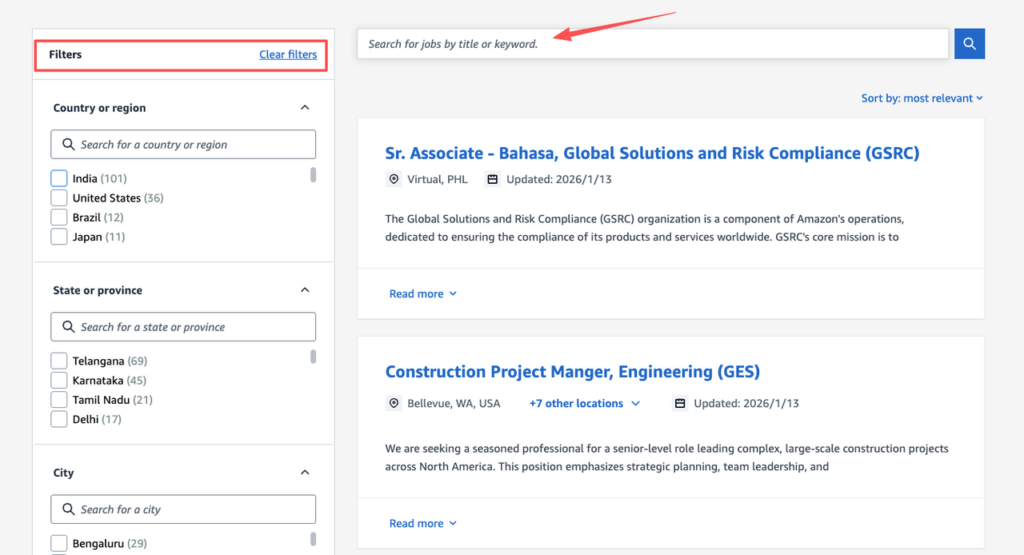
Remote openness: Medium to High, depending on team. Many roles are “hybrid” tied to hubs like Seattle, Arlington, or Austin, but you’ll see “US, Virtual” or “Remote – US” in the location filter on Amazon’s remote jobs portal.
Visanote: AWS is a major H‑1B sponsor. Public LCA data from the U.S. Department of Labor’s Office of Foreign Labor Certification shows thousands of H‑1B positions certified for Amazon and AWS every year. USCIS data also lists Amazon among top H‑1B employers.
If you’re international, you’re safer focusing here than on pure customer support roles, which rarely sponsor.
Signals vs noise here:
- Strong signal: Cloud skills (AWS, Terraform, Kubernetes), distributed systems, high-scale design.
- Noise: Generic “full stack developer” with no mention of AWS services.
Recruiters won’t tell you this, but AWS roles quietly filter out resumes that don’t show direct alignment to the cloud stack in the job post. You can explore current openings on the AWS Careers page.
Amazon Customer Service Virtual Jobs (Work From Home)
These are the “Amazon work from home” jobs most people find on TikTok.
Typical titles:
- Customer Support Associate (Virtual)
- Seller Support Associate
- Technical Support Associate (entry / mid)
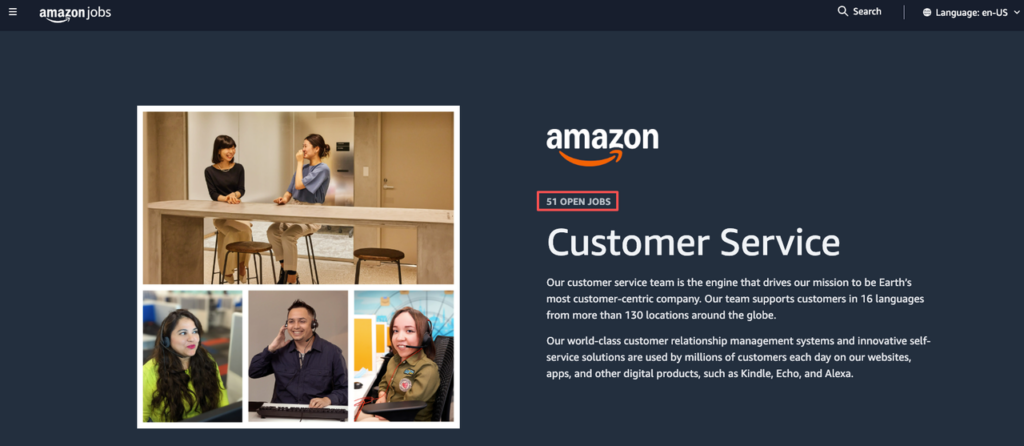
Remote openness: High. Many of these are fully virtual within a country or even within specific states. Browse current openings on Amazon’s Customer Service jobs page.
If you’re on F‑1 OPT and need long-term sponsorship, I’d avoid targeting these as your main path.
Who should target this:
- You need fast income and flexible work.
- You’re in the same country and don’t need sponsorship.
- You plan to pivot later into internal transfers.
But if your goal is a long-term tech career plus visa sponsorship, these roles are usually a detour, not a strategy.
Remote Operations & Logistics Roles at Amazon
Amazon has a huge operations footprint, logistics, supply chain, product, and program management.
Typical partial-remote roles:
- Program Manager (Ops / Last Mile)
- Product Manager – Tech (often hub-based with some remote flex)
- Business Analyst, Operations
- Workforce Staffing Specialist
Remote openness: Medium. Many roles say “flexible location” or “multiple locations,” which often still means being near a fulfillment center or regional office.
Visa note: Some PMT and data-heavy ops roles sponsor, but far fewer than pure software roles. Again, check H‑1B LCA trends for Amazon’s specific job titles and locations in the DOL database.
Signal vs noise test:
- Strong signal: Hard metrics on cost savings, throughput gains, on-time delivery, or SLA improvements.
- Noise: “Managed projects” with no numbers.
Stop guessing. Let’s look at the data: internal operations roles that show hard impact metrics see much higher recruiter response rates than resumes that only list “responsibilities.”
Amazon Remote Job Types & Skill Requirements Explained
While job boards make Amazon remote jobs look random, they mostly fall into a small set of patterns.
Think of three core remote role clusters:
- Deep tech (SDE, data, ML, cloud)
- Customer-facing but technical (SA, TAM, tech support)
- Business & operations (PM, PMT, analyst)
Visual: Role Cluster vs Core Skills Chart
| Role Cluster | Coding | System Design | Customer Interaction | Business Metrics |
| SDE / Data / ML | High (LeetCode-style + System Design) | High | Low to Medium | Medium |
| Tech Support / SA / TAM | Low to Medium (Scripting, Reading Logs) | Medium | High | Medium |
| PM / PMT / Analyst | Low to Medium (SQL, some Scripting) | Medium (Especially PMT) | Medium | High |
Here’s the harsh truth: many candidates apply to all three clusters with one generic resume. That kills your conversion rate.
If you’re an SDE or data person:
- You need to show language depth (Java, Python, TypeScript), system design, and scale.
- Data from Amazon and Meta engineering blogs shows that distributed systems, fault tolerance, and observability are core themes in modern backend roles. Read posts on aws.amazon.com/blogs and engineering.fb.com to mirror the language.
If you’re tech support / SA / TAM focused:
- You must show both technical stack (AWS services, networking basics) and customer outcomes (reduced downtime, faster resolution).
- Remote SAs who can drive adoption and renewals are far more defensible in layoffs and market shifts.
If you’re PM / PMT / analyst:
- Signal is in metrics: revenue lift, churn drop, NPS, conversion rate changes.
- Data-backed PMs with SQL and experimentation experience are trending up, per job post analysis across 2025–2026.
Recruiters won’t tell you this, but if your resume doesn’t clearly sit in one of these clusters, they’ll move on fast, especially for remote roles with 1,000+ applicants.
Amazon Resume Keywords & Tailoring Checklist for Remote Roles
Let’s talk ATS. Your resume has to survive what I call the ATS Stress Test:
80% keyword match to the job post, zero parsing corruption, no design gimmicks.
Here’s the harsh truth: fancy templates drop your conversion rate. When the ATS can’t read your resume, you become invisible.
Step 1: Strip formatting noise
- Use a single-column layout in Word or Google Docs.
- Save as PDF only if the job portal allows: some Amazon portals prefer DOCX.
- No text boxes, icons, headshots, or multi-column designs, those often break parsing.
Step 2: Match Amazon’s language (not yours)
Create a simple two-column text “table” on a scratch page:
- Left column: Exact phrases from the job description.
- Right column: Where you can mirror them in your bullet points.
Common keyword families for Amazon remote tech roles:
- AWS: EC2, S3, Lambda, DynamoDB, API Gateway, IAM, CloudWatch.
- SDE: Java, Python, microservices, REST, distributed systems, scalability, latency.
- Data: SQL, data pipelines, ETL, Redshift, Spark, dashboards, experimentation.
- PM / Ops: roadmap, backlog, OKRs, KPIs, experimentation, A/B testing, cost optimization.
Stop guessing. Let’s look at the data: third‑party resume parsers often show a jump from ~40–50% keyword match to 80%+ after a pass of targeted phrasing, even when the candidate doesn’t change their actual experience.
Step 3: Turn responsibility into outcome
Before (noise):
- “Responsible for maintaining APIs for internal tools.”
After (signal):
- “Reduced average API latency by 35% by redesigning request caching and pagination for internal tools used by 200+ users.”
Notice what changed: I added a metric, a mechanism, and a scale signal. That aligns with Amazon’s bias for data-backed impact.
Quick tailoring checklist for an Amazon remote role:
- [ ] Job title and team match your profile cluster (SDE / Data / PM / Support).
- [ ] 8–12 exact or close-match skills from the posting appear on page one.
- [ ] At least 70% of bullets have a clear metric (time, money, users, reliability).
- [ ] “Amazonian” phrases where honest: ownership, bar-raising, customer obsession, mechanisms.
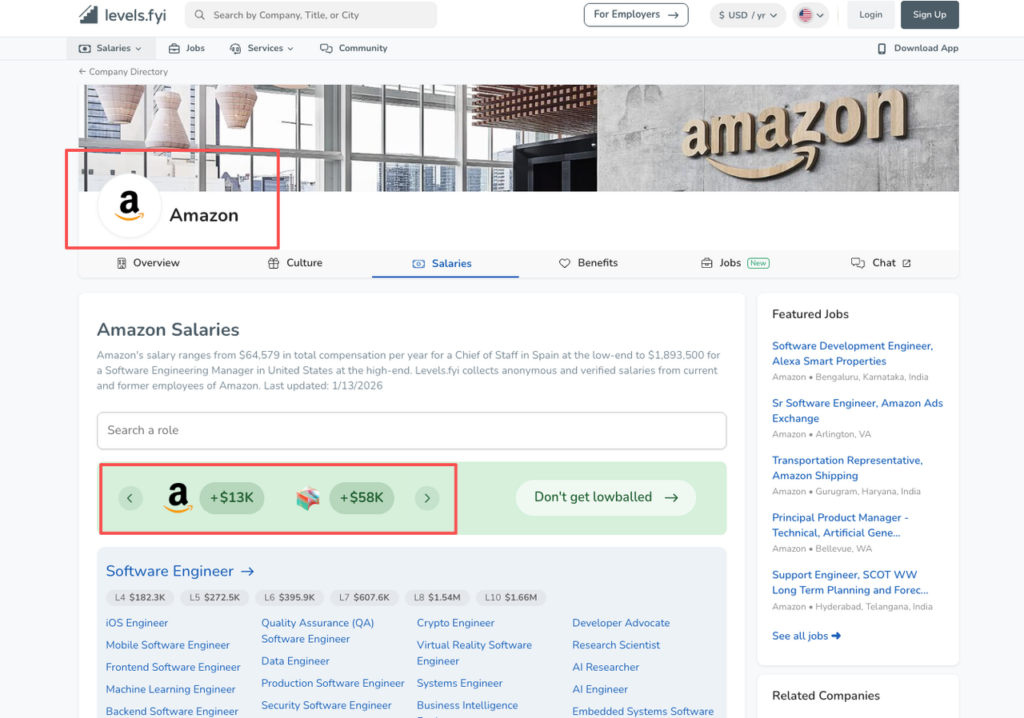
This is how you amplify signal and strip out resume noise. For salary benchmarking as you tailor your expectations, check Amazon compensation data on Levels.fyi.
Amazon Hiring Process Timeline for Remote & Virtual Jobs
Timelines shift, but across 2025–2026, I’ve seen a consistent pattern for Amazon remote roles.
Visual: Hiring Timeline Flow (described)
Picture a left-to-right flow with days under each step.
- Application → ATS screen (0–7 days)
- If your resume passes the parser and keyword match, a recruiter may review it.
- Many candidates get stuck here because of formatting or weak alignment.
- Recruiter screen (7–21 days)
- 20–30 minutes phone or video.
- Focus: role fit, comp band, location / remote rules, work authorization.
- For visa‑dependent candidates, expect direct questions on status and timelines: cross-check with USCIS date ranges for H‑1B/OPT.
- Technical / functional rounds (2–4 weeks)
- SDE: 1–2 online assessments, then 3–4 interviews including coding and system design.
- Non‑SDE: case studies, product sense, data exercises.
- Virtual loop / final panel (same or following week)
- Behavioral interviews centered on Leadership Principles.
- Remote roles lean hard on ownership, communication, and async collaboration.
- Offer + background check (1–3 weeks)
- Levels.fyi data for 2025–2026 shows Amazon total comp still competitive at L4/L5, but more volatile at higher bands.
From application to offer, expect 4–10 weeks in a normal case.
Here’s the harsh truth: if you hear nothing for 21+ days after recruiter screen, chances are your profile is paused or rejected. Keep a pipeline of 10–15 active processes instead of obsessing over one Amazon role.
Common Amazon Application Rejection Reasons (And How to Fix Them)
Most Amazon remote job rejections fall into a few repeatable buckets. Once you see the pattern, you can fix it.
1. ATS parsing failure
- Symptom: You apply, never hear back, even for roles you’re well‑qualified for.
- Root cause: Multi-column resume, icons, or unusual fonts break parsing.
- Fix: Switch to a clean, single-column layout. Test with a free ATS parser and aim for 80%+ keyword match with no garbled text.
2. Weak alignment to the actual role
- Symptom: You get recruiter screens but no next rounds.
- Root cause: Your experience doesn’t map cleanly to the team’s stack or cluster.
- Fix: Narrow to 1–2 role clusters (for example SDE + data engineer). Tune your bullets to that cluster’s core skills and metrics.
3. No clear impact metrics
- Symptom: Feedback like “strong background, but not a bar-raiser.”
- Root cause: Your resume reads like a job description, not a performance report.
- Fix: Every project should have at least one number, latency, revenue, cost, NPS, error rate, throughput.
4. Visa risk without a plan
- Symptom: Interest dies after initial work authorization questions.
- Root cause: You can’t explain your timeline across OPT, STEM extension, and H‑1B filing windows.
- Fix: Read current H‑1B and OPT guidance on USCIS. Build a clear 2–3 sentence script on your status and timeline so you sound planned, not risky.
5. Spray-and-pray application strategy
- Symptom: Dozens of applications, almost no interviews.
- Root cause: You apply to every Amazon remote job with one generic resume.
- Fix: Limit yourself to 5–7 tailored Amazon applications per week. Track conversion rate from application → recruiter screen. If it’s under 10%, your resume needs a redesign.
Here’s your action challenge:
Today, pick one Amazon remote job you’d actually accept. Run your current resume through an ATS parser and write down your keyword match score. Then, rewrite just three bullets to add clear metrics and exact job-description keywords. Re-test. Don’t guess, measure the change.
You’re not fighting Amazon. You’re fighting noise. Once your resume becomes a clean, data-backed signal, remote roles stop feeling like an application black hole and start behaving like a system you can learn, test, and improve.
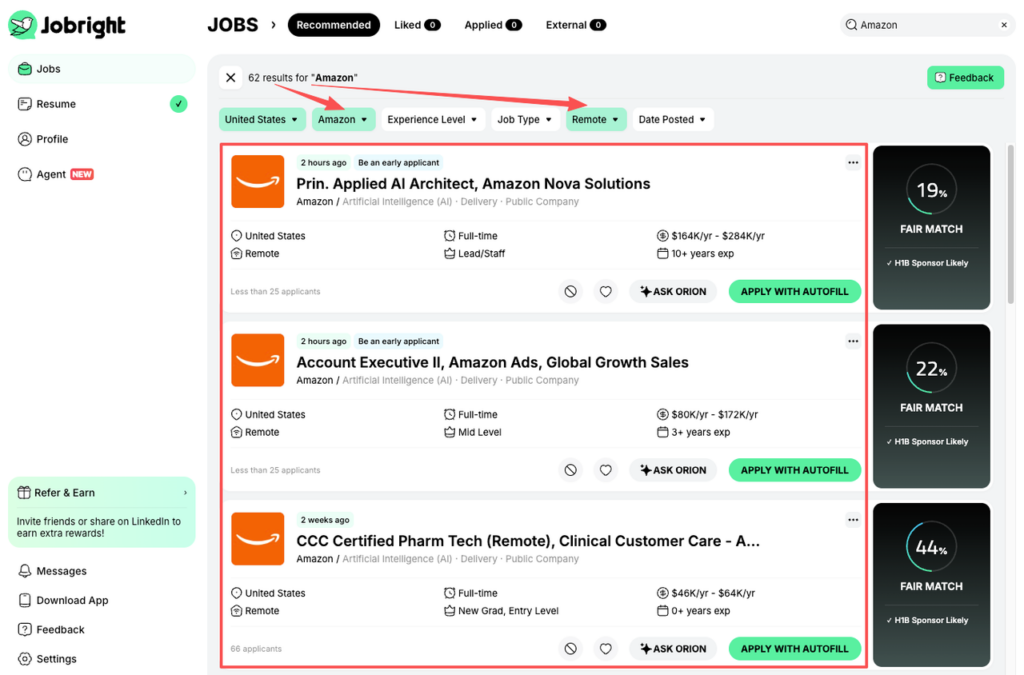
Before rewriting our resumes, let’s find the right target first. Browse verified Remote Jobs on JobRight now.
Frequently Asked Questions About Amazon Remote Jobs
What are the main types of Amazon remote jobs and how do they differ?
Amazon remote jobs typically fall into three clusters: deep tech (SDE, data, ML), customer-facing but technical roles (Solutions Architect, TAM, tech support), and business/operations roles (PM, PMT, analyst). Each cluster emphasizes different skills—coding and system design for engineers, customer interaction for SAs/TAMs, and metrics/experimentation for PMs and analysts.
Which Amazon teams are most remote-friendly and best for long-term careers?
AWS and technical roles (SDE, data, cloud support, Solutions Architect, TAM) are among the most remote-friendly and career-scalable, with better odds of visa sponsorship. Customer service and basic virtual support jobs are highly remote but usually don’t sponsor visas and are better for short-term income than long-term tech careers.
How can I optimize my resume for Amazon remote jobs and pass the ATS?
Use a clean, single-column resume with no graphics or text boxes, and match at least 80% of the job’s keywords. Mirror Amazon’s language—AWS services, programming languages, metrics, and “ownership” style phrases—and turn responsibilities into outcomes with clear numbers (latency reduction, revenue impact, users served) to stand out in ATS and recruiter screens.
What does the Amazon hiring process for remote roles usually look like?
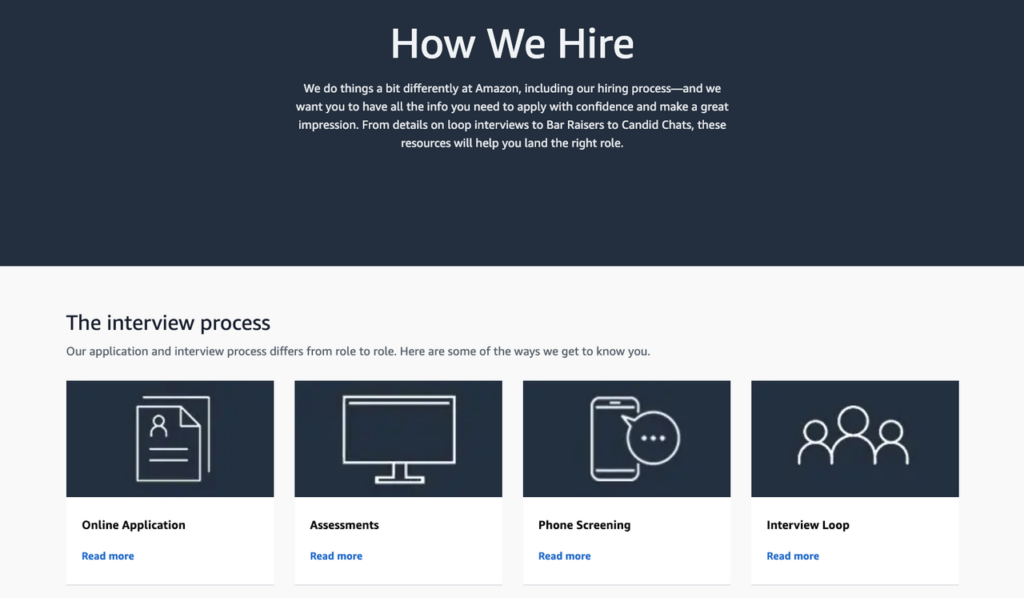
For Amazon remote jobs, expect: application and ATS screen (0–7 days), recruiter call (7–21 days), technical or functional interviews over 2–4 weeks, then a virtual loop focused heavily on Leadership Principles, followed by offer and background check. Typical total timeline is 4–10 weeks if the process moves forward. Learn more about Amazon’s hiring process.
Do Amazon remote jobs offer visa sponsorship for international candidates?
Some Amazon remote jobs do sponsor visas, but it varies strongly by team. AWS software, data, and some technical roles are far more likely to sponsor H‑1B than customer service or basic support roles. International candidates should prioritize AWS and higher-skill technical positions and verify sponsorship history by job title and location through the Department of Labor’s performance data.
Related Posts: