
Anthropic Technical Interview Questions: Complete Guide 2025
Succeeding in an Anthropic interview requires more than just technical brilliance; it demands a profound commitment to building safe, interpretable, and beneficial AI. Unlike other tech giants, Anthropic weaves its mission of AI safety into every fiber of its hiring process. Candidates are expected to demonstrate not only exceptional engineering and research skills but also deep thoughtfulness about the ethical implications and long-term consequences of their work, a point emphasized in many interview guides.
This guide provides a comprehensive overview of the Anthropic technical interview process, delves into the most common questions asked, and offers a roadmap for preparation. We’ve synthesized information from dozens of recent candidate experiences to give you a clear picture of what it takes to join one of the world’s leading AI safety companies.
1.Anthropic Interview Process
The Anthropic interview process is designed to be rigorous, efficient, and deeply reflective of the company’s core values. While the exact stages can vary by role, most technical candidates can expect a process that looks similar to this, based on recent candidate experiences.
- Resume Screen: Your application is first reviewed by recruiters to assess the alignment between your background and the role’s requirements. As reported by IGotAnOffer, Anthropic values “direct evidence of ability” over specific credentials, so strong projects, open-source contributions, or relevant publications can matter more than your educational background.
- Recruiter Call: This initial 30-45 minute conversation focuses on your motivation, background, and high-level technical experience. Expect questions about why you’re interested in Anthropic specifically. This is your first chance to show you’ve done your homework on their mission and research, according to candidate experiences shared on Medium.
- Hiring Manager Screen: This is a deeper technical dive with the manager of the team you’re applying to. It often involves a detailed discussion of your past projects and experiences. You’ll need to demonstrate a thorough understanding of your work’s implementation details and the technical decisions you made, as detailed in online interview reports.
- Skills-Based Assessment: This is often the most demanding technical screen. According to multiple candidate reports, software engineers might face a 90-minute timed coding challenge on a platform like CodeSignal. These are often multi-part problems that require you to build upon your code in stages, testing your ability to write modular and adaptable solutions under pressure. Other roles may have take-home projects or practical LLM-based exercises.
- Final Interviews (Onsite/Virtual): This is the final marathon, typically consisting of 4-6 interviews over one or two days. These rounds are a mix of coding, system design, ML theory, and behavioral discussions. A significant portion of these interviews will focus on AI safety, ethical reasoning, and alignment with Anthropic’s values. According to experiences shared on Medium, candidates have also reported that after initial rounds, they are sometimes told to expect contact for scheduling the next steps on the same day, though candidate reports on Glassdoor suggest the actual timeline may vary.
- Offer: If you are successful, the team will move forward with reference checks and an offer. Anthropic is known for its competitive compensation packages, which are discussed in more detail in the Compensation and Offer section below.
2.Top Anthropic Interview Questions and Answers
How to answer:
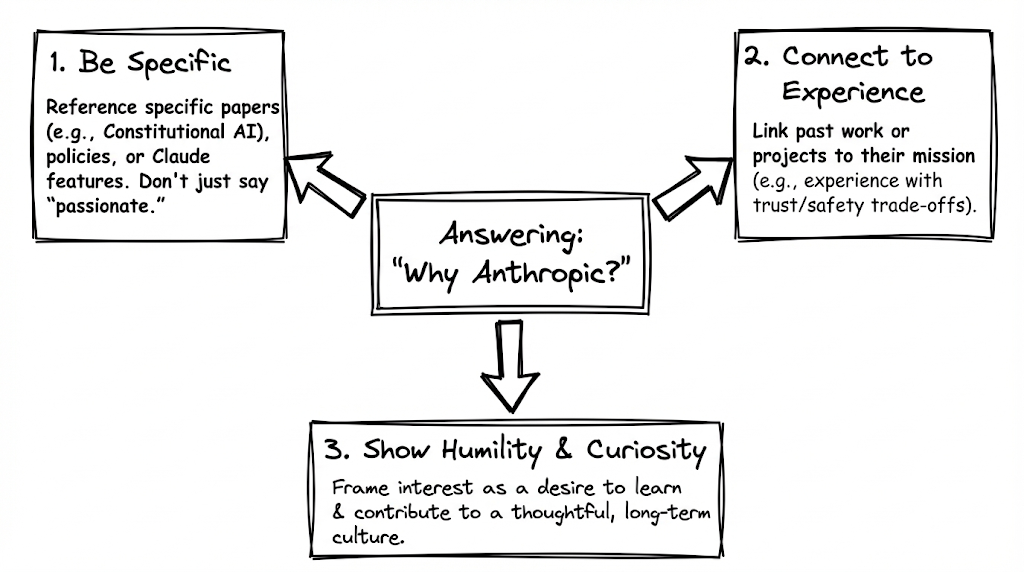
- Be Specific: Go beyond saying you’re “passionate about AI.” As recommended by guides on InterviewQuery, reference a specific Anthropic research paper (like their work on Constitutional AI), a policy document (like the Responsible Scaling Policy), or a feature of Claude that you find compelling.
- Connect to Your Experience: Link your past work or personal projects to their mission. For example, “In my previous role, I worked on a system where we had to balance performance with user trust, which sparked my interest in the formal safety research Anthropic is pioneering.”
- Show Humility and Curiosity: Frame your interest as a desire to contribute and learn within a culture that prioritizes thoughtfulness and long-term impact.
2.1 Tell me about a time you made a safety-first decision in a project, even if it meant a trade-off.
How to answer: Use the STAR (Situation, Task, Action, Result) method.
- Result: Explain the outcome and what you learned. “We delayed the feature by two weeks, but we launched without the vulnerability. This reinforced the importance of proactive security audits and taught me how to advocate for safety priorities by clearly communicating risks and trade-offs.” This type of question has been frequently reported by candidates on platforms like Linkjob.ai.
2.2 More Behavioral Questions
Interviewers at Anthropic use behavioral questions to understand your past performance, values, and collaboration style.
- “Tell me about a time when a technical misjudgment led to a project delay. What did you learn?” (A question reported by candidates on Linkjob.ai)
- “Describe a time you had a technical disagreement with a colleague. How did you resolve it?” (A common question noted by InterviewQuery)
- “What would you do if, midway through a project, you realized it was actually unfeasible or couldn’t be completed?” (Another scenario shared by past applicants on Linkjob.ai)
2.3 Coding Challenge: Implement an In-Memory Database
Why they ask: This is a common multi-level coding challenge that tests your ability to write clean, modular, and extensible code. It’s not about finding a clever one-line solution; it’s about building a system that can evolve. Interviewers evaluate your coding speed, accuracy, and design choices as complexity increases, according to experiences shared on Medium.
- Level 4: Persistence/Compression: You might be asked to save the database to a file and load it back. The interviewer may suggest a format like JSON, and you should be able to discuss the trade-offs (e.g., JSON is human-readable but
picklecan handle more complex Python objects), a follow-up reported by past candidates on Linkjob.ai.
2.4 System Design: Design an API for an LLM with a Safety Layer
Why they ask: This question combines classic system design principles with Anthropic’s unique focus. They want to see if you can design a scalable, reliable system while also integrating robust safety and moderation features, a topic covered in various system design guides.
- Constitutional AI: Mention how you might incorporate a set of rules or principles to guide the model’s responses, even before it generates them, a concept detailed in Anthropic’s public documentation on its Constitutional AI.
- Discuss Trade-offs: Talk about batching requests for higher throughput vs. real-time processing for lower latency. Discuss the challenge of updating the safety layer without downtime.
2.5 System Design: Implement a GPU Scheduling System Using Credits
- Logic and Trade-offs: Discuss how you would handle preemption (e.g., can a high-priority job interrupt a low-priority one?). How do you prevent a single user from monopolizing resources? How do you handle node failures? A simple approach is a periodic credit allocation, while a more complex one could involve a dynamic market for GPU time, reflecting the complexity discussed in some candidate reports on Glassdoor.
2.6 What do you think is the biggest risk of anthropomorphizing language models?
Why they ask: This is a philosophical, open-ended question designed to probe your thinking on AI safety and ethics. There is no single “right” answer. The interviewer wants to see your ability to reason thoughtfully about complex, non-technical risks and communicate your perspective clearly, as noted in a collection of real interview questions shared by a candidate on Medium.
2.7 System Design: Design a 1-on-1 Chat System
Why they ask: This question has appeared in recent interviews and tests core system design fundamentals in a tightly scoped problem. By stripping away complex features like group chat or channels, interviewers can dive extremely deep into the details of a one-on-one messaging architecture, focusing on reliability, latency, and data consistency, according to experiences shared on forums like 1point3acres.
- Database Choice: Discuss the pros and cons of SQL vs. NoSQL. A wide-column store like Cassandra could be a good choice for handling a high volume of messages, partitioned by user ID or chat ID, a common pattern in system design interviews.
- Deep Dive Areas: Be prepared for follow-up questions. How do you handle message delivery to an offline user? (Push notifications, storing messages in the database). How do you ensure message order? (Sequence numbers). How do you scale the WebSocket-handling service? (Consistent hashing to route users to the same server), with discussions on platforms like Blind confirming the depth of these technical dives.
3.More Anthropic Interview Questions (By Role)
3.1 Software Engineer
- “Implement an LRU Cache. Now, how would you make it persistent?” (a reported follow-up question on Linkjob.ai).
- Database implementation variants, which build on the concepts seen in the ‘In-Memory Database’ challenge, according to candidate reports on 1point3acres.
- Concurrency problems: “Design a rate limiter” or “Solve a producer-consumer problem,” with candidates on Medium detailing concurrency-specific rounds.
- “How would you design APIs that developers use to access Anthropic’s AI models?” (a design question noted in the System Design Handbook).
3.2 Research Scientist
Research scientist interviews test your depth of knowledge, research experience, and ability to think creatively and critically about AI safety.
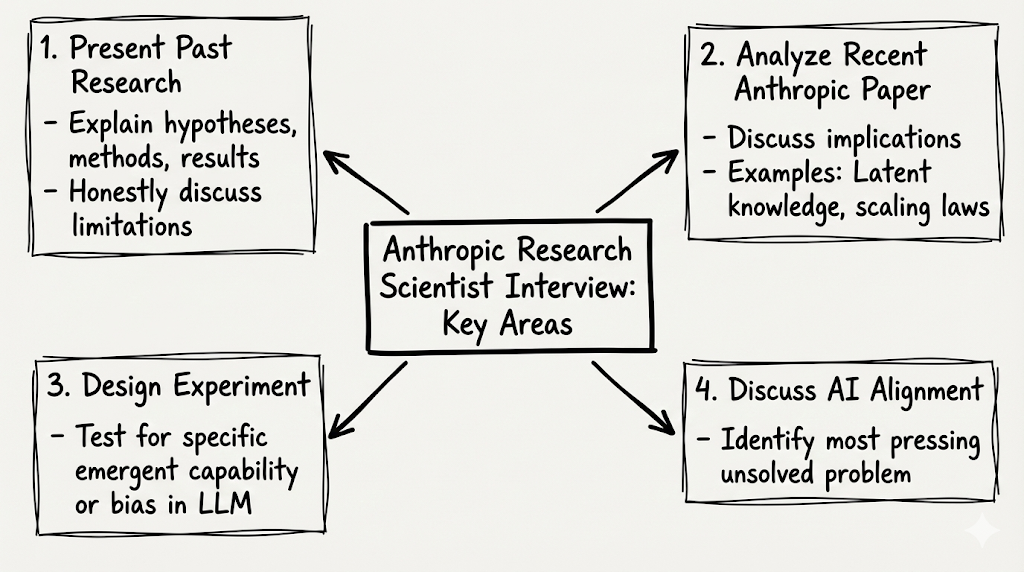
- You will almost certainly be asked to present your past research. Be prepared to explain your hypotheses, methods, and results, and to honestly discuss the limitations of your work, as the InterviewQuery guide for this role confirms.
- You may be asked to analyze a recent Anthropic paper and discuss its implications. This could include topics like their work on discovering latent knowledge in language models or scaling laws, which can be found on Anthropic’s public research page.
- “How would you design an experiment to test for [a specific emergent capability or bias] in a large language model?” (a question mentioned in interview prep guides).
- “What do you see as the most pressing unsolved problem in AI alignment?” (a common question for this specialization, according to InterviewQuery).
3.3 Machine Learning Engineer
MLE roles bridge the gap between research and production. You’ll need to demonstrate strong engineering fundamentals and a solid understanding of the ML lifecycle.
- “Explain the architecture of a Transformer model. What are the key components and why are they important?” (a fundamental ML question also seen in OpenAI interviews).
- “How would you optimize a model for inference latency?” (e.g., quantization, distillation, hardware acceleration), as detailed in technical documentation from sources like Hugging Face Optimum.
- System Design: “Design a distributed training pipeline for a large language model. How would you handle fault tolerance?” (a classic large-scale ML system design problem covered by resources like InterviewQuery).
- Coding questions are similar to the SWE track but may have a stronger data-manipulation or algorithmic flavor.
3.4 Performance Engineer
This role focuses on low-level optimization and performance tuning. Instead of a standard coding screen, candidates may face a specialized take-home exam, based on experiences shared on forums like 1point3acres.
- Take-Home Exam: Core Kernel Optimization: Candidates are given a 2-hour timed exam to optimize the core kernel function of a mocked system. The task is similar to GPU kernel optimization, requiring techniques like loop unrolling, memory coalescing, and operation fusion. AI tools are permitted. The goal is to achieve a significant performance improvement (e.g., one candidate reported an 8x improvement with a score of over 600/1000 was required to advance to the final interviews).
4. Compensation and Offer
Unlike some tech companies, Anthropic reportedly has a straightforward compensation structure and is known for not engaging in salary negotiation, a practice also seen at other top AI labs and discussed by engineers on Blind. Their packages are highly competitive and heavily weighted towards long-term equity, often in the form of Profit Participation Units (PPUs), which align employee incentives with the company’s long-term success. Expect a significant total compensation package, but be prepared for the initial offer to be the final offer, a point corroborated by salary data on Levels.fyi.
5. How to Prepare for an Anthropic Interview
5.1 Learn by Yourself
This is the foundational step. Don’t just practice coding; immerse yourself in Anthropic’s culture and research.
- Read Their Material: Read Anthropic’s research blog, their Core Views on AI Safety, and their Responsible Scaling Policy. Pay special attention to their work on interpretability (understanding the “black box”) and Constitutional AI. Try to summarize them in your own words, a preparation tip frequently recommended by InterviewQuery.
- Understand their Products: Use Claude. Think about how it’s different from other models. Read the API documentation.
- Practice Practical Coding: Focus on writing clean, extensible code. Since many assessments are reportedly on platforms like CodeSignal, it’s wise to practice on CodeSignal to get comfortable with the environment. Practicing in a shared environment like Google Colab also often mimics the interview setup, as noted by IGotAnOffer.
- Study Core Concepts: For research and ML roles, foundational texts like the Deep Learning Book are highly recommended to solidify your understanding of core principles, a recommendation often given for top AI lab interviews.
5.2 Practice with Experienced Interviewers
For a company as competitive as Anthropic, practicing with experts who have experience with top-tier AI lab interviews can make a significant difference. A coach from a service like IGotAnOffer can provide:
- Company-Specific Feedback: An expert can give you feedback tailored to Anthropic’s unique focus on safety and practical engineering.
- Realistic Mock Interviews: Simulate the pressure and style of a real Anthropic system design or coding interview.
- Targeted Improvement: Identify your blind spots and help you craft a narrative that connects your skills to Anthropic’s mission.
6. Land Your Anthropic Role with jobright
While mastering interview skills is essential, finding and applying to the right Anthropic opportunities is equally critical to your success. Even the best-prepared candidate needs to discover roles that match their unique background and career goals.
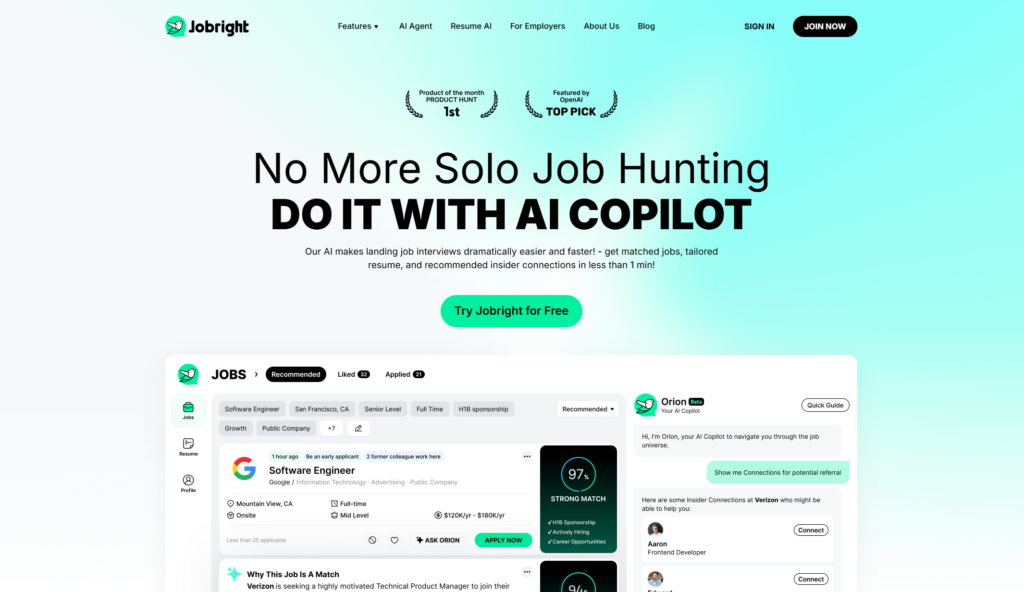
jobright.ai is an AI-powered job search copilot designed to streamline your Anthropic job search and maximize your chances of landing interviews. Here’s how jobright.ai can complement your interview preparation:
6.1 AI-Powered Smart Matching & Discovery
jobright.ai doesn’t just list jobs; it understands them. Its AI engine scans thousands of openings across Anthropic’s vast ecosystem (AWS, Alexa, Prime, etc.) and provides a Match Score for every role.
- Identify “Hidden” Roles: Surface positions that are often buried under generic titles but perfectly match your technical stack.
- Precision Filters: Filter by “Visa Sponsorship,” “Remote/Hybrid,” and “Salary Range” to ensure you only spend time on roles that meet your criteria.
6.2 The “Magic” Resume Autofill & One-Click Application
One of jobright.ai‘s most powerful features is its ability to eliminate “application fatigue.”
- Resume Autofill: Using the jobright.ai Chrome Extension, the platform intelligently parses your resume and automatically fills out complex application forms on portals like Workday, Lever, and Greenhouse. No more re-typing your work history dozens of times.
- One-Click Efficiency: Apply to multiple Anthropic-related roles in a fraction of the time, ensuring you are among the first applicants to a newly posted position.
6.3 AI Resume Tailoring & Optimization
Anthropic uses sophisticated Applicant Tracking Systems (ATS). jobright.ai helps you beat them:
- Instant Optimization: For every specific Anthropic JD (Job Description), jobright.ai’s AI suggests real-time edits to your resume, highlighting the Leadership Principles and technical keywords (e.g., LCL, Distributed Systems, S3) that Anthropic recruiters look for.
- Score Improvement: Get a breakdown of how well your current resume aligns with the role and actionable steps to reach a 90%+ match score.
6.4 Comprehensive Job Tracker (CRM for Job Seekers)
Managing dozens of applications can be chaotic. jobright.ai provides a centralized Job Board to manage your entire pipeline:
- Status Tracking: Automatically update the status of your applications from “Applied” to “Interview” or “Offer.”
- Follow-up Reminders: Never miss a critical window to follow up with a recruiter or prepare for a coding challenge.
6.5 AI Career Coach & Interview Simulation
Beyond the application, jobright.ai acts as your personal mentor:
- Company Insights: Access “Insider Intelligence” on Anthropic’s team structures, recent projects, and specific tech stacks.
- AI Mock Interviews: Practice answering Anthropic’s famous behavioral questions based on the STAR method. The AI provides instant feedback on your tone, content, and alignment with Anthropic’s culture.
Ready to Accelerate Your Anthropic Career?
Don’t let manual data entry and generic resumes hold you back. Visit jobright.ai today to:
- Install the Chrome Extension for seamless Resume Autofill.
- Generate an ATS-ready resume tailored specifically for Anthropic AWS or SDE roles.
- Discover your Match Score for the latest openings at Anthropic.