
Blue Cross Blue Shield Work From Home Jobs: Legit Listings vs Scams
Table of Contents
Last Updated: January 15, 2026
Hi there, I’m Dora.
Let me guess: if you’re searching for “blue cross blue shield work from home” right now, you are probably exhausted. You’re likely tired of the “application black hole” and those so-called “remote” roles that quietly demand you be on‑site three days a week.
I’ve seen it happen too many times, but here’s the harsh truth: if you treat BCBS remote jobs like random LinkedIn applies, you’ll lose to people who know how the ATS, internal referrals, and healthcare hiring cycles actually work.
That’s why I wrote this guide. I’m going to break down exactly how to navigate this:
- What BCBS work from home roles actually exist (and which ones are entry points for tech talent)
- Where to find legit Blue Cross Blue Shield work from home listings
- How to avoid scams
- The exact resume keywords and workflow I use so applications hit >80% keyword match with zero formatting issues
Stop guessing. Let’s look at the data together and build a clean, repeatable strategy.
Common BCBS Work From Home Roles
When people hear “Blue Cross Blue Shield work from home,” they often imagine only call center jobs. That’s outdated. BCBS is a network of 30+ independent companies, and many have remote or hybrid teams across operations, analytics, IT, and care management.
Here’s the harsh truth: if you’re a tech professional, you won’t start as VP of Data Science. But you can target roles close to the data and platforms that run the health plan.
Below are the three broad remote categories you’ll see most often.
Customer Service Positions

Customer service is often the largest pool of BCBS work from home jobs. These are the classic “member support” or “provider support” phone and chat roles.
What they look like in postings:
- “Customer Service Representative – Remote”
- “Provider Services Associate – Work from Home”
- “Member Contact Center Specialist – Remote”
Key tasks:
- Handling inbound calls from members or doctors
- Explaining benefits, eligibility, and coverage
- Logging each interaction in a CRM or internal system
Why this matters if you’re tech:
- These roles feed data into the systems analysts and engineers support
- They’re an entry point if you’re early career or switching into healthcare from another field
- High-volume operations give you real metrics: call handle time, resolution rate, quality scores
Signal vs. noise in your resume:
- Signal: metrics like “Handled 60+ calls/day with 95% quality score”
- Noise: “Great communication skills” with no data to back it up
Recruiters won’t tell you this, but many BCBS companies track and export performance data from call tools. If you document those metrics on your resume, you instantly beat generic applications.
If you’re exploring similar opportunities beyond healthcare, you can browse remote customer support and success roles across multiple industries to compare requirements and compensation.
Claims Processing Opportunities
Claims operations are the core of every health insurer. Remote claims jobs often include:
- “Claims Processor / Claims Examiner – Remote”
- “Billing & Claims Specialist”
- “Medical Claims Analyst”
Typical responsibilities:
- Reviewing member and provider claims
- Verifying coding (ICD-10, CPT, HCPCS) and coverage
- Applying rules in claims systems and flagging exceptions
For tech and data people, this is where the algorithm meets reality. Claims engines run on rules, tables, and logic trees. Many BCBS organizations then pull that data into warehouses for analytics.
Why this is attractive for tech talent:
- Deep exposure to data fields and logic used downstream
- Pathways into business analyst, data analyst, or product roles
- Chance to speak the language of healthcare operations in future interviews
Example of signal vs. noise for a claims-focused resume bullet:
- Signal: “Processed 175+ claims/day with 98% accuracy: flagged 12% of high-cost claims for manual review using system rules.”
- Noise: “Reviewed many claims in a fast-paced environment.”
Stop guessing. Let’s look at the data: health insurance is projected to keep growing with aging populations and ongoing care demand (source: U.S. Bureau of Labor Statistics). Claims volume doesn’t shrink, and that keeps these remote roles stable.
Member Services Careers
Member services is where operations, communications, and light analytics meet. Titles often include:
- “Member Engagement Specialist”
- “Care Coordinator – Remote”
- “Population Health Outreach Specialist”
Day to day, these roles may:
- Reach out to members for preventive care reminders
- Coordinate appointments and referrals
- Track engagement metrics in dashboards
If you’re a product manager, UX designer, or data analyst, these jobs give you user behavior data and access to cross‑functional teams.
For example, you might:
- A/B test different outreach scripts
- Report on conversion rates for screening campaigns
- Partner with IT to tweak member portals
This is where the value prop of your tech background becomes clear. You’re not just “helping members.” You’re using data to drive health outcomes.
If you want to move into analytics or product later, roles with structured data exposure (claims, engagement, workflows) give you better long‑term ROI than generic admin jobs.
Where to Find Legitimate BCBS Remote Job Listings
Here’s the harsh truth: typing “blue cross blue shield work from home” into random job boards and clicking “Easy Apply” is almost pure noise. You’re feeding ATS systems weak signals with no targeting.
Instead, I split BCBS remote search into four signal‑heavy channels.
Official Blue Cross Blue Shield Company Sites
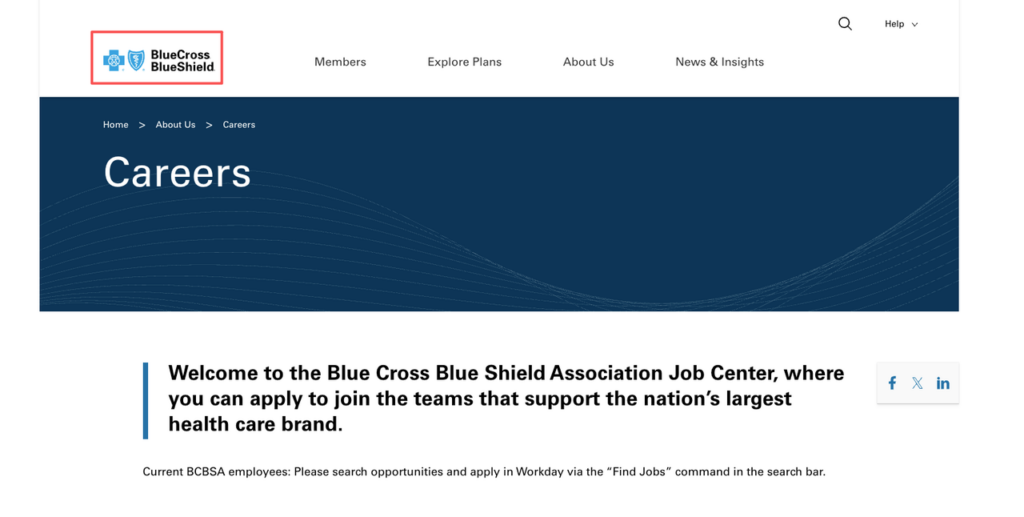
Each state BCBS plan is its own company (for example, Blue Cross Blue Shield of Texas, Anthem Blue Cross, Horizon BCBS). Go straight to their careers pages and filter by:
- Location: “Remote” or “Work from home”
- Category: Customer service, claims, IT, analytics
Why this matters:
- Highest conversion rate from view → real application
- Lower scam risk
- Job descriptions are detailed enough for exact keyword match
LinkedIn – But With Filters and Caution
LinkedIn can work if you stop using the “Easy Apply” spray-and-pray strategy.
My filter combo:
- Keywords: “Blue Cross Blue Shield”, “BCBS”, “health plan”, plus your skill (“SQL”, “Python”, “product manager”)
- Location: “United States – Remote”
- Experience level: Entry / Associate / Mid‑Senior as needed
Then I:
- Open the posting in the employer’s site
- Save the job description to extract keywords
- Apply only on the official site to avoid parsing errors
You can also check FlexJobs’ BCBS remote listings for additional verified opportunities.
Visa‑Focused Databases (for International Candidates)
If you’re on F‑1, OPT, or H‑1B, you can’t just chase any Blue Cross Blue Shield work from home posting. You need evidence that the company sponsors.
Here’s what I check:
- USCIS H‑1B Employer Data Hub: search employer names like “Anthem Inc.” or “HCSC”
- LCA disclosure data from the U.S. Department of Labor: confirm past H‑1B LCAs and wage levels
- Levels.fyi: look at real salary bands and titles to gauge negotiation ranges
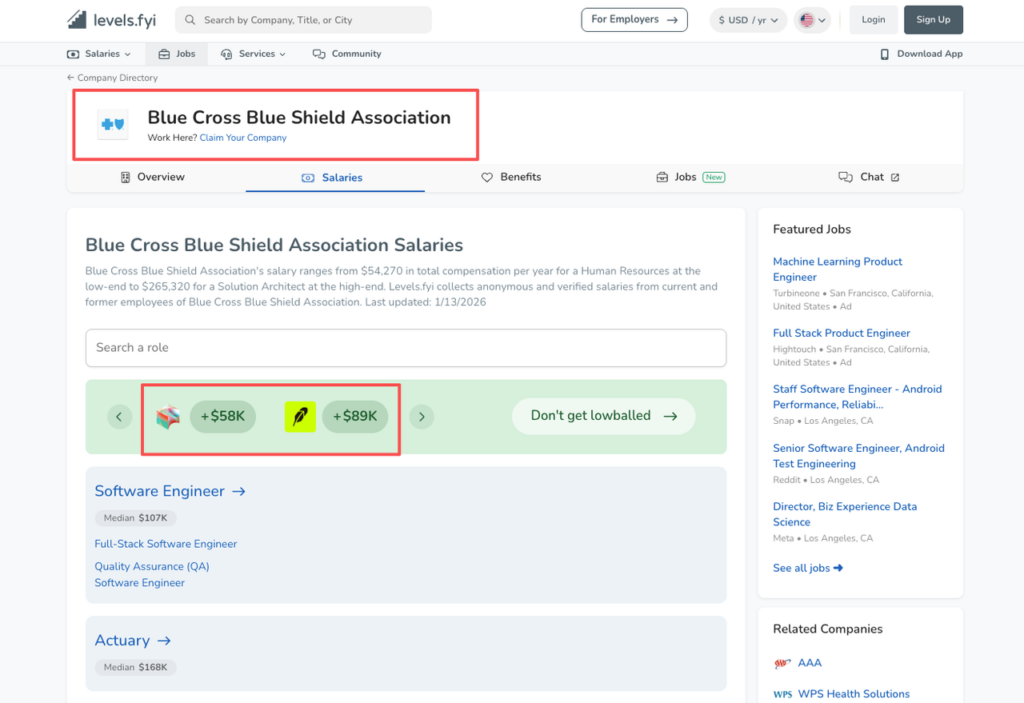
If a BCBS entity has zero H‑1B records for the last 3–5 years, I don’t depend on them as a primary sponsor strategy.
Internal Referrals and Insider Connections
Recruiters won’t tell you this, but many BCBS companies track referral vs. cold application conversion rates. Internal referrals can dramatically raise your chance of getting a screening call.
Finding the right person to ask is usually the hardest part, so I use JobRight’s referral engine to instantly match with employees who are actually open to referring, rather than hunting them down manually.
I target:
- Alumni from my school who now work at BCBS plans
- Ex‑consultants now in BCBS analytics or IT
- People who post on the official engineering or data blogs (for example, if a BCBS plan has a tech blog similar to the Meta or Google engineering blogs)
My simple message script:
“I saw you work at [BCBS entity]. I’m targeting remote roles in [team]. I’ve done [X metric result]. Would you be open to a quick 10‑minute chat so I can see if my background aligns with what your team values?”
Short, data‑backed, and focused on alignment, not begging for a favor.
Recognizing BCBS Work From Home Scams & Red Flags
If you search “blue cross blue shield work from home” on open job boards, you’ll see scams mixed with real roles. Some pretend to be BCBS: others abuse the brand name for phishing.
Here’s the harsh truth: if a job looks like free money with no screening, it’s probably targeting your identity, not your talent.
Stop guessing. Let’s look at the data and patterns from FTC job scam reports and BBB scam alerts.
Common Red Flags
- Interviews only over Telegram, WhatsApp, or generic chat apps
Legit BCBS companies almost always use:
- Corporate email addresses with the company domain (for example, @bcbs[STATE].com, @anthem.com)
- Standard video tools (Teams, Zoom)
- Requests for bank info or ID before an offer letter
In the U.S., direct deposit and I‑9 verification usually start after a written offer. If they ask for:
- Bank details
- Passport scan
- Social Security number
before a formal offer and background check flow, walk away.
- Pay that ignores market data
Use Levels.fyi and LCA wage data from the Department of Labor to anchor reality. If similar roles pay $20–$30/hour for entry‑level support and a posting offers $70/hour for “no experience,” that’s noise.
- No listing on the official company careers page
Always cross‑check: copy the job title + company name, search inside the official BCBS careers site. If it’s missing, that’s a major red flag.
Quick Mental Checklist (Picture This as a Flow Diagram)
Imagine a simple decision diagram:
- Step 1: Does the recruiter email match the official company domain? If no → High risk.
- Step 2: Is the job listed on the official careers site? If no → High risk.
- Step 3: Are they asking for money, crypto, or gift cards at any stage? If yes → Scam.
- Step 4: Is the pay within 20–30% of what Levels.fyi or LCA data shows? If no → Needs extra checking.
Use this to filter noise so you only spend energy on real Blue Cross Blue Shield work from home roles.
BCBS Remote Jobs Resume Keywords & Tailoring Checklist
Most candidates fail the ATS stress test. The parser misreads their resume, the keyword match falls below 60%, and the application dies before a human ever sees it.
For Blue Cross Blue Shield work from home roles, you need two things:
- Clean, ATS‑safe formatting
- Targeted keywords tied to healthcare operations
1. Formatting That Won’t Break Parsing
Here’s the harsh truth: fancy designs destroy ATS conversion rates. Stop doing this immediately:
- Complex tables for layout
- Text inside images
- Icons instead of text for contact details
Instead, use:
- Simple one‑column layout
- Standard section headers: “Experience,” “Education,” “Skills”
- Font like Arial, Calibri, or similar
I’ve tested resumes in common ATS parsers and aim for 80–90% keyword match with no corrupted sections.
2. Core Keyword Themes by Role Type
Think of your resume as a signal amplifier. You want the right terms repeated in natural ways.
Customer Service / Member Services Keywords:
- “member experience,” “provider support,” “benefits explanation”
- “call center,” “inbound calls,” “first call resolution”
- Tools: “CRM,” “Zendesk,” “Salesforce Service Cloud” (only if true)
Claims / Operations Keywords:
- “claims processing,” “claims adjudication,” “EOB (Explanation of Benefits)”
- “ICD‑10,” “CPT,” “HCPCS,” “medical billing”
- “accuracy rate,” “audit,” “compliance,” “appeals”
Tech / Data / Product Keywords (when targeting BCBS):
- “SQL,” “Python,” “Tableau,” “Power BI” (if accurate)
- “requirements gathering,” “workflow,” “business rules”
- “EHR data,” “healthcare data,” “claims data”
For deeper insight into healthcare employment trends, check the Bureau of Labor Statistics projections.
3. Simple Before/After Keyword Match Example
Imagine your target posting says:
- “Handle high volume inbound calls”
- “Explain complex benefits in simple terms”
- “Document interactions in CRM system”
Before (weak signal):
“Helped many customers with questions: used different tools.”
After (strong signal):
“Handled 60–70 inbound calls per shift: explained health plan benefits in clear language: documented each interaction in CRM for accurate member records.”
Same work, different signal. The second version mirrors the posting’s phrasing and adds metrics.
4. My Tailoring Checklist for Each BCBS Application
- Paste the job description into a doc. Highlight repeated nouns and verbs.
- Map each key phrase to one bullet in your experience, if true.
- Quantify at least one metric per role (calls/day, claims/day, NPS, accuracy rate, project impact).
- Run the resume through a keyword scanner (there are free parsers) and aim for 80%+ match.
Let’s stop guessing the keywords. Use JobRight to analyze the job description and find out exactly what the ATS wants to see.
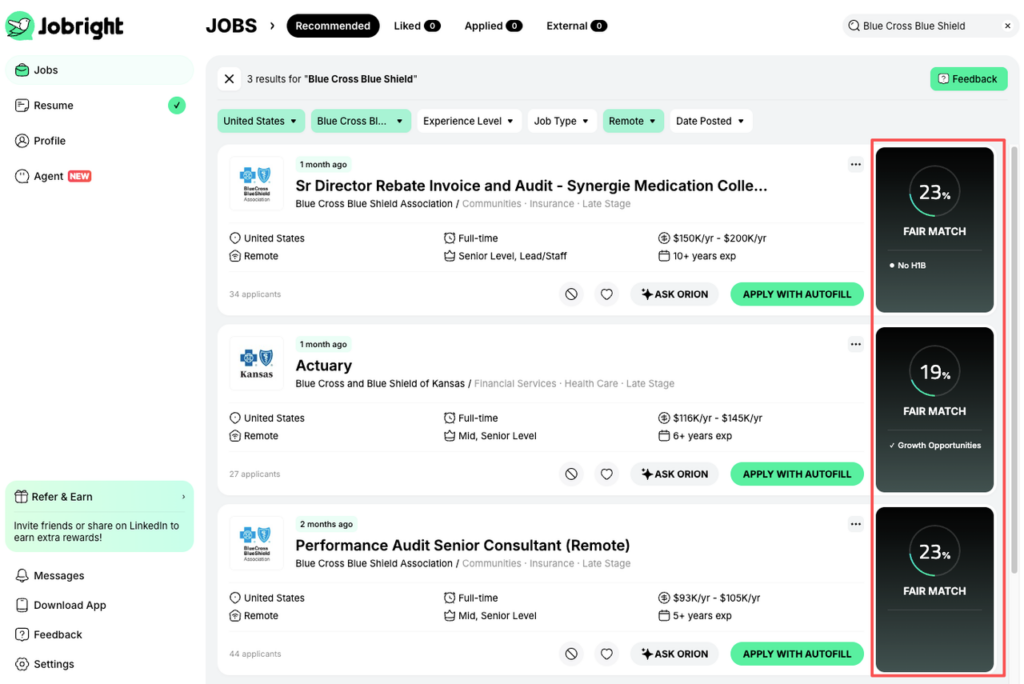
- Save as PDF only if the ATS supports it: otherwise, upload Word.
This is how you move from noise‑heavy, generic resumes to high‑signal, data‑backed applications.
Step-by-Step BCBS Work From Home Application Workflow
Now I’ll pull this together into a repeatable workflow you can run every week for Blue Cross Blue Shield work from home jobs.
Step 1: Define Your Target Lane
Don’t search everything at once. Choose one primary lane for 30 days:
- Lane A: Customer / Member / Provider support
- Lane B: Claims and operations
- Lane C: Analytics / Product / Tech
Your resume, keywords, and outreach should align with that lane. This alignment is how you raise your conversion rate from applications → interviews.
Step 2: Build a Lead List (10–20 Roles/Week)
Use the channels from earlier:
- 50% from official BCBS entity sites
- 30% from LinkedIn (but applied on company site)
- 20% from visa‑sponsoring BCBS entities if you need sponsorship (confirmed via USCIS and DOL data)
Track them in a simple spreadsheet:
- Columns: Company, Role, Link, Date Applied, Referral (Y/N), Status, Notes
This acts like your mini CRM and keeps you honest about output.
Step 3: Run the ATS Stress Test for Each Role
For every role on your list:
- Copy the job description.
- Highlight all repeated skills, tools, and healthcare terms.
- Insert them into your resume only where true, written as clear bullets with metrics.
- Test your resume file in an online ATS parser:
- Confirm: name, phone, email, job titles, and dates parse correctly.
- Aim: 80%+ keyword match.
If parsing fails, fix formatting before you send anything.
Step 4: Apply on the Official Site, Then Add One Human Touch
Application order:
- Apply on the official BCBS careers portal.
- Save the confirmation number or screenshot.
- Within 24 hours, find:
- The recruiter (if listed)
- A team member in that department on LinkedIn
Send a short data‑backed note:
“I applied to [Job ID] – [Title] today on your careers site. I’ve handled [X metric result in similar context]. If it seems aligned, I’d appreciate a chance to discuss how I can support your [claims/member experience/analytics] goals.”
You just added a human signal on top of the ATS signal.
Step 5: Prepare for Metric‑Based Interviews
Once you start getting screens, your story has to match your resume metrics.
I prepare three short case stories:
- Volume story – handling high call or claim volume with quality
- Complexity story – explaining benefits or fixing tricky claim issues
- Data story – using metrics or reports to improve a process
Each story anchored in:
- Situation
- Action
- Measurable result (time saved, accuracy, satisfaction score)
For international candidates, I also check current USCIS and Department of Labor guidance on remote work and visa status (uscis.gov, dol.gov), because remote policies can interact with work location rules.
Step 6: Negotiate From Data, Not Emotion
When an offer comes, I don’t guess. I:
- Check Levels.fyi for similar roles in health insurance
- Look at LCA wage data for that employer and role level
- Anchor my ask in a range, not a single number
Example:
“Based on market data for similar remote roles in health insurance and my [X years] supporting [claims/member operations], I’m targeting a total compensation range of [$A–$B]. How close can we get to that?”
You’re calm, professional, and data‑backed. That’s the signal of someone they want on their team.
Action Challenge (Do This Today):
Pick one Blue Cross Blue Shield work from home role from an official BCBS careers site. Copy the description, rewrite three of your resume bullets with clear metrics and matching keywords, then run it through an ATS parser and push your match score above 80%.
Once you see that bump, you’ll stop treating the job search like a lottery and start treating it like what it is: a system you can learn, measure, and improve.
Frequently Asked Questions
What types of Blue Cross Blue Shield work from home jobs are most common?
Common Blue Cross Blue Shield work from home roles fall into three main buckets: customer or provider service (call center and support), claims processing and operations, and member services or care coordination. These roles often involve handling calls, processing claims, managing member outreach, and working with healthcare or claims data.
How can I find legitimate Blue Cross Blue Shield work from home listings and avoid scams?
Start with official BCBS entity career sites and filter by “Remote” or “Work from home.” Use LinkedIn only as a discovery tool, then apply on the employer’s site. Verify that recruiters use official company email domains, that the role appears on the official careers page, and be wary of requests for money, crypto, or early bank/ID details. Learn more about spotting job scams and protecting yourself during open enrollment season.
How do I tailor my resume for Blue Cross Blue Shield work from home jobs so it passes ATS screening?
Use a simple one‑column layout with standard headings and no complex tables or graphics. Mirror key phrases from the job description—such as “claims processing,” “inbound calls,” “member experience,” or “claims data”—in your bullets, and add metrics like call volume, accuracy rates, or resolution times. Aim for an 80%+ keyword match in ATS parsers.
Are Blue Cross Blue Shield work from home jobs good for people transitioning into tech or analytics?
Yes. Remote roles in claims, member services, and high‑volume customer support expose you to structured healthcare and claims data, business rules, and performance metrics. That experience can position you for later transitions into business analyst, data analyst, product, or operations roles inside health plans or other healthcare organizations.
Do Blue Cross Blue Shield work from home positions provide equipment and what skills are usually required?
Many BCBS entities provide basic equipment for remote employees, such as a laptop and secure access tools, though policies vary by company and role. Typically required skills include reliable internet, comfort with CRMs or claims systems, clear written and verbal communication, basic data entry accuracy, and the ability to follow detailed workflows and compliance rules.
Recommended reads