
ByteDance Technical Interview Questions: Complete 2025 Guide
Getting a job at ByteDance is a significant achievement, but the path is notoriously difficult. With a hiring success rate estimated to be extremely low, the interview process is designed to be one of the most rigorous in the tech industry. To get the job, your answers will need to be outstanding.
If that sounds daunting, don’t worry, we’re here to help. We’ve analyzed hundreds of ByteDance interview questions and worked with candidates to understand exactly what sort of questions you can expect in your interview. ByteDance Interview Guide
Below, we’ll go through the most common ByteDance interview questions and show how you can best answer each one.
Here’s what we’ll cover:
- Top 7 ByteDance interview questions & answers
- Real interview questions from recent candidates (2025)
- How to prepare for a ByteDance interview
- ByteDance interview FAQs
- More ByteDance interview questions
- Practice ByteDance interview questions
Let’s dive right in!
1. Top 7 ByteDance Interview Questions & Answers
Based on extensive analysis of real ByteDance interview experiences and interviewer feedback, we’ve identified the 7 most frequently asked questions. These questions span behavioral interviews, algorithms, system design, and probability—representing the core question types for ByteDance technical roles.
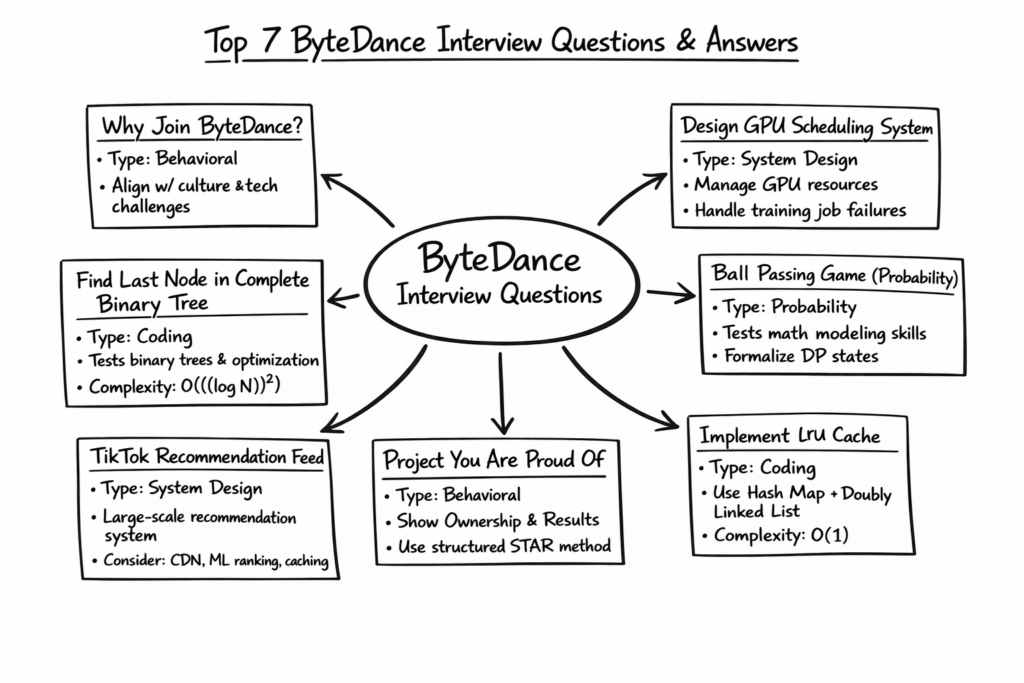
1.1 Why do you want to join ByteDance?
Type: Behavioral
Why they ask: This isn’t about whether you “know the company”—it’s about assessing:
- Whether you’re only attracted by high compensation or prestige.
- Whether you truly align with ByteDance’s core culture (pursuit of excellence, rapid iteration, technology-driven).
- Whether you understand the technical complexity and business scale behind ByteDance products.
ByteDance seeks candidates genuinely interested in complex systems, extreme efficiency, and massive-scale user problems.
How to answer:
- Avoid generic product praise (e.g., “I love scrolling TikTok”).
- Focus on technical challenges + personal capability alignment.
- Specify the “type of problems” you want to solve, not just the job title.
Right example
“I’m fascinated by how ByteDance’s recommendation system maintains millisecond-level response times at petabyte scale. ByteDance emphasizes ‘Aim for the Highest,’ and my experience in distributed systems and performance optimization aligns perfectly with reducing global user latency and improving system stability. I want to solve truly large-scale technical challenges in this fast-iterating environment.”
1.2 Find the Last Node in a Complete Binary Tree
Type: Coding (Medium)
Why they ask: On the surface, it’s about tree structure, but it actually tests:
- Whether you understand complete binary tree properties.
- Whether you can avoid brute-force traversal.
- Your awareness of complexity optimization (the target solution must be better than O(N)).
How to answer:
- Approach: Leverage the height properties of complete binary trees and apply binary search on the last level nodes. You need to determine if a node with a specific index exists by traversing from the root.
- Complexity: Time: O((log N)^2); Space: O(1).
- Key Point: Proactively explain why you’re not using BFS/DFS—this is a major bonus point in the interview. Reddit Interview Experience
1.3 Design the TikTok Recommendation Feed
Type: System Design
This is ByteDance’s most core and representative system design question.
Why they ask:
- Recommendation systems are ByteDance’s technical moat.
- Tests your large-scale system abstraction capability.
- Tests whether you can balance high throughput with low latency.
How to answer (Framework):
- Requirements Analysis: Video uploads, personalized feed, likes/comments/shares. The system needs high availability and low latency.
- Scale Estimation: 1B+ DAU, dozens of requests per user daily, extremely high bandwidth consumption.
Overall Architecture:
- CDN for video delivery.
- Microservices (User Service, Video Service, Recommendation Service).
- Storage: Object storage (S3) for videos, NoSQL for metadata.
Deep Dive (Recommendation System):
- Candidate retrieval (following, trending, similar users).
- ML model ranking.
- Using Redis/local cache to reduce latency. ByteDance System Design Guide
1.4 Probability: The “Ball Passing” Game
Type: Probability / Mathematical Modeling
Question: A, B, and C are passing a ball, starting from A. After N passes, what is the probability the ball returns to A?
Why they ask: Tests whether you can formalize the problem, your basic probability modeling skills, and your ability to avoid random guessing.
How to answer:
- Approach: Use Dynamic Programming.
- State Definition:
dp[i][player]= probability that the ball is with a specific player afteripasses.
- Transition: A can only receive from B or C; probability is evenly distributed.
- Note: The key isn’t calculating the final number, but whether your modeling process is clear. Reddit LeetCode Discussion
1.5 Tell me about a project you are most proud of
Type: Behavioral
Why they ask: Tests whether you have an Ownership mentality. They want to know if you actually drove results rather than just “participated,” and how you handle complex or ambiguous problems.
How to answer (SPSIL Method):
- Situation: “At my previous company, our API latency spiked during peak hours.”
- Problem: “This caused 5% request failure.”
- Solution: “I identified a bottleneck in the database connection pool. I implemented a sharding strategy and introduced a Redis cache layer.”
- Impact: “Latency dropped by 40%, and I documented the new architecture for the team.”
- Lessons: “I learned the importance of proactive monitoring.”
ByteDance highly values whether you proactively take responsibility and drive execution.
1.6 Implement an LRU Cache
Type: Coding (Medium/Hard)
Why they ask: This is a classic question, but the focus is on whether you truly understand why O(1) is achievable and whether you can write production-ready code.
How to answer:
- Standard Solution: Use a Hash Map for O(1) lookup and a Doubly Linked List for O(1) insertion, deletion, and node movement.
- Bonus Points: Explain why a singly linked list won’t work and discuss how to handle capacity limits. Explain how to extend the design for thread safety.
1.7 Design a GPU Scheduling System
Type: System Design
Why they ask: With ByteDance’s heavy investment in AI (Doubao, TikTok algorithms), managing GPU resources for training models is a real-world challenge.
How to answer:
- Scope: Is this for internal researchers submitting training jobs?
- Components: Job Queue (Priority Queue), Scheduler (Kubernetes-like), Resource Monitor.
- Key Challenges: Fairness (quota management), Bin-packing (efficiently placing tasks on GPUs), and Fault Tolerance (what if a node fails during a 3-day training job?).
2. Real Interview Questions from Recent Candidates (2025)
Based on authentic reports from candidates who interviewed at ByteDance in 2024-2025, here are detailed breakdowns of the interview structure and specific questions asked across different technical roles. These are real experiences that provide valuable insight into what to expect.
2.1 TikTok Machine Learning Engineer (MLE) – Onsite Interview (VO)
This role emphasizes project background and core algorithm capabilities, with a focus on recommendation system architecture and high-difficulty coding challenges.
Interview Structure (3 Rounds):
Round 1: HR Screening
- Content: Non-technical interview focusing on personal background, high-level project descriptions, role interest, and visa/sponsorship status.
- Atmosphere: Relatively relaxed, serving as an initial screening.
Round 2: Hiring Manager Round (Technical & Project Deep Dive)
- Business Assessment: A deep dive into recommendation system architecture. Candidates must describe in detail the specific models used in the Candidate Generator phase of their past projects.
- Algorithm Coding: One LeetCode Hard-level Dynamic Programming problem with a strict 15-minute time limit for high-quality code completion.
- Note: This is an extremely tight time constraint—you must be able to recognize DP patterns instantly.
Round 3: Cross-functional/Leadership Round
Typically involves behavioral assessment or team fit evaluation. ByteDance MLE Interview Guide
2.2 TikTok US Data Security (USDS) – Site Reliability Engineer (SRE)
The TikTok USDS team follows a highly structured, fast-paced interview process with a “knockout” mechanism. After HR contact, all four rounds are scheduled upfront. If you don’t pass an early round, subsequent interviews are automatically canceled.
Interview Structure (4 Rounds, each 1 hour, completed within 2 weeks):
Round 1: Coding (Algorithm Programming)
- Focus: Fundamental algorithm capabilities and code implementation standards.
- Expect: Standard DSA questions similar to other tech companies.
Round 2: Network/Linux (Infrastructure Fundamentals)
- Deep Dive: Computer networking protocols (TCP/IP, DNS, BGP, routing).
- Systems: Linux kernel knowledge, system performance tuning, and troubleshooting methodologies.
- Practical Scenarios: “How would you diagnose packet loss?” or “Explain the Linux boot process.”
Round 3: System Design
- Focus: Design highly available, scalable distributed systems.
- Emphasis: Fault tolerance mechanisms and data security considerations.
- Example: “Design a real-time log aggregation system for TikTok’s infrastructure.”
Round 4: Hiring Manager Round (Comprehensive & Team Fit)
- Focus: Architectural thinking, approach to solving complex problems, and cultural alignment.
- Behavioral: Assessment aligned with ByteStyles values. ByteDance SRE Experience
2.3 TikTok Test Development Engineer (QA/SDET) – Detailed Interview Experience
This role bridges software development and quality assurance. The interview comprehensively assesses project business logic understanding, programming fundamentals, scenario-based testing design, and logical reasoning.
Interview Content Breakdown:
Project Deep Dive & Business Understanding
- Deep Examination: Specific questions about a project from your resume.
- Module Testing: Questions about modules you tested (e.g., data connection management, user management, permission/authorization).
- Risk Identification: “What are the critical testing risk points in the above modules in a production environment?”
Python Core Fundamentals
- OOP Basics: Explain the three fundamental characteristics of Object-Oriented Programming (Encapsulation, Inheritance, Polymorphism).
- Memory Management: Deep Copy vs. Shallow Copy—when to use each.
- Data Structures: Differences between List and Tuple, and appropriate use cases.
- Dictionary (Dict): Key characteristics and underlying implementation (hash table).
- Decorators: How they work and their applications in test automation.
- Magic Methods: Difference between
__init__(initializer) and__new__(constructor). Python Documentation
Algorithm Coding Question
- String Processing: Given a string like “AaADbDEeEbcvQv”, filter out “camelCase” patterns like “AaA” and “vQv” (uppercase-lowercase-uppercase) to output the remaining characters “bc”.
- Why: This tests pattern recognition and string manipulation skills.
Scenario Design Question
- Topic: WeChat QR Code Payment Testing.
- Requirements: Design comprehensive test cases covering:
- Functional: Normal flow, payment success/failure.
- Performance: Concurrent users, response time.
- Security: Authentication, data encryption.
- Exception Handling: Network interruption, timeout scenarios.
- Edge Cases: Insufficient balance, expired QR code.
Logic Puzzle
- The Gold Bar Salary Problem: A worker works 7 days and receives one gold bar as payment. The bar can only be broken twice. How can you make two cuts to enable daily payment settlement for 7 days with equal daily wages?
- Solution: Cut into pieces of 1/7, 2/7, and 4/7. This allows binary-like combinations (1, 2, 1+2=3, 4, 4+1=5, 4+2=6, 4+2+1=7).
3. How to Prepare for a ByteDance Interview
Depending on your target role (Backend/Frontend/Algorithm/Infrastructure/AI), ByteDance will assess a combination of coding algorithms, system design, and behavioral interviews. The overall difficulty is significantly higher than industry average, with strong emphasis on technical depth and rigorous thinking.
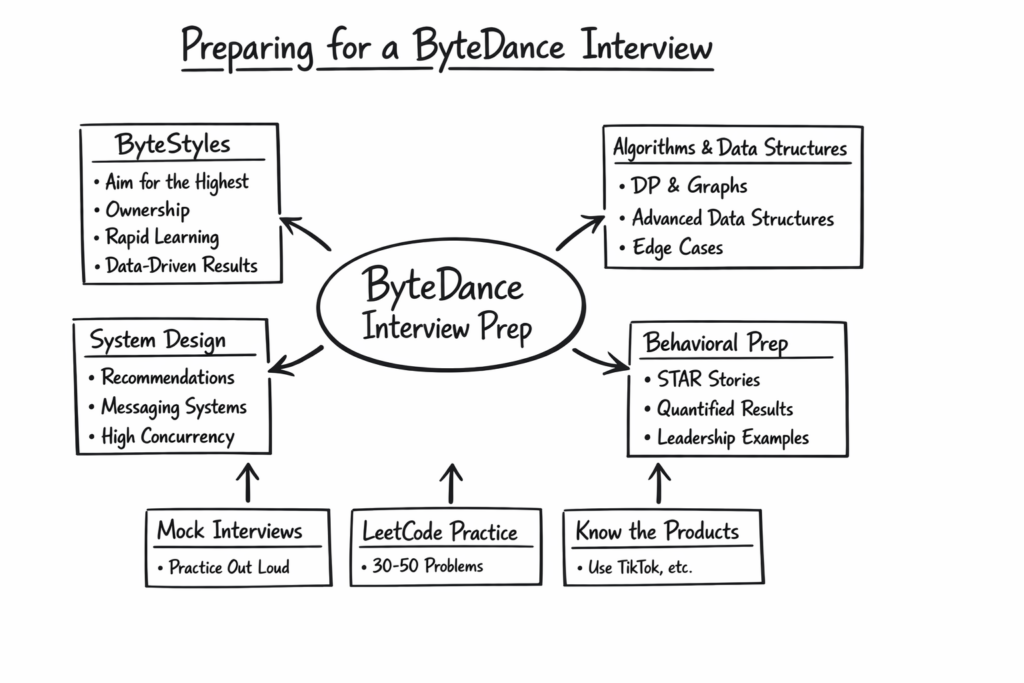
3.1 ByteDance Culture & Values (“ByteStyles”)
Deeply understand the core traits ByteDance emphasizes:
- Aim for the Highest: Pursue excellence.
- Ownership: Take initiative and responsibility.
- Rapid Learning & Self-Iteration: Continuously improve.
- Data-Driven Results: Let numbers and outcomes speak.
You need to prepare quantifiable, interview-ready real examples for each of these traits. ByteDance Culture
3.2 Algorithm & Data Structures Preparation
LeetCode Strategy: Systematically practice problems, with focus on:
- Dynamic Programming (DP)
- Graph Theory: (BFS/DFS, Shortest Path, Topological Sort).
- Advanced Data Structures: (Union-Find, Monotonic Stack, Heaps).
ByteDance algorithm questions typically feature:
- Multiple edge cases.
- Strong modeling capability requirements.
- Pursuit of optimal time and space complexity.
Recommendation: Focus on Medium to Hard difficulty rather than just quantity. Aim for 30-50 high-quality problems. LeetCode ByteDance Questions
For structured learning, resources like NeetCode are highly recommended.
3.3 System Design Preparation
Focus on learning real, practical system architectures:
- Recommendation Systems: Retrieval, ranking, caching, real-time features.
- Instant Messaging Systems: Message reliability, ordering, online status.
- High-Concurrency Services: Rate limiting, graceful degradation, fault tolerance.
Pay special attention to:
- Why design this way (trade-offs).
- Balancing high throughput and low latency.
- How to evolve from monolith to distributed architecture.
Framework: Use the “Clarify → Design API → DB Schema → High Level Design → Deep Dive → Scale” approach. System Design Primer
3.4 Behavioral Interview Preparation
Behavioral interviews account for a significant portion of ByteDance interviews—no less important than technical rounds.
Preparation Method:
- Prepare 1-2 complete STAR stories for each core “ByteStyle” value.
- Each story must include:
- You as the core driver (not just a participant).
- Clear decision points.
- Quantified results (metrics, data, impact).
Avoid:
- Team achievements where your individual contribution is unclear.
- Process-only stories without results or reflection.
Tip: Prepare 6-10 reusable STAR stories and map each one explicitly to ByteStyles values.
3.5 Additional Preparation Resources
- Mock Interviews: Practice explaining your thought process out loud. Silence during interviews is a red flag. Pramp Mock Interviews
- CodeSignal Practice: Familiarize yourself with the platform’s IDE to manage time effectively during the OA.
- Know the Product: Download and actively use TikTok, CapCut, or Lark. Understand their business models (ads, in-app purchases) and technical challenges.
3.6 Key Preparation Summary
- Master common algorithm patterns, especially DP and graph theory.
- Complete at least 30-50 high-quality algorithm problems.
- Become familiar with 2-3 core system design templates (Recommendation/IM/High-Concurrency).
- Prepare 6-10 reusable STAR behavioral stories.
- Map each story explicitly to ByteDance’s core values.
4. ByteDance Interview FAQs
Here are answers to the most common questions about ByteDance interviews.
4.1 How difficult is a ByteDance interview?
ByteDance interviews are considered extremely challenging and are among the most rigorous in the tech industry. Glassdoor users rate the difficulty at 3.07 out of 5, with a 49% positive interview experience rating.
The coding questions are notably harder than average—when sorted by company on LeetCode, ByteDance’s most popular questions are predominantly Hard difficulty, compared to Medium difficulty at companies like Google or Amazon. Each coding round typically includes multiple questions with increasing difficulty; interviewers start with a simpler problem, then progressively modify it to make it harder, requiring you to adapt your solution in real-time. ByteDance Interview Difficulty
Candidates must write compile-ready, bug-free code (not pseudocode) and run test cases during the interview. According to various reports, the overall acceptance rate from application to offer is estimated around 1-2%, with the online assessment alone filtering out approximately 75-80% of candidates. Success requires not just solving problems correctly but also optimizing for time/space complexity and clearly explaining your thought process. LeetCode Discussion
4.2 What programming language should I use for ByteDance coding interviews?
ByteDance allows you to use any mainstream programming language (Python, Java, C++, Go, JavaScript, etc.). Python is the most popular choice among candidates due to its concise syntax and rich standard library, making it easier to implement solutions quickly within strict time limits.
However, Java and C++ are also commonly used, especially by candidates with strong backgrounds in these languages. The key is to choose the language you’re most comfortable with and know deeply—you’ll be expected to write syntactically correct, efficient code without IDE assistance. For Machine Learning roles, proficiency in Python is particularly important, though familiarity with C++ can be valuable for performance-critical components. Coding Interview Language Tips
4.3 How should I prepare for ByteDance’s culture and values (ByteStyles)?
Study all 6 ByteStyles thoroughly and prepare 1-2 detailed STAR stories for each value:
- Aim for the Highest
- Be Grounded and Courageous
- Be Open and Humble
- Be Candid and Clear
- Always Day 1
- Champion Diversity and Inclusion
Your stories should be real, specific, and demonstrate measurable impact with quantified results. ByteStyles are actively used in performance evaluations and hiring decisions—employees are rewarded for exhibiting these values, and interviewers explicitly assess cultural fit. Focus especially on “Aim for the Highest” and “Ownership,” as ByteDance values candidates who set aggressive goals and take initiative.
Practice articulating your stories in under 3 minutes while including all STAR elements (Situation, Task, Action, Result). Be prepared for questions like “Tell me about a time you challenged the status quo” or “Describe a situation where you had to learn something completely new under pressure.” ByteStyles aren’t just corporate slogans—they’re integrated into daily work culture, so demonstrate genuine alignment rather than memorized responses. ByteDance Culture
4.4 How long does the ByteDance interview process take?
The ByteDance interview process typically takes 2-5 weeks from application to offer, though it can vary significantly. The timeline breaks down roughly as:
- Resume screening: 3-7 days
- Recruiter call: Scheduled within 1 week of resume approval
- Online Assessment: Must be completed within 5-7 days of invitation
- Technical phone screens (2-3 rounds): Each round scheduled 3-5 days apart
- Final onsite/virtual loop: Scheduled 1-2 weeks after phone screens
- Hiring decision: Typically communicated same day or within 1-3 days after each round
ByteDance is known for moving faster than many other tech companies—some candidates report completing the entire process in as little as 2-3 weeks. The process uses a “knockout” mechanism: if you don’t pass one round, subsequent interviews may be canceled immediately. Successful candidates often receive offer calls on the same day as their final interview. The process can be slower (4-6 weeks) if there are scheduling conflicts, Chinese holidays, or if you’re applying to multiple teams. Some teams (especially USDS) schedule all interview rounds upfront in one batch. Interview Timeline Discussion
4.5 What is the online assessment (OA) like at ByteDance?
- Platform: Typically hosted on CodeSignal or HackerRank.
- Duration: 70-120 minutes.
Format: Usually 4 questions.
Q1-Q2: Easy to Medium difficulty (arrays, strings, basic algorithms).
Q3: Medium to Hard difficulty (dynamic programming, graphs, trees).
Q4: Hard difficulty or SQL query (for data roles).
ByteDance OAs are known to be significantly more challenging than other companies’ assessments. The OA is a major filter—approximately 75-80% of candidates don’t pass this stage. You must write working code, not pseudocode, as the platform runs automated test cases. Time management is critical—don’t spend too much time on easier questions. Partial credit is given, so even if you can’t fully solve a problem, write clean code for edge cases. Familiarize yourself with the platform’s IDE beforehand to avoid wasting time during the actual assessment. OA Preparation Guide
5. More ByteDance Interview Questions
We’ve analyzed 250+ interview questions reported by ByteDance candidates on Glassdoor, LeetCode, and other interview platforms to identify the most frequently asked types: coding, system design, and behavioral questions organized by ByteStyles values. Below are additional questions for you to practice.
5.1 ByteDance Coding and System Design Interview Questions
Here are additional coding and system design questions to practice with:
Coding Questions:
- Two Sum (LeetCode 1)
- Reverse Linked List (LeetCode 206)
- Valid Parentheses (LeetCode 20)
- Merge Two Sorted Lists (LeetCode 21)
- Longest Substring Without Repeating Characters (LeetCode 3)
- Shortest Path in Binary Matrix (LeetCode 1293)
- Number of Islands (LeetCode 200)
- Binary Tree Maximum Path Sum (LeetCode 124)
- LRU Cache (LeetCode 146)
- Happy Number (LeetCode 202)
- Daily Temperatures (LeetCode 739)
- Kth Largest Element in an Array (LeetCode 215)
LeetCode ByteDance Questions ByteDance Coding Interview Guide
System Design Questions:
- Design TikTok’s recommendation feed system
- Design a short-form video streaming platform
- Design a distributed notification system
- Design a real-time monitoring and alerting system
- Design a content moderation system at scale
- Design a video storage and CDN architecture
- Design a distributed file storage system
- Design a like and comment system for videos
ByteDance System Design Guide System Design Interview Questions
We recommend using the frameworks provided in section 1 and section 3 to practice these questions systematically.
5.2 ByteDance ByteStyles Behavioral Questions
ByteDance’s 6 ByteStyles values drive every interview. Here are additional behavioral questions organized by each principle:
Aim for the Highest:
- Tell me about a time you set an ambitious goal and achieved it
- Describe a situation where you refused to settle for “good enough”
Be Grounded and Courageous:
- Tell me about a time you took a calculated risk that paid off
- Describe a situation where you had to make a difficult decision with incomplete information
Be Open and Humble:
- Tell me about a time you received critical feedback and how you responded
- Describe a situation where you changed your approach based on someone else’s suggestion
Be Candid and Clear:
- Tell me about a time you had to deliver difficult news to your team or manager
- Describe how you communicate complex technical concepts to non-technical stakeholders
Always Day 1:
- Tell me about a time you learned a completely new technology or skill under pressure
- Describe how you stay curious and continuously improve in your role
Champion Diversity and Inclusion:
- Tell me about a time you worked with a diverse team to solve a problem
- Describe how you ensure different perspectives are heard in your projects
ByteDance Culture & Values TikTok Interview Guide
6. Practice ByteDance Interview Questions
To help you ace the process, we’ve identified three proven ways to practice for ByteDance interviews.
6.1 Learn by yourself
Self-study is an essential first step. Start with the frameworks and example answers provided in section 1 of this guide. Use free resources like LeetCode, HackerRank, CodeSignal, and ByteDance’s official interview preparation materials.
However, self-study has limitations. You can’t simulate the pressure of a live interview, you won’t get feedback on your communication style, and you can’t practice handling unexpected follow-up questions. ByteDance interviews are known for their progressive difficulty—interviewers often start with a simpler problem, then modify it to make it harder, requiring you to adapt your solution in real-time. That’s why most candidates combine self-study with other approaches. ByteDance Interview Difficulty
6.2 Practice with peers
Practicing with friends or peers who are also preparing for interviews can be helpful. You can take turns being the interviewer and candidate, which helps you understand both perspectives.
The main challenges with peer practice are:
- Your peers may not know ByteDance’s specific expectations or ByteStyles values
- They can’t give you company-specific feedback
- Neither of you may know the optimal solutions or evaluation criteria
- It’s hard to simulate the seniority and experience gap of a real interviewer
- ByteDance’s interview process varies significantly between teams, making standardized preparation difficult
TikTok Interview Guide TikTok Interview Questions
For these reasons, many candidates supplement peer practice with expert coaching.
6.3 Practice with experienced ByteDance interviewers
In our experience, practicing with former ByteDance interviewers makes the biggest difference in interview performance. Working with an expert coach allows you to:
- Get real-time feedback on your technical problem-solving approach
- Learn exactly how ByteDance evaluates STAR stories and ByteStyles principles
- Understand what strong vs. weak answers sound like
- Practice handling progressive difficulty questions that get harder in real-time
- Receive personalized guidance on your specific weaknesses
- Gain insights into team-specific expectations and the fast-paced ByteDance culture
ByteDance Software Engineer Interview Guide ByteDance Interview Process Guide
Mock interview platforms like Pramp, Interviewing.io, and DesignGurus.io offer opportunities to practice with experienced engineers, including some who have worked at ByteDance or similar high-growth tech companies. These platforms provide structured feedback and help you build confidence before the real interview.
7. Land Your ByteDance Role with Jobright.ai
While mastering interview skills is essential, finding and applying to the right ByteDance opportunities is equally critical to your success. Even the best-prepared candidate needs to discover roles that match their unique background and career goals.
Jobright.ai is an AI-powered job search copilot designed to streamline your ByteDance job search and maximize your chances of landing interviews. Here’s how Jobright.ai can complement your interview preparation:
7.1 Discover Hidden Opportunities
Jobright.ai‘s AI algorithms scan thousands of ByteDance job postings across all divisions—TikTok, Lark, CapCut, Douyin, and ByteDance’s global R&D centers—to surface roles that match your specific skills, experience level, and career interests. Many of these positions aren’t widely advertised on traditional job boards.
7.2 Get Personalized Job Recommendations
Instead of manually searching through hundreds of listings, Jobright.ai learns from your profile and preferences to deliver tailored ByteDance job recommendations. Whether you’re targeting Software Engineer roles, Machine Learning Engineer positions, or Backend Development opportunities, the platform identifies the best-fit roles for your background.
7.3 Optimize Your Resume for ByteDance Roles
Jobright.ai‘s AI analyzes specific ByteDance job descriptions and provides actionable insights on how to tailor your resume to highlight the most relevant skills and experiences. This targeted approach significantly increases your chances of passing the initial resume screening.
7.4 Access Company and Team Insights
Get intelligence on specific ByteDance teams, their tech stacks, recent projects, and interview focus areas. Understanding the context of each role helps you prepare more effectively and ask informed questions during your interviews.
7.5 Ready to Accelerate Your ByteDance Job Search?
Visit Jobright.ai today to:
- Start your AI-powered job search for ByteDance roles
- Get matched with opportunities that fit your profile
- Receive personalized application guidance
- Track your progress toward landing your dream ByteDance offer
Combine the interview preparation strategies in this guide with Jobright.ai‘s intelligent job search platform to maximize your chances of success. Your ByteDance career starts with finding the right opportunity—let Jobright.ai help you discover it.