
Can Jobs Tell If You Use ChatGPT? (What Employers Actually Check)
Table of Contents
Last Updated: Feb 11, 2026
Applicable to 2026 hiring season
Hi, I’m Dora. Let’s be honest about that cover letter ChatGPT just wrote for you. It has perfect grammar. It’s structured beautifully. But when you read it out loud, does it sound like you?
Or does it sound like a corporate robot using words like “unwavering,” “delve,” and “tapestry”—words you would never actually say in a coffee chat?
Here is the trap: Recruiters might not run your resume through a detector software, but they have a highly sensitive “BS radar.” When you sound like everyone else, you become invisible.
In this guide, I’ll answer the core question, “can jobs tell if you use ChatGPT?”, and show you how to strip away the “robot accent” from your application. We’ll explore how to keep the efficiency of AI without losing the human spark that actually gets you hired.
What Employers Actually Check
First, a reality check: most companies don’t have time to run deep forensics on every resume. But that doesn’t mean they’re blind.
According to a 2024 TopResume/AI-in-hiring survey, over one-third of recruiters say they’re using some form of AI or automation to screen candidates. At the same time, a 2024 Forbes piece reported that about 80% of hiring managers say they discard applications they believe are fully AI-generated.
Stop guessing. Let’s look at the data. Companies mainly check three layers:
- ATS parsing and keyword match (the machine layer)
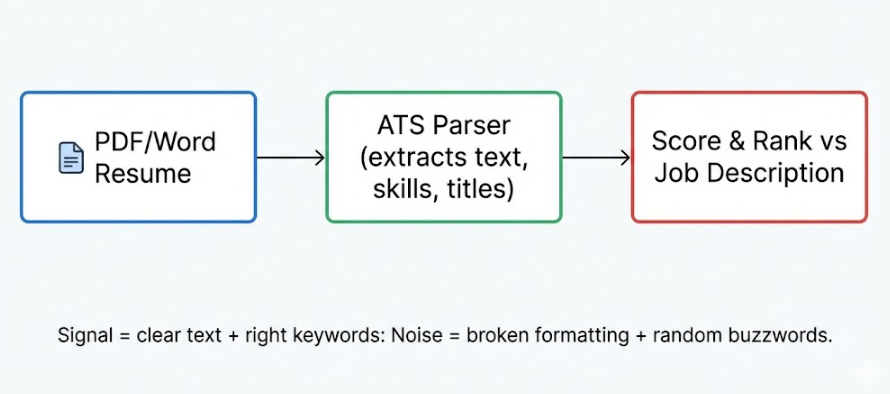
Your resume hits an Applicant Tracking System (ATS). The ATS parses your text into fields (title, skills, dates) and calculates a keyword match score against the job description. If the parsing breaks, you’re in the application black hole.
- If your resume formatting corrupts (tables, columns, graphics), the ATS may mis-read it.
- If the keyword match is low (<50–60%), you may never reach a human.
- AI-content flags (the pattern layer)
Some companies now use AI-detection tools for writing samples and cover letters. These look for statistical patterns: super-even sentence length, over-generic language, and low originality. Tools used in schools are slowly moving into hiring.
- Human pattern-matching (the judgment layer)
Recruiters won’t tell you this, but most “detection” happens in their heads:
- Does your writing sound like a real person in this role?
- Do your stories stay consistent from resume → take-home → interview?
- Do you break down projects at the level a genuine SWE / PM / Data person would?
AI Detection Tools – How They Work
AI detectors don’t “see” ChatGPT. They see probability patterns.
- They calculate how likely each word is, given the previous words.
- Human writing tends to have more spikes: odd phrases, personal details, uneven rhythm.
- AI writing tends to be smooth, polite, generic, and evenly structured.
Some tools also check similarity across many submissions. If a company receives 50 cover letters with almost the same phrasing, that’s a loud signal.
Important: These tools are not perfectly accurate. Research from multiple universities has shown high false-positive rates, particularly regarding how models handle facts versus beliefs, which can disadvantage non‑native English speakers. That’s why most employers treat them as a hint, then do manual review.
What Triggers Manual Review
Here’s what often makes a recruiter or hiring manager stop and look closer:
- Same tone everywhere: resume, cover letter, and take-home all read like a corporate blog post.
- Unnatural phrasing: “I am highly passionate about leveraging cross-functional stakeholder alignment to drive impact” on a junior role.
- Too-polished grammar from a candidate who then struggles with basic phrasing in the screen.
- Zero quantification: long smart-sounding sentences with no metrics, no scope, no tech detail.
While AI detectors get attention, most rejections still come from simple mismatch: your document doesn’t prove you can do the job at the level they need.
Signals That Look AI-Generated
When people ask me, “can jobs tell if you use ChatGPT?”, this is where I usually start. They don’t see the tool. They see the signals.
Generic Phrasing Patterns
Let’s look at a quick comparison.
Visual: Comparison table (AI-style vs human-style bullet)
| High-Noise (AI-style) | High-Signal (Human-style) |
| “Led cross-functional teams to deliver scalable solutions that drove business impact.” | “Led a squad of 6 (3 eng, 2 data, 1 design) to ship a recommendations API that lifted CTR by 11%.” |
| “I am passionate about innovation and continuous improvement.” | “I cut build times from 18 to 7 minutes by reworking our CI pipeline (GitHub Actions + Docker cache).” |
| “I thrive in fast-paced, dynamic environments.” | “I joined as engineer #5: we scaled from ~20 to 300 daily deploys in one year.” |
The bullets on the left scream “templated ChatGPT.” The bullets on the right show specific context, metrics, and tech stack, which is exactly what real hiring managers want.
Mismatch Between Resume and Interview
This is the biggest killer.
- On paper, you “architected an end‑to‑end data platform.”
- On Zoom, you can’t explain why you chose Snowflake vs BigQuery.
- Your resume claims “expertise in distributed systems,” but you struggle to define a quorum or talk about backpressure.
For international candidates on F‑1 OPT/CPT or H‑1B, this matters even more. Employers know they’re making a multi‑year bet, often with immigration cost and complexity. They check consistency harder.
Here’s the harsh truth: if your resume makes you look like a Staff Engineer, but your interview sounds like a new grad, you’ve burned trust. It’s not only about detection: it’s about reliability.
When I talk to recruiters, they say the same thing: “I don’t care if they used ChatGPT. I care if they can’t back up what’s on the page.”
How to Use ChatGPT Responsibly
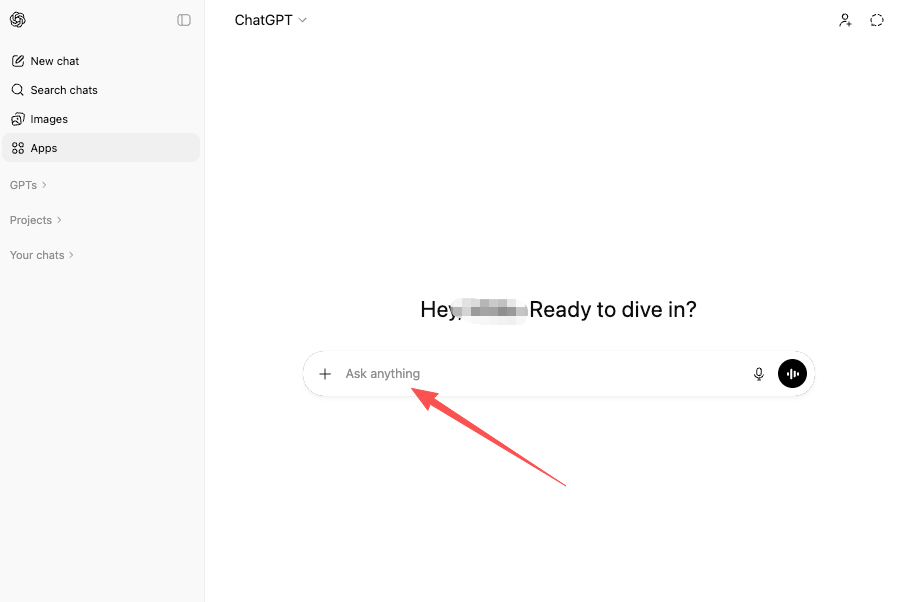
Now the part you actually need: how to use ChatGPT without tanking your chances.
Use It as Starting Point, Not Final Draft
Think of ChatGPT as an ATSoptimization engine and brainstorming partner, not as your ghostwriter.
High-ROI uses:
- Keyword alignment: paste a job description and your resume. Ask: “Show me a list of missing skills and keywords.” This can raise your keyword match from, say, 50% to 80%+, which is exactly what you need to beat most parsers.
- Structure cleanup: ask for a clear, simple layout that won’t break parsing (no columns, no text boxes, standard headings).
- Bullet formula: “impact-first” wording like: Action → Scope → Tool → Metric.
Low-ROI, stop-now uses:
- Asking ChatGPT to “write my whole resume from scratch.”
- Copy-pasting AI output directly into LinkedIn or applications with no edits.
- Letting it invent metrics or project ownership you never had.
This leads to a sharp drop in interview conversion rate because your story isn’t consistent anymore.
Add Specific Details Only You Know
This is where you beat the algorithm and protect your credibility.
After you get a first draft, go line by line and inject data only you can provide:
- Replace “improved performance” with “cut p95 latency from 900ms to 250ms by adding Redis caching.”
- Replace “worked with stakeholders” with “worked with 3 PMs across Pricing, Billing, and Growth to align on experiment guardrails.”
- Replace “supported data efforts” with “built a dbt model that fed 4 core revenue dashboards viewed daily by VP+.”
For salary and role calibration, cross-check your level using Levels.fyi data and, for US-based roles, compare with public wage data from the US Department of Labor and H‑1B disclosure data (LCA records). This gives you real numbers when you negotiate and stops you from guessing.
This mix, AI for structure and keyword match, you for truth and detail, is the highest-ROI strategy I’ve seen for tech resumes in 2025–2026.
The Real Risk – Trust, Not Detection
Let’s answer the question cleanly: can jobs tell if you use ChatGPT? Often, no. But they can tell when you break trust.
Why Authenticity Matters in Interviews
Interviewers in tech care about one thing above all: “Can I trust this person on my team?”
When your resume, portfolio, take-home assignment, and live interview feel like four different people, trust collapses. That’s when:
- They assume your take-home was over-assisted by AI or someone else.
- They worry you’ll hide behind tools when real problems appear in production.
- They hesitate to sponsor visas because the risk feels higher.
This connects to broader industry trends. Research covered by SHRM and Harvard Business Review has shown that as AI use expands in hiring, transparency and authenticity matter more than ever before.
Building a Consistent Story
Here’s a simple consistency framework you can follow:
Visual: Three-circle Venn diagram
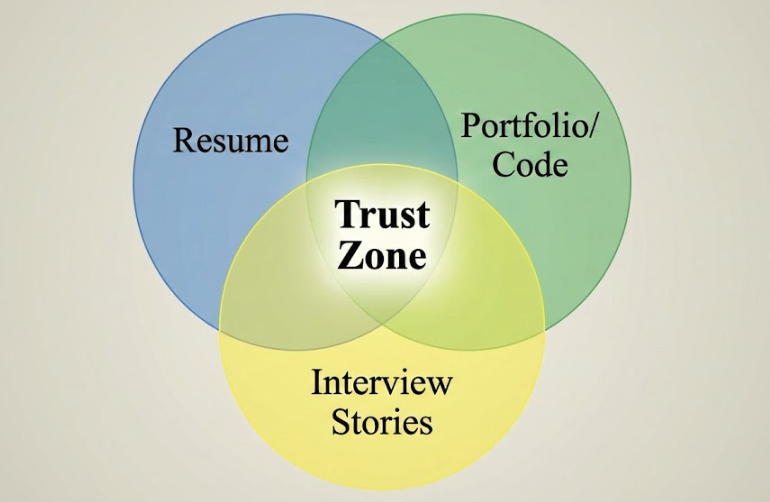
The overlap in the middle is your trust zone. The goal: maximize the overlap.
For each major project you list:
- Resume: one or two tight, quantified bullets.
- Portfolio / GitHub: actual code, diagrams, or write-ups that match those bullets.
- Interview: a clear breakdown, problem, constraints, your role, tradeoffs, metrics.
Recruiters won’t tell you this, but if they see that your code samples on GitHub or your system design write-up line up with your resume claims, their suspicion about AI drops fast. The risk isn’t “they caught me using ChatGPT.” The risk is “they don’t believe my story holds up.”
Prompts to Sound Like You
Let me give you concrete prompts you can paste into ChatGPT to train ChatGPT to write like you so your writing sounds more like you and less like a template.
Personalization Prompt
Use this when you’re drafting a resume bullet or short answer:
“I’m a [role, e.g., backend engineer] applying for [company] as a [target role]. Here’s my raw bullet/notes: [paste your messy notes]. Rewrite this in clear, simple language at a US 7th-grade reading level. Keep my specific metrics, tech stack, and scope. Do not add responsibilities I didn’t mention. Make it sound direct and grounded, not corporate.”
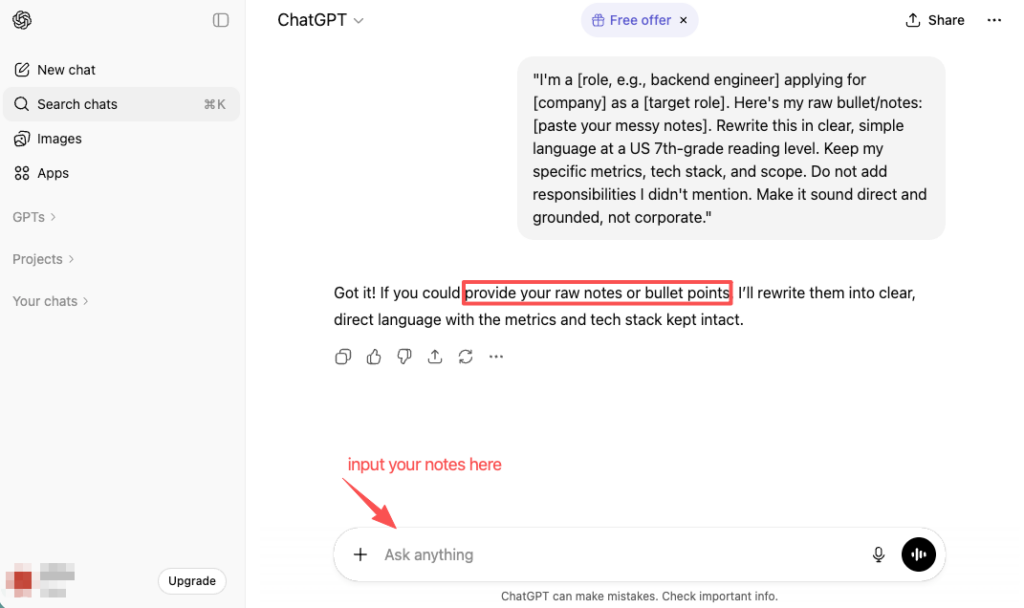
Then edit the result. Add any missing context. Strip out any vague phrases that sneak in.
Voice Matching Prompt
Now you align everything so your resume, LinkedIn, and cover letters sound like the same person:
- Copy a paragraph from a message you’d send a colleague (Slack, email, PR description).
- Use this prompt:
“Here is a sample of how I usually write at work: [paste sample]. Learn this style: sentence length, word choice, level of detail. Now I’ll paste a resume summary. Rewrite it to match my natural style. Keep all factual details, metrics, and tools. Avoid corporate clichés and vague claims.”
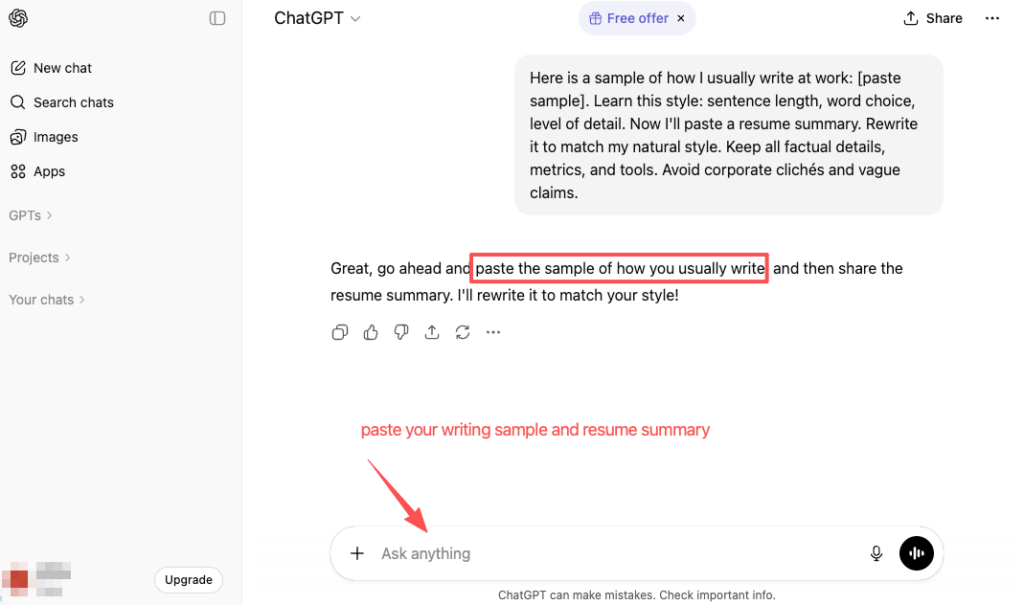
Finally, Action Challenge (do this today, not “someday”):
- Pick one target job description.
- Run your current resume through an ATS-style keyword checker (even a simple online tool).
Let’s use Jobright.ai to instantly scan our resumes against the job description—it helps us spot the missing keywords hiring managers actually look for.
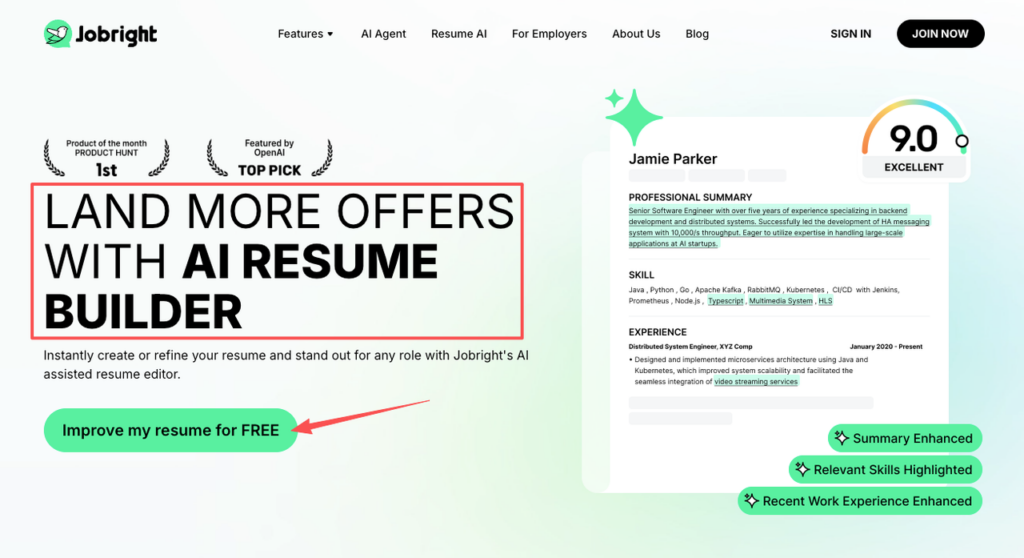
- Use ChatGPT with the prompts above to fix formatting issues and raise your keyword match for that one job to at least 80%, without inventing anything.
- Update one interview story so it matches that new resume bullet, with real numbers and tradeoffs.
Do this once, carefully. Then reuse the pattern. That’s how you escape the application black hole, by sending higher-signal, lower-noise applications that both the ATS and humans can trust.
Frequently Asked Questions
Can jobs tell if you use ChatGPT on your resume or cover letter?
Most jobs can’t directly prove you used ChatGPT, but they can pick up signals that your resume or answers are AI-shaped: overly generic phrases, perfectly polished yet vague writing, and claims you can’t explain in interviews. Detection is less about the tool and more about inconsistency and lack of concrete detail.
How do employers detect AI-generated content in job applications?
Employers combine three layers: ATS parsing and keyword scoring, AI-content detection tools that flag generic or highly probable text, and human judgment. Recruiters notice when tone is identical everywhere, phrasing sounds corporate and unnatural, and your technical depth or stories don’t match what’s written on your resume or in take-homes.
Is it safe to use ChatGPT to help with job applications?
It’s generally safe if you use ChatGPT as a helper, not a ghostwriter. Use it to improve structure, raise ATS keyword match, and clean up wording. Then manually add specific metrics, tech stack details, and real responsibilities. The risk comes when you copy outputs verbatim or let AI invent achievements you can’t back up.
What are the biggest red flags that make a resume look AI-generated?
Red flags include generic bullets like “drove business impact” without metrics, identical corporate tone across resume, LinkedIn, and take-homes, advanced-sounding claims you can’t explain in interviews, and zero role-specific detail. Hiring managers expect uneven, personal, metric-backed stories—not smooth, vague language that could apply to any candidate.
Will Applicant Tracking Systems (ATS) specifically detect if I used ChatGPT?
ATS tools mainly parse and score resumes against job descriptions; they don’t usually identify which ones were written with ChatGPT. What matters is clean formatting and relevant keywords. Problems arise when AI-generated text is stuffed with buzzwords, lacks real experience, or creates a mismatch between your profile and your actual skills.
Recommended Reads