
ChatGPT for Entry-Level Remote Jobs (No Experience Guide)
Table of Contents
Last Updated: Feb 10, 2026 Applicable to: 2026 hiring season
You spot a perfect “Junior” role. You click. Then you see it: “Requires 3-5 years of experience.” You close the tab, feeling like even the bottom rung of the ladder is out of reach.
Stop letting broken job descriptions dictate your worth.
I’m Dora, and I’ve spent years analyzing these patterns. I’m here to tell you that you don’t need to wait for permission to start working.
In this guide, I’ll show you how to bypass those impossible requirements by targeting remote, ChatGPT-adjacent jobs. We will focus on building undeniable proof in just 7 days and using specific prompts to translate your “irrelevant” background into job-ready signals that actually survive the ATS stress test.
What No Experience Really Means to Employers
Companies almost never mean “we don’t care what you’ve done” when they say no experience.
Here’s the harsh truth: they mean “no direct job titles, but you must still prove you can create value fast.” For remote roles, that’s even stronger because managers can’t watch you ramp up in person.
A 2025 Forbes breakdown of remote jobs hiring with no experience needed shows that many “no experience” roles still list 5–7 skill requirements and tools you must know. That’s the signal. Job titles are optional: capability is not.
Transferable Skills They Accept
When I talk to hiring managers in tech, they repeat the same pattern. For entry-level and “ChatGPT jobs remote no experience” roles, they’ll accept transfer from:
- School projects (CS, data, UX, PM capstones)
- Bootcamps / online courses (Coursera, Codecademy, etc.)
- Freelance or volunteer work (student clubs, NGOs, open-source)
FlexJobs surveys show that problem solving, communication, and self-management are top transferable skills for remote hires. For AI/ChatGPT-aligned roles, I see these three stand out:
- Prompt design & iteration – refining prompts to hit a goal metric.
- Documentation – clear written instructions, guidelines, FAQs.
- Light data work – cleaning data, tagging, basic analysis.
Recruiters won’t tell you this, but if you can show measurable impact (even from school), they stop caring that you haven’t held the title yet.
Proof Types That Replace Experience
Stop guessing. Let’s look at the data.
When I review early-career resumes, I see higher interview conversion rates (20–30% vs 5–10%) when candidates show at least two of these proof types:
- Portfolio projects – even small ones, but with metrics.
- Live demos or links – GitHub, Notion, personal site.
- Public artifacts – blog posts, Loom walkthroughs, short case studies.
- Course certificates with a project component (Coursera reports that learners with projects signal higher job readiness to employers).
Think of it as signal vs noise:
Titles are weak signals. Proof is a strong signal the ATS and the human can both parse.
ChatGPT Prompts for Entry-Level Job Search
While everyone else types “Write my resume” into ChatGPT and sends the result into the application black hole, you’re going to use it as a strategy tool, not a copy-paste machine.
Skill Translation Prompt (School/Volunteer to Work)
Most international and early-career candidates tell me, “I have no experience.” Then I look at their background and see 10+ projects hiding.
Here’s a prompt I use to translate that into ATS-friendly language:
Prompt: “I am applying for an entry-level remote role as [job title] that requires: [paste job description].
Here is my background:
- Courses: [list key courses / bootcamps]
- Projects: [1–3 short project descriptions]
- Volunteer work: [relevant examples].
- Extract the top 15 skills and keywords from the job description.
- Map each of my projects/experiences to those skills.
- Rewrite my bullets in simple resume language with metrics where possible.
- Keep bullets short and clear so they parse cleanly in ATS.”
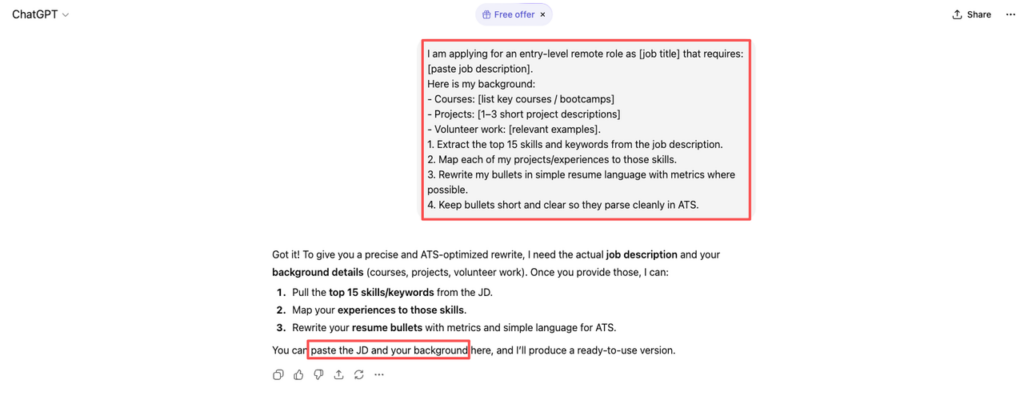
Then you copy the bullets, edit them in your voice, and check keyword match with a resume scanner. Aim for 80%+ keyword match without lying.
Entry-Level Role Finder Prompt
Remote roles with no experience are often titled in confusing ways. Instead of searching “remote ChatGPT job,” use ChatGPT prompts that supercharge your job search to decode the market first.
Prompt: “I am looking for remote, entry-level roles that:
- Involve using ChatGPT or other AI tools.
- Are suitable for someone with no formal work experience but some projects.
- Allow international candidates / mention visa sponsorship (if possible).
Based on current 2026 trends, list 10 real job titles I should search for on job boards.
For each title, give:
- Common alternative titles
- 5 must-have skills
- 3 recommended portfolio project ideas.”
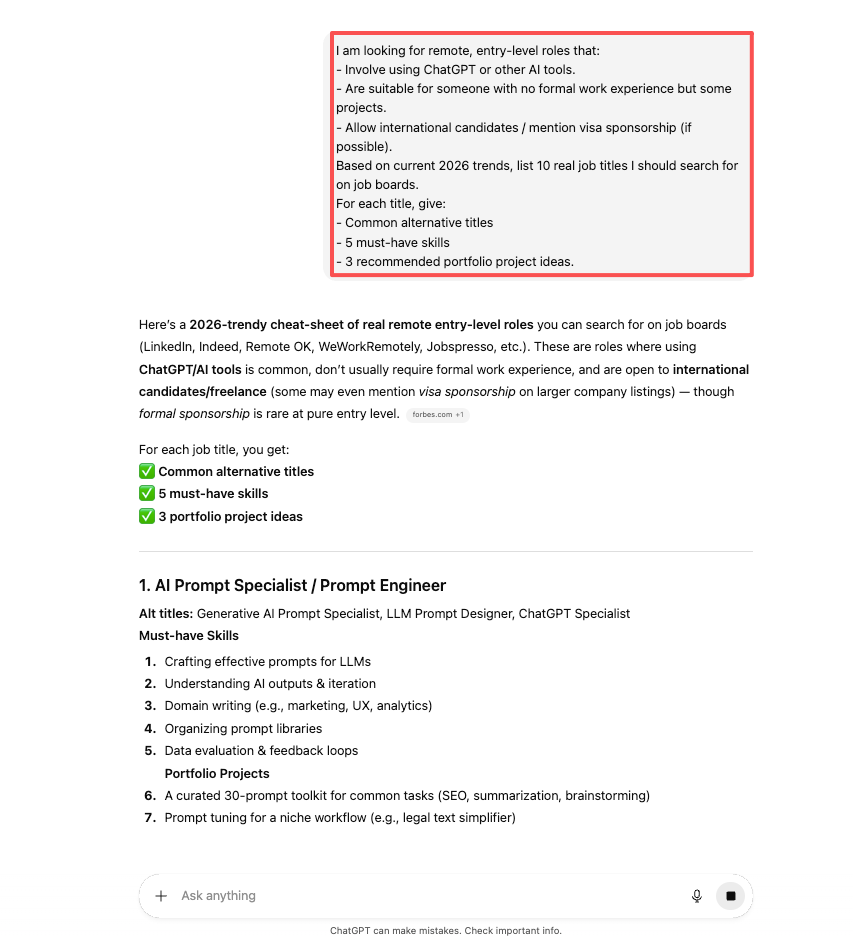
Cross-check what you get with live listings on LinkedIn, RemoteOK, and company career pages. This turns noise (random job posts) into a targeted search strategy aligned with real demand.
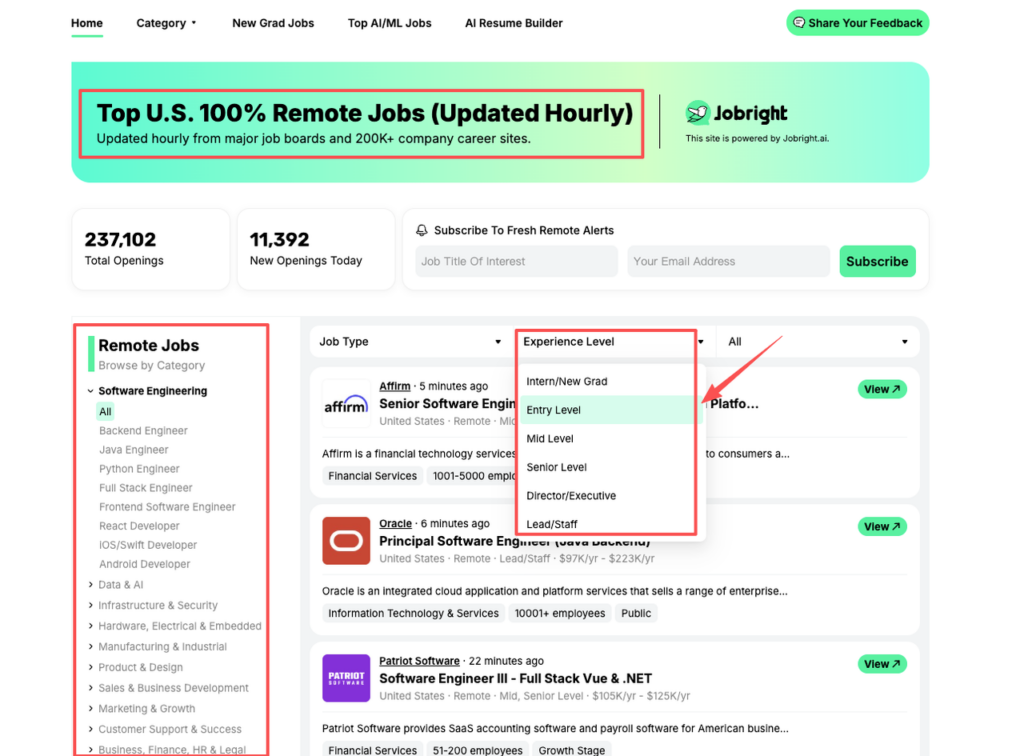
To skip the manual digging and potential scams, we recommend plugging those target titles directly into our AI-powered remote job board to instantly surface verified opportunities.
Build Proof Without a Job (7-Day Plan)
You don’t need a job to create job-level proof. You need a system.
Below is a simple 7-day sprint I use with candidates who want “chatgpt jobs remote no experience” but have zero portfolio.
Visual: 7-Day Proof Sprint Table
| Day | Focus Area | Action Step | The Artifact (Output) |
| Day 1 | Workflow Demo | Record a screen video showing how you use ChatGPT to rewrite messy emails or summarize technical articles. | Loom/Video Link (2-3 mins) |
| Day 2 | Prompt Library | Curate 10–15 specific prompts for a niche (e.g., “SQL Debugging” or “Customer Empathy”). Save them in a clean doc. | Notion Page / Google Doc |
| Day 3 | Micro Case Study | Write a short breakdown: “Problem $\rightarrow$ My Prompt Sequence $\rightarrow$ Outcome.” Quantify time saved. | Short PDF or Blog Post |
| Day 4 | Support Ops | Simulate 20 customer tickets. Use AI to draft replies, auto-tag issues, and generate a FAQ. | FAQ Doc + Process Log |
| Day 5 | Documentation | Pick an open-source tool. Use AI to generate a “Quick Start Guide” or simplify their technical docs. | User Guide / Wiki Entry |
| Day 6 | Data Analysis | Take a public dataset (e.g., Kaggle). Use AI to write SQL queries and summarize key findings. | Mini Report / Notebook |
| Day 7 | Polish & Launch | Consolidate all the above assets into one central hub. Add this link to your resume header. | Portfolio URL (GitHub/Web) |
Day 1-3: Portfolio Starter Ideas
Days 1–3, your only goal is to create small, shippable artifacts:
Day 1 – ChatGPTWorkflow Demo
Create a simple Loom video where you show how you use ChatGPT to:
- Rewrite a messy email into clear language.
- Generate test cases from a user story.
- Summarize a technical article from the Google Engineering blog.
Upload the video, write a 4–5 line description.
Day 2 – Prompt Library
Build a Notion or Google Doc with 10–15 prompts you use for:
- Bug triage, ticket grooming (for SWE/PM).
- Data cleaning, SQL query drafting (for data).
- UX copy ideas and user interview questions (for UX).
This becomes a shareable artifact in your resume.
Day 3 – Micro Case Study
Take one problem (e.g., turning a messy spec into user stories) and write:
- Problem
- Your ChatGPT prompt sequence
- Outcome and time saved (estimate in minutes or hours)
Even without an employer, you’ve now quantified impact.
Day 4-7: Mini-Project Examples
Coursera’s 2025 guidance on getting a job with no experience is clear: projects that tie to real workflows convert better than generic practice tasks.
Day 4 – Support / Operations Mini-Project
Create a fake inbox of 20 customer emails (you can ask ChatGPT to generate them). Use ChatGPT to:
- Draft responses.
- Tag and classify issues.
- Create a FAQ document.
Document: “Handled 20 tickets, auto-tagged 5 categories, built 1 FAQ.”
Day 5 – Content / Documentation Mini-Project
Pick a public API or open-source tool. Use ChatGPT to:
- Generate quick-start docs.
- Suggest examples.
- Rewrite for non-technical users.
Now you have a documentation sample for remote content or knowledge-base roles.
Day 6 – Data / Analysis Mini-Project
Grab a public dataset (Kaggle or government open data). Use ChatGPT to:
- Brainstorm questions.
- Draft SQL or Python snippets.
- Summarize findings for a non-technical manager.
Output: short notebook + 1-page summary.
Day 7 – Polish & Publish
Put everything into a simple portfolio: GitHub, Notion, or a basic site.
Link this in your resume header as “Selected AI / ChatGPT Projects”.
Now your applications carry signal, not just a list of tools.
Entry-Level Remote Job Categories
Not every remote job labeled “no experience” is safe. Some hide sales quotas, unpaid trials, or scam behavior. FlexJobs reports a spike in remote job scams since 2023, especially in “assistant” and “data entry” roles.
Roles with Lowest Barriers
For 2026, I see consistent openings in roles where ChatGPT is built into the workflow:
- AI Content Assistant / Content Specialist (junior) Draft blog posts, help center articles, FAQs with AI.
- Customer Support / Success Associate (remote) Use ChatGPT to draft replies, build macros, update documentation.
- Operations or RevOps Assistant Build SOPs, clean data in CRMs, create reports with AI help.
- Junior Prompt / AI Workflow Designer Internal role where you design prompt templates for teams.
These roles often care more about clear writing + basic tooling than deep experience.
Roles to Avoid (Hidden Requirements)
Here’s the harsh truth: some “no experience” remote roles have a 15–20% lower conversion rate to real interviews because they hide:
- Mandatory local presence or citizenship (problem for visa-dependent candidates).
- Heavy outbound sales expectations with commission-only pay.
- Upfront “training” fees (major red flag).
Recruiters won’t tell you this, but you should be skeptical of:
- “Crypto project assistant” with no company info.
- “Remote data entry” that asks for bank details early.
- “ChatGPT side hustle coach” charging a fee.
Cross-check companies on LinkedIn, Glassdoor, and scam alert lists. For international candidates, confirm sponsorship history in the USCIS H-1B data or Labor Condition Application databases before investing serious time.
Application Strategy for Beginners
Most beginners default to volume: 50+ low-quality applications a week. Data from job search platforms and labor market research shows this leads to low ROI and burnout.
Instead of burning out on volume, we use Jobright.ai to pre-filter high-match roles and focus our energy on applications that actually convert.
Quality vs Volume – What Works
Think of your applications as experiments. You want a higher conversion rate, not just bigger numbers.
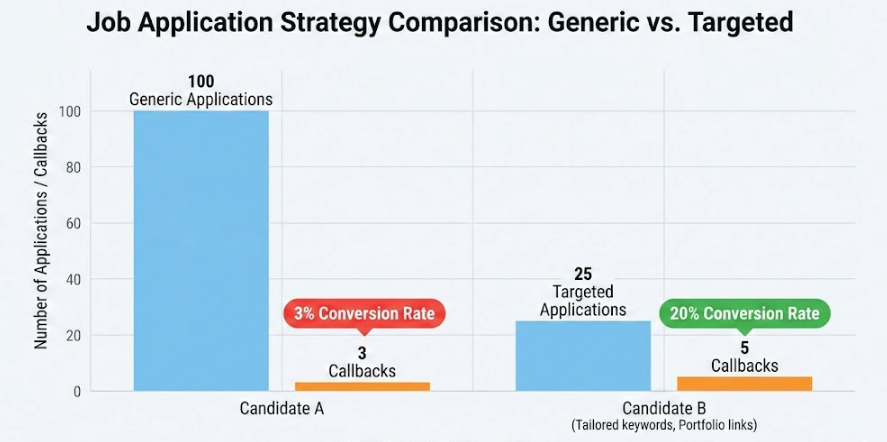
Same time spent: B wins on signal.
My baseline strategy:
- 5–7 high-quality applications per weekday.
- Each one:
- Resume tuned with the Skill Translation Prompt.
- 80%+ keyword match in an ATS scanner.
- 1–2 relevant portfolio links.
For international candidates, add a filter: companies with clear remote policies and past visa sponsorship, checked via USCIS records or trusted databases.
Cover Letter Tips for No Experience
Cover letters still matter for “chatgpt jobs remote no experience” because they can explain your proof.
Simple structure I use:
- Opening: One sentence that mirrors their problem.
- “You need someone who can turn messy customer questions into fast, helpful answers using AI.”
- Evidence paragraph: 2–3 lines tying a mini-project to that problem.
- Mention your 7-day sprint work and metrics.
- Fit paragraph: 2–3 lines stating tools you know (ChatGPT, docs tools, CRM, basic SQL, etc.).
- Close: Clear call to action.
- “If you’d like, I can walk you through a 5-minute demo of how I handled 20+ support tickets with AI in a single afternoon.”
Keep it short, scannable, and free of formatting noise so both the algorithm and the human can parse it.
Action Challenge (Do This Today):
Before you send another application, do this 30-minute reset:
- Use the Entry-Level Role Finder Prompt and list 10 target job titles.
- Pick one role. Run the Skill Translation Prompt on your resume for that role.
- Build one mini-project (Day 1 or Day 4 style) and link it.
Once you see your responses grow from zero to even one or two callbacks, you’ll know your signal is cutting through the noise, and that’s when the real momentum starts.
Frequently Asked Questions
What does “no experience” really mean for ChatGPT remote jobs?
For most “chatgpt jobs remote no experience” listings, employers mean no prior job title, not no skills. They still expect you to show you can create value quickly—usually with proof like projects, demos, or documentation that demonstrate prompt use, clear writing, and basic data or workflow skills.
How can I get a ChatGPT remote job with no experience in 7 days?
Use a 7-day proof sprint: record a ChatGPT workflow demo, build a small prompt library, and write a micro case study. Then add a support, content, or data mini-project and publish everything in a simple portfolio. Link these assets in your resume and applications to replace formal experience.
What types of remote entry-level roles use ChatGPT the most?
Common 2026 entry-level roles include AI content assistant, customer support or success associate, operations or RevOps assistant, and junior prompt or AI workflow designer. These roles rely heavily on ChatGPT for drafting content, handling tickets, documenting processes, and standardizing prompts, and typically value communication and self-management over long experience. According to FlexJobs’ remote work economy research, remote hiring continues to grow in these categories.
How should I apply for ChatGPT jobs remote no experience without getting ignored by ATS?
Treat each application as an experiment, not a numbers game. Use a Skill Translation Prompt in ChatGPT to map your courses and projects to job keywords, then aim for 80%+ keyword match in an ATS scanner. Send 5–7 tailored applications per weekday, each with at least one relevant portfolio link.
What skills should I focus on to be competitive for ChatGPT remote jobs?
Focus on three areas: prompt design and iteration (getting reliable outputs from ChatGPT), strong written communication and documentation, and light data skills such as cleaning, tagging, or basic analysis. Pair these with self-management and reliability, which are critical for remote work and often highlighted in hiring surveys. Research from Stanford’s Digital Economy Lab shows these skills align with emerging AI-augmented roles.
Recommended Reads