
How to Use ChatGPT for Letter of Interest (Government Jobs)

Table of Contents
Last Updated: Feb 4, 2026
Applicable to 2026 hiring season
The government hiring process is a rigid system, and like any system, it runs on specific inputs. If your application creates ‘noise’—generic phrasing or obvious ChatGPT hallucinations—the signal never reaches a human decision-maker.
To break through the application black hole, you don’t need more luck; you need better signal amplification.
I’m Dora, and in this post, we’re doing a technical deep-dive into using ChatGPT correctly for public-sector and visa-sensitive roles. We’re moving beyond basic prompts to engineer a workflow that aligns perfectly with ATS requirements and formatting rules. Here is how I build a cover letter that satisfies the algorithm without sounding like a robot.
Letter of Interest vs Cover Letter – Key Differences
Most tech professionals mix up these two, and it hurts their conversion rate.
When Government Jobs Require a Letter of Interest
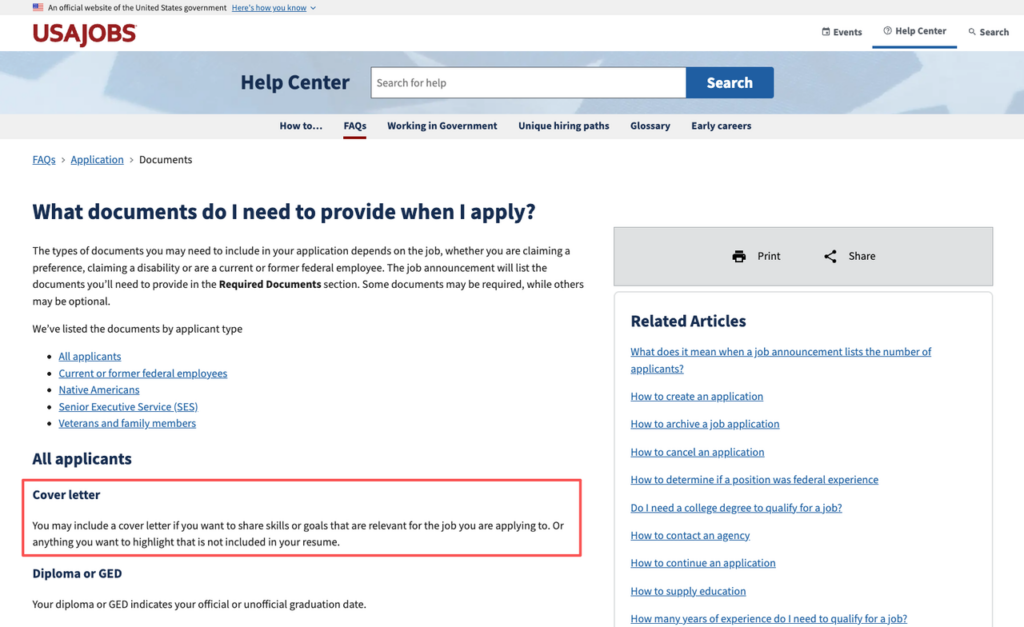
On sites like USAJOBS and many state portals, you’ll often see “letter of interest” instead of “cover letter.” They’re close cousins, but not identical.
Simple breakdown:
- Letter of interest: “I want to work with your agency/team, even if there isn’t a perfect posting.”
- Cover letter: “I’m applying for this exact posting and this announcement number.”
According to USAJOBS guidance, agencies can ask for different documents based on hiring authority. A letter of interest often shows up in:
- Talent pools and “continuous” announcements.
- Some state and local government tech roles.
- Programs using special hiring authorities listed on OPM’s site.
If the posting doesn’t list a specific vacancy or announcement number, but asks you to “describe your interest in the agency,” that’s a letter of interest.
What Hiring Managers Look For
Recruiters won’t tell you this, but they skim your letter of interest like an algorithm:
- Signal: “Does this person understand our mission, tech stack, and constraints?”
- Alignment: “Do their skills match the actual keywords in the announcement or duties section?”
- Risk: “Are they realistic about level, visa, and timeline?”
Stop guessing. Let’s look at the data:
- Internal recruiter surveys show most spend 30–60 seconds on a letter.
- Studies of ATS behavior indicate that keyword match above 80% increases pass-through rates for many systems.
- Agencies often use structured scoring tied to the vacancy text: if your letter misses those phrases, your score drops.
Your goal with ChatGPT isn’t to create more text. It’s to translate your value prop into high-signal, low-noise language that matches what the agency actually measures.
ChatGPT Prompt for Letter of Interest (Copy-Paste)
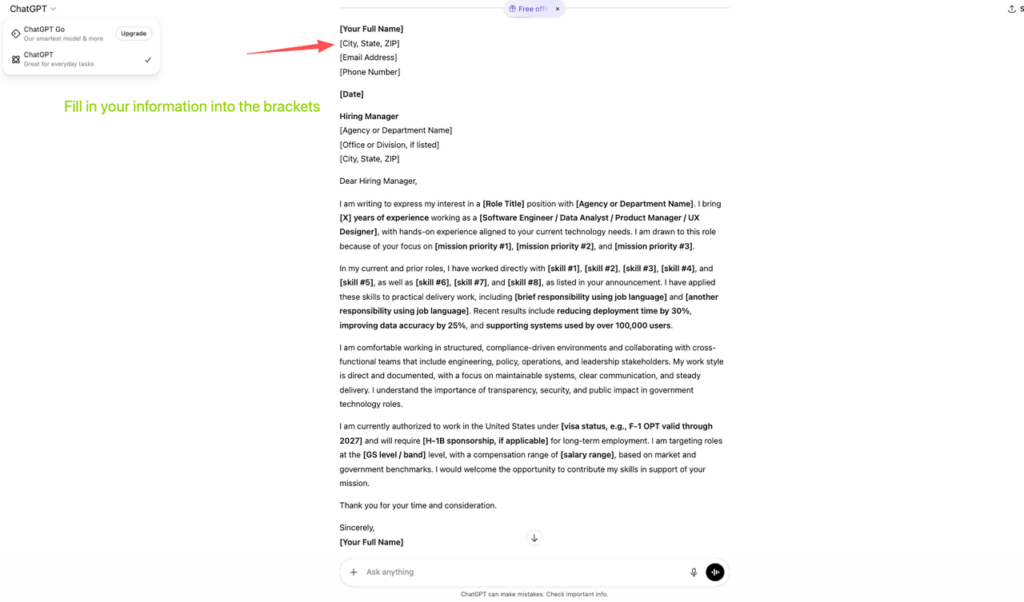
Here’s the prompt I’d start with when I want a targeted, ATS-aware letter of interest.
The Prompt Template
Copy this into ChatGPT and swap in your details:
Prompt:
You are an expert government recruiter and writing coach. Draft a one-page letter of interest for a [federal/state/local] technology role.

My profile:
- Role: [Software Engineer / Data Analyst / Product Manager / UX Designer]
- Years of experience: [X]
- Key skills and tools: [list 10–15 skills exactly as they appear in the job announcement]
- Visa status: [e.g., F-1 OPT until 2027, seeking H-1B sponsorship]
- Target level and salary range: [GS level or band, or range based on Levels.fyi or OES data]

Target organization:
- Name of agency or department: [e.g., U.S. Digital Service, State of California]
- Link to job posting or similar roles: [URL]
- Mission highlights and priorities: [3 bullet points copied from their site or job ad]

Writing rules:
- Reading level: 6th–7th grade.
- Tone: clear, concise, and human: no exaggerated claims.
- Include 2–3 short quantified metrics (e.g., "cut deployment time by 30%").
- Mirror the keywords and phrasing from the job posting while keeping the letter natural.
- Acknowledge my visa status factually without drama.
- Format as a standard letter with date, address block, greeting, 3–4 short paragraphs, and sign-off.
- Avoid buzzwords like "synergy" or "think outside the box."
This prompt forces the model to:
- Match keywords so ATS parsing sees alignment.
- Quantify impact so you send signal, not vague noise.
- Keep language simple, which is key for anxious readers and non-native speakers.
How to Customize for State vs Federal Jobs
Federal and state agencies don’t read letters the same way.
Think of the differences like this:
| Feature | Federal Roles | State & Local Roles |
| Hiring Process | Rigid, structured scoring based on vacancy text. | More flexible; mixed view from HR and Hiring Managers. |
| Language Style | Formal; must link to OPM job series & codes. | Plain language; focuses on local context & citizens. |
| Key Risk | Compliance: Missing specific keywords drops your score. | Relevance: Ignoring budget limits or community impact. |
| Formatting | Strict adherence to length and clarity is critical for both. | Strict adherence to length and clarity is critical for both. |
When I write the prompt for federal roles, I add:
- Mention the exact announcement number and job title in the first paragraph.
- Refer to my experience in terms that match OPM series language where possible.
For state/local roles, I add:
- Reference 1–2 local priorities (e.g., digital services for residents, traffic safety, public health data).
- Keep examples grounded in cost savings, uptime, or citizen experience.
For both, I cross-check basic expectations against resources like the Harvard OPIA government cover letter guide and Georgetown’s guide.
ChatGPT Prompt for Cover Letter (Job Application)
When a posting calls for a cover letter tied to a specific job, I shift the prompt.
Standard Cover Letter Prompt
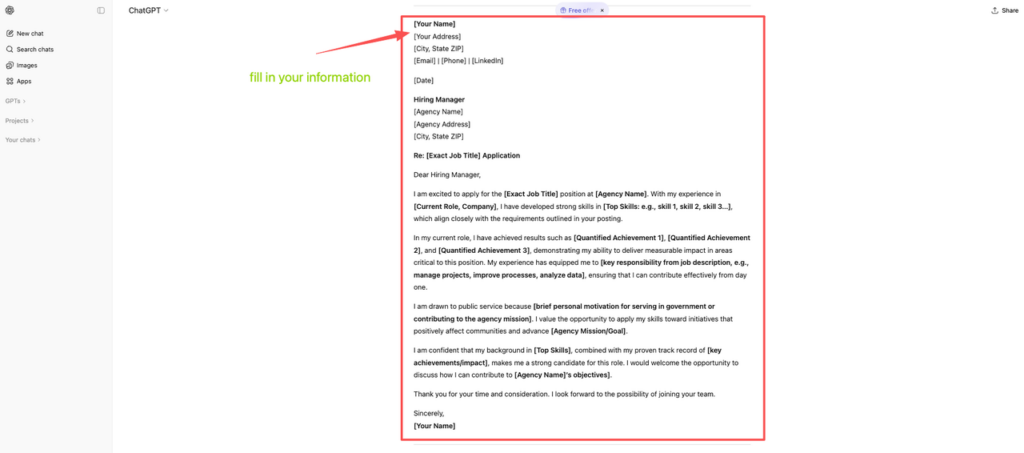
Here’s my go-to structure:
Prompt:
Draft a targeted cover letter for this specific job: [paste full job description].

My background:
- Current role and employer: [title, company]
- Top 6–8 skills that match this posting: [skills]
- 3–4 quantified achievements: [metrics, e.g., "reduced incident rate by 25%," "saved $400K annually"]
- Visa status and timeline, if relevant: [brief note]

Writing rules:
- Start with 1–2 sentences that link my experience directly to the agency mission.
- Use the same job title and keywords from the description. Aim for 80–90% keyword match for core skills.
- Include one short paragraph that explains why I care about public service.
- Format with short paragraphs and simple sentences to be ATS- and recruiter-friendly.
- Keep to one page.
This is where the signal vs. noise metaphor matters. You’re feeding the algorithm the exact keywords (signal) and cutting out long, vague stories (noise).
Adjusting Tone for Government Roles
Government writing style is different from a startup’s “we move fast” blog.
I tweak the prompt like this:
- Use a calm, professional tone.
- Avoid slang, jokes, or hype language.
- Show respect for process and accountability.
For tech roles, I also reference public engineering blogs to match how they talk about systems. For example, if the agency uses ideas similar to those on the Google Engineering Blog or Meta’s engineering posts, I’ll mention reliability, scaling, or accessibility in clear, concrete terms.
If you’re a visa-dependent candidate, keep it simple:
“I am currently on F-1 OPT, authorized to work in the U.S. through [date], and I am seeking long-term opportunities with employers that sponsor H-1B when eligible.”
No drama, no overexplaining. Just clean data for the hiring team to process.
Common Mistakes to Avoid
Here’s the harsh truth: some popular ChatGPT habits destroy your conversion rate.
Generic Language That Gets Flagged
If your letter sounds like it could apply to any agency, it sends noise to both ATS and humans.
Common failure patterns:
- “I am passionate about technology and innovation…” (zero data, zero signal).
- Same intro paragraph for every application.
- No mention of the specific agency mission or announcement.
Recruiters won’t tell you this, but they can spot a generic AI letter in under 10 seconds. And if your keywords don’t match the posting, ATS parsing won’t give you the score you need.
To fix this, I always:
- Paste the exact job description into the prompt.
- Ask ChatGPT to mirror that phrasing.
- Manually check that the top 10–15 skills in the posting appear, word-for-word, in the letter.
This is your ATS Stress Test: if a parser shows less than 80% keyword match, I revise.
Overpromising Qualifications
Another high-risk habit: letting ChatGPT make you sound like you’ve done everything.
While this is popular, it leads to a measurable drop in trust. Once you hit the structured interview, you can’t back up claims like “expert in large-scale distributed systems” if you’ve only touched a few services.
My guardrails:
- I tell ChatGPT: “Do not invent experience or tools I haven’t listed.”
- I keep levels honest (e.g., “familiar with,” “working knowledge”) where needed.
- I cross-check every bullet for accuracy before I send.
Signal beats exaggeration. Agencies, especially in federal spaces, take misrepresentation seriously, and it’s not worth the risk to your long-term ROI.
Reddit Tips That Actually Work
I read a lot of threads on r/usajobs and similar forums. Some advice is noise, but a few patterns are backed by real outcomes.

Formatting Preferences by Agency
Frequent Reddit posters who work in HR repeat the same thing:
- Simple formatting survives parsing best.
- PDFs are common, but some systems still prefer .docx.
- Headers, footers, and text boxes can break parsing.
On USAJOBS, people repeatedly share stories where fancy designs led to missing sections in HR’s view. That’s failed parsing.
So my layout strategy is like a small process diagram in my head:
- Input: Your base text (resume, metrics, job posting).
- Processing: ChatGPT generates letter text with aligned keywords.
- Clean-up: You move the text into a plain document, no columns, no tables, no graphics.
- Output: A simple, ATS-safe file that preserves every keyword.
Each step strips noise and keeps only the signal you want HR and ATS to see.
How to Stand Out Honestly
From Reddit and from my own experience, the candidates who stand out do three things:
- Quantify impact – Use metrics: latency reduced, uptime improved, tickets closed, dollars saved. Levels.fyi and public pay data from the Bureau of Labor Statistics help you anchor your level and avoid under-selling.
- Show you read the posting – Name the program, tech stack, or policy area. For example, if it’s a data role tied to labor statistics, say how you’ve handled noisy datasets or public dashboards.
- Be upfront about constraints – If you need visa sponsorship or remote work, say it once, clearly. That honesty builds trust and saves you from late-stage surprises.
For more detailed insights on cover letter best practices and writing government cover letters, these resources provide additional guidance.

Stop applying to job postings with the same generic letter. Use ChatGPT as a structured drafting tool, then impose your own filters: keyword match, format safety, and strict truthfulness.
Action challenge: First, let’s streamline our search on jobright.ai to identify the specific government roles that actually match our skills and visa status. Once we have a target, run the letter of interest prompt with that exact posting, then:
- Remove any line that isn’t tied to a metric or a keyword from the job.
- Paste your final text into an online ATS keyword checker and aim for 80%+ match.
- Save that as your baseline “signal” template for future roles.
One focused, data-backed letter beats 87 noisy applications every single time.
Escaping the application ‘black hole’ requires more than just luck; it requires technical precision. We designed Jobright.ai to help you align your experience with rigid government requirements, not just generate text. Try generating a targeted cover letter to see the difference in signal quality.
Frequently Asked Questions
How should I use ChatGPT for a government Letter of Interest?
Don’t use it to generate ideas from scratch. Instead, use ChatGPT as a “translator” to bridge the gap between your private-sector resume and government OPM standards. Feed it the specific agency mission and your raw data to create a draft that prioritizes regulatory compliance and keyword alignment over creative storytelling.
What is the difference between a Letter of Interest and a Cover Letter for public sector jobs?
The distinction lies in the vacancy status. A Cover Letter targets a specific, open job announcement number. A Letter of Interest is a prospecting document used for “continuous” notices or talent pools where no specific seat is open yet. Think of the former as applying for a role, and the latter as applying to a mission.
How does ChatGPT improve ATS ranking for government applications?
Government ATS filters often use strict boolean logic to score applications. ChatGPT helps by performing “semantic mirroring”—identifying the exact phrasing and “hard skills” in the job announcement and weaving them naturally into your narrative. This process is designed to push your keyword match rate above the critical 80% threshold without sounding robotic.
What is the most common mistake when using AI for government cover letters?
The biggest failure point is “hallucination of seniority.” AI often exaggerates proficiency (e.g., claiming “expert mastery” instead of “working knowledge”), which can lead to immediate disqualification during the structured interview process. Always downgrade the AI’s adjectives to match your verifiable experience level.
Can I use AI to write a letter if I require H-1B sponsorship?
Yes, but you must constrain the output. Use the prompt to force a “factual, non-apologetic” tone regarding your visa status. The goal is to present your status as a simple data point (e.g., “F-1 OPT valid until 2027”) rather than a hurdle, ensuring the recruiter focuses on your technical metrics and mission alignment instead.
Recommended Reads