
ChatGPT for Remote Jobs: How to Find Work-From-Home Roles (2026)
Table of Contents
You found the perfect job listing, you met 100% of the requirements, and you hit ‘Apply’ with confidence… and then, absolute silence.
Sound familiar?
Hi, I’m Dora. If you are tired of shouting into the void, stop applying to job postings the same old way. Here is why, and how we are going to use ChatGPT to supercharge your job search.
Right now, remote and hybrid roles are still alive, but more targeted. FlexJobs’ January 2026 report on the top 100 companies for remote jobs (covered by CNBC’s analysis of top companies hiring for hybrid and remote jobs) shows thousands of remote and hybrid listings, but conversion rates are low because most candidates spray and pray.
Here’s the harsh truth: if your search terms, resume parsing, and ATS keyword match are noisy, your application falls into the application black hole before a human ever sees it.
In this guide, I’ll show you how I’d use ChatGPT, real job boards, and simple data to:
- Search smarter for remote jobs.
- Avoid remote job scams.
- Optimize your resume for remote hiring and ATS.
- Spot visa-friendly employers if you need sponsorship.
How to Search for Remote Jobs with ChatGPT
Most people type “remote jobs” once, scroll, then give up. That’s noise. You need a search strategy that ChatGPT can help you design and refine.
Keywords That Work (Remote vs WFH vs Hybrid)
Different companies describe the same thing with different words. If you only search “remote,” you’ll miss a chunk of real openings.
From scanning multiple 2025–2026 job feeds (including Jobright and FlexJobs data via CNBC), I see four common patterns in titles and filters:
- Remote
- Work From Home (WFH)
- Hybrid
- Distributed / Fully Distributed
Here’s a simple keyword matrix you can “feed” into ChatGPT:
| Goal | Keywords | Where to Use |
| Fully remote | “remote”, “fully remote”, “work from anywhere” | LinkedIn/Indeed search bar, ChatGPT prompts |
| Hybrid but remote-first | “hybrid”, “remote eligible”, “2-3 days onsite” | Company career pages, ChatGPT company-policy prompts |
| US remote, open to H-1B | “H-1B sponsorship”, “visa sponsorship”, “global remote” | LCA databases, company job sites |
Here’s a simple keyword matrix you can “feed” into ChatGPT:
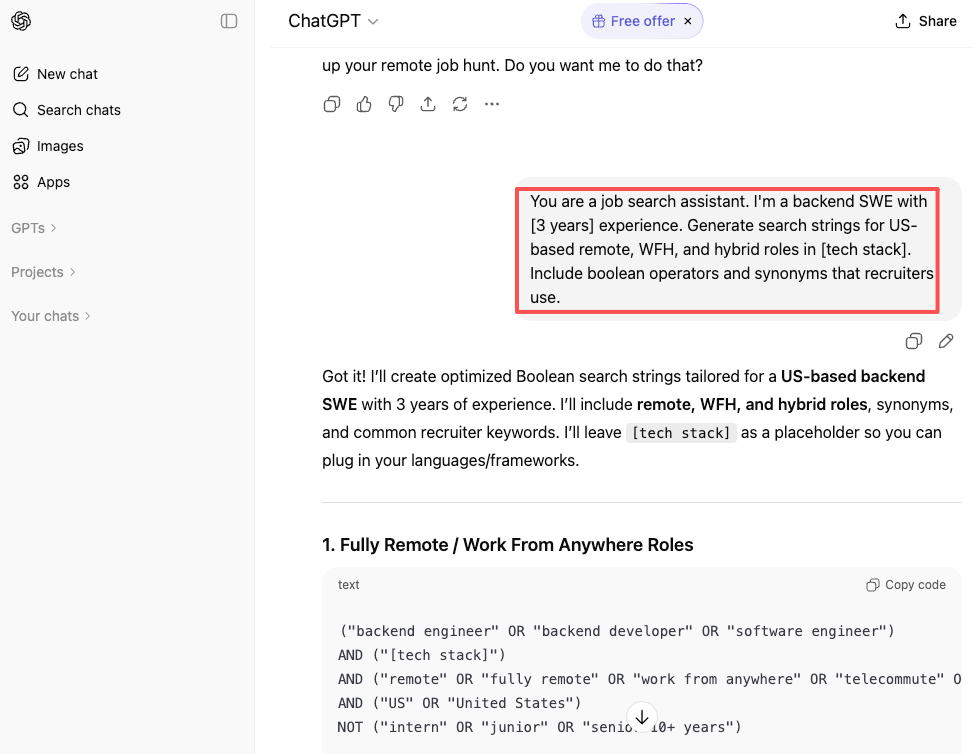
You can give ChatGPT a prompt like:
“You are a job search assistant. I’m a [role: e.g., backend SWE] with [X years] experience. Generate search strings for US-based remote, WFH, and hybrid roles in [tech stack]. Include boolean operators and synonyms that recruiters use.”
This turns your vague “remote jobs” search into a targeted signal the job boards and ATS algorithms can interpret.
Timezone and Location Filters
Remote does not mean “anywhere” anymore. Recruiters won’t tell you this, but many “remote” jobs are timezone-bounded or country-locked for tax and legal reasons.
Recent 2026 listings on Jobright and LinkedIn show patterns like:
- “Remote – US only”
- “Remote – must be within ±3 hours of PST”
- “Remote – India only”
If you need US sponsorship (H-1B, OPT, CPT), you must align your search with employers that:
- Hire in the US.
- Appear in H-1B disclosure data from the USCIS H-1B Employer Data Hub or DOL’s foreign labor performance data.
Try this ChatGPT prompt:
“I’m a [role] based in [country], targeting remote or hybrid roles for US companies that have filed H-1B in the past 3 years. Use public DOL/USCIS data as a guide and output: 20 target companies + typical job titles I should search + common timezone notes from job descriptions.”
Stop guessing. Let the data shape your target list. Then plug those titles and companies into Jobright, LinkedIn, and company job boards.
ChatGPT Prompts for Remote Job Search
Now let’s turn ChatGPT into a remote job targeting engine instead of a quote generator.
Remote Role Discovery Prompt
Most tech pros chase the same 3 titles: “Software Engineer,” “Data Analyst,” “Product Manager.” That raises competition and lowers conversion rate.
Here’s the harsh truth: if you only search generic titles, you’re fighting thousands of applicants for each role.
Use this discovery prompt to surface adjacent roles with better ROI:
“I’m a [role] with [skills: e.g., Python, SQL, React, Figma]. My top 5 strengths: [list]. Generate 15 remote-friendly job titles I’m qualified for, grouped by: (1) individual contributor, (2) lead/IC+, (3) contract/freelance. For each title, give sample responsibilities and the 5 most important keywords for ATS optimization.”
Why this works:
- You get a keyword list you can paste into your resume and job board searches.
- You uncover roles like “Data Product Analyst,” “Developer Relations Engineer,” “Technical Program Specialist” that often have fewer applicants.
Company Remote Policy Research Prompt
Remote policy confusion kills time. You apply, get to final rounds, then learn it’s “3 days in-office in a city you don’t live in.”
Instead, ask ChatGPT to centralize public info. According to Forbes’ expert predictions on remote and hybrid jobs in 2026, policies are shifting, so verification is critical:
“Research the current (2025–2026) remote and hybrid work policies for [Company A], [Company B], [Company C]. Use recent company blog posts, engineering blogs (e.g., Google/Meta), press releases, and reputable news like Forbes or CNBC. Summarize in a table: office expectations, eligible locations, visa sponsorship signals, and whether teams are distributed.”
Then you compare:
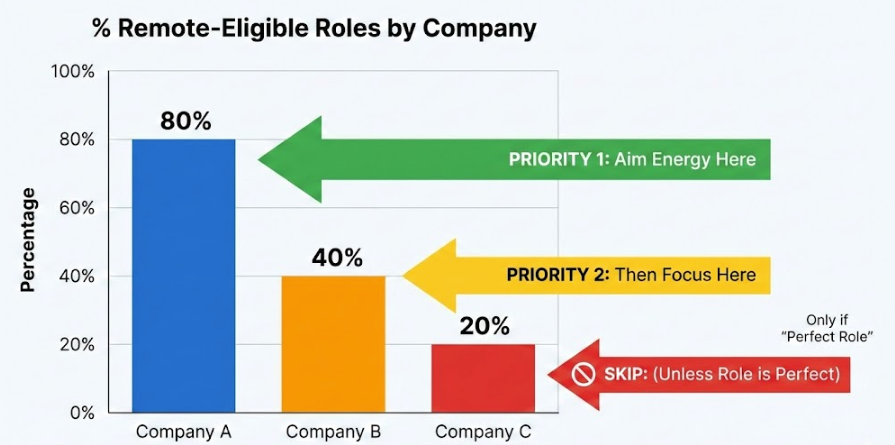
That’s how you move from emotional guessing to data-backed targeting.
Remote Job Scam Detection (Important)
Remote roles attract scammers because they can hide behind “work from home” language. The US Federal Trade Commission’s official guidance on job scams warns that job scams cost people hundreds of millions of dollars a year.
Here’s the harsh truth: if a remote job looks too easy and fast, the risk is high.
Red Flags to Watch For
Based on FTC data and common scam reports, watch for:
- Upfront fees: Training, equipment, or visa processing you must pay for.
- No interview: “You’re hired” after one short chat or text.
- Personal accounts: They ask you to receive payments or packages.
- Off-channel communication only: Only WhatsApp/Telegram, no official email.
- No company footprint: No LinkedIn employees, no engineering blog, no recent product updates.
Recruiters won’t tell you this, but even some “placement agencies” resell your data instead of placing you.
Verification Checklist Before Applying
Use ChatGPT as a scam filter, not a trust engine. Feed it data, then ask, “What’s the risk?”
Prompt:
“I’m considering a remote role with [company name]. Here is the full job description and email thread [paste]. Cross-check this with standard FTC job fraud warnings. Output a checklist of risk signals and a 1–10 risk score.”
Then run this manual checklist yourself:
- Website + LinkedIn: Does the company have recent posts, real employees, and actual products?
- Domain check: Is the email from @company.com or a lookalike Gmail?
- Pay benchmark: Compare salary with Levels.fyi or similar. If it’s 2x market with almost no requirements, danger.
- Visa claims: If they promise “guaranteed H-1B” without details, cross-check policies on uscis.gov.
Stop guessing. Let data and official sources guide you. If something fails 2 or more checks, your time ROI is low, move on.
Resume Tips for Remote Hiring
Most remote roles go through heavy ATS parsing. If your resume breaks the parser, your keyword match drops and you vanish from the list.
Here’s the harsh truth: a fancy design that corrupts parsing is worse than a plain text resume.
Skills Remote Employers Look For
From 2025–2026 remote job posts on Indeed and Jobright, I keep seeing the same clusters:
Core technical alignment
- For SWE: cloud (AWS/GCP/Azure), APIs, CI/CD.
- For Data: SQL, Python/R, dashboards, experimentation.
- For PM/UX: roadmapping, user research, analytics tools.
Remote-specific skills
- Async communication (Slack, email, docs).
- Writing clear specs, tickets, and updates.
- Self-management and basic project tracking.
You can ask ChatGPT:
“Here is a remote [role] job description [paste]. Extract the top 20 skills and keywords. Score my resume bullets from 0–100 for keyword match and alignment. Suggest edits that keep my meaning but increase ATS keyword match without keyword stuffing.”
Your goal: >80% keyword match in ATS tools like Jobscan or Simplify, with zero formatting corruption.
How to Show Remote-Ready Experience
Even if you’ve never had a full remote role, you can show remote-ready signals. Indeed’s career advice on writing your remote job resume emphasizes demonstrating async communication skills.
Before (noise):
- “Led team projects and managed stakeholders.”
After (signal):
- “Led a 6-person team across 3 time zones using async updates (Slack + Jira), increasing on-time delivery rate from 60% to 90%.”
Before (noise):
- “Responsible for standups and meetings.”
After (signal):
- “Ran weekly Zoom standups and documented decisions in Confluence: reduced meeting time by 30% by shifting updates to written briefs.”
For international candidates, add clarity on location and work status:
- “Based in Seattle, WA – on STEM OPT through May 2027, open to H-1B sponsorship.”
- “Location: Bangalore, India – open to remote contract roles with US-based teams.”
This helps recruiters filter by timezone and visa without guessing.
Here is a 4-step Process diagram
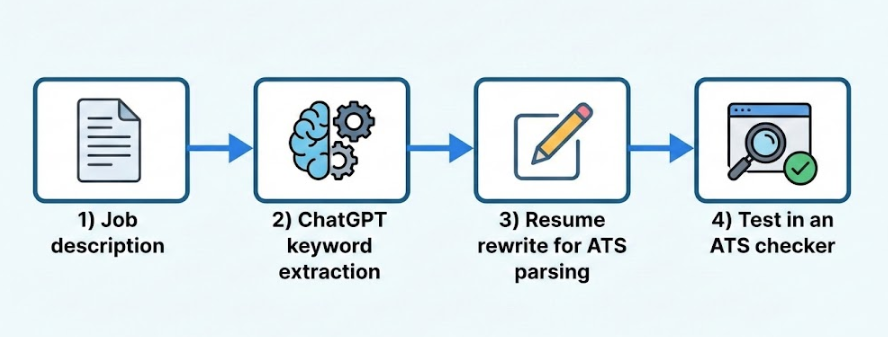
At each step, noise (irrelevant details, broken formatting) is removed and signal (impact metrics, aligned keywords) is amplified.
Work From Home Jobs – Categories
Not all remote jobs look like FAANG SWE roles. If you only chase the top-tier brand names, you miss easier entry points, especially for international and early-career candidates.
Common Remote Job Types
Based on 2026 remote job trends (FlexJobs, CNBC, Jobright feeds), I see stable demand in:
- Engineering & Data: SWE, data engineer, analytics engineer, ML engineer.
- Product & Design: product manager, UX/UI designer, UX researcher.
- DevRel & Support: developer advocate, solutions engineer, technical support.
- Ops & Rev: rev ops analyst, sales ops, CS ops.
Instead of scrolling through generic feeds, we’ve built shortcuts for you. Jump straight into curated lists for Product & Design or Data & AI, or see every available remote role right now.
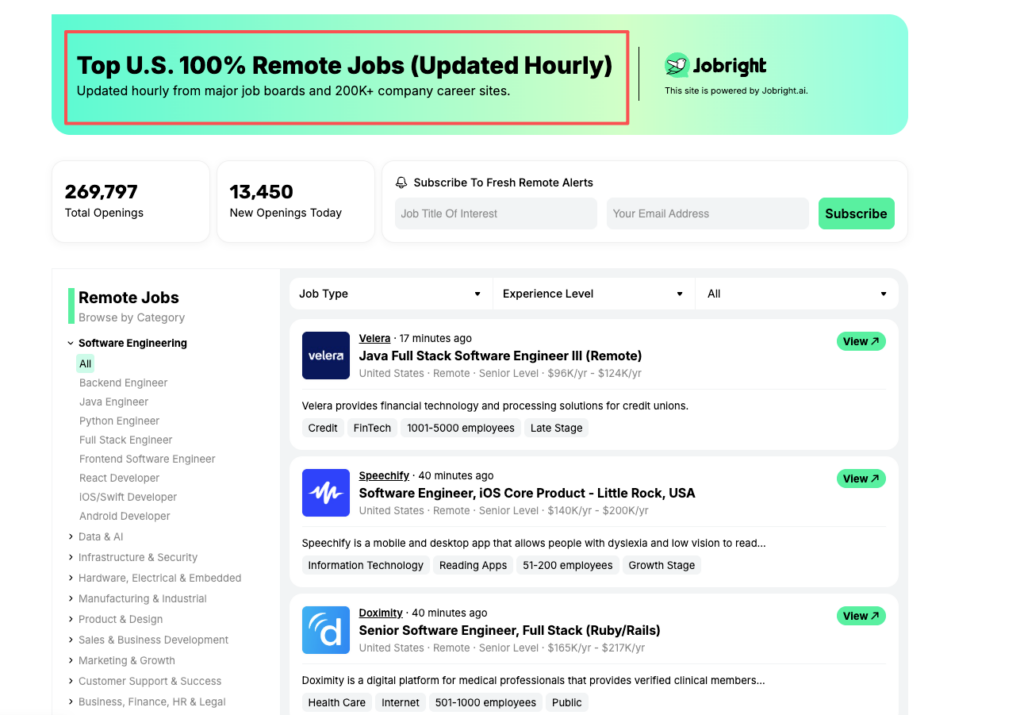
Many of these are remote-first or hybrid with flexible onsite expectations.
For international job seekers, roles that tie to global teams (support, SRE, data) often have better time zone and sponsorship flexibility. Check the company’s LCA or H-1B data via DOL/USCIS to see if they’ve sponsored before.
Entry-Level Options
Entry-level remote roles exist, but they’re crowded. You need a sharper signal.
Better entry paths I see in 2025–2026 data:
- Apprenticeships and returnships: Some big tech and fintech firms run remote-friendly programs: they often appear on company engineering blogs.
- Contract-to-hire: Short remote contracts that convert if performance is strong.
- Support/ops roles with a technical edge: e.g., support engineer, data support analyst.
Use ChatGPT like this:
“I’m an early-career [role] with [skills]. Generate a 90-day plan to break into remote work: (1) target titles, (2) portfolio or GitHub projects to build, (3) LinkedIn headline optimized for recruiters searching for remote juniors, (4) 3 short outreach messages to hiring managers.”
Then execute. Track metrics: number of targeted applications, responses, interviews, offers. If your conversion rate from application → interview is under 5%, something in your signal (resume, keywords, roles) is off.
Action Challenge (Do This in the Next 20 Minutes)
- Pick one remote job you’d apply for today.
- Paste the job description into ChatGPT and run the ATS keyword extraction + resume rewrite prompt from the resume section.
- Test the updated resume in an ATS checker and push your keyword match above 80% while keeping clean parsing.
If you do that for even 10 targeted roles this week, you’ll send fewer applications, but each one will be a strong, data-backed signal instead of more noise.
Ready to put this into practice? We built Jobright to turn these strategies into your unfair advantage—AI-powered matching that does the keyword work for you.
Frequently Asked Questions About Using ChatGPT to Find Remote Jobs
How can I use ChatGPT to find remote jobs more effectively?
Use ChatGPT to design targeted search strings instead of typing “remote jobs” once and scrolling. Give your role, tech stack, and years of experience, and ask it to generate Boolean search queries, related job titles, and synonyms recruiters use. Then paste those into LinkedIn, Indeed, Jobright, and company career pages.
What are the best keywords to search for ChatGPT remote jobs or work‑from‑home roles?
Don’t just search “remote.” Combine terms like “remote,” “fully remote,” “work from anywhere,” “WFH,” “hybrid,” and “distributed.” Ask ChatGPT to create Boolean strings such as (“remote” OR “work from home” OR “WFH”) AND (“ChatGPT” OR “AI assistant” OR “LLM”) tailored to your skills and target industry.
How can ChatGPT help me optimize my resume for remote and hybrid jobs?
Paste a specific remote job description into ChatGPT and ask it to extract the top skills and keywords. Then have it rewrite your resume bullets to match those terms while preserving your real impact. Aim for clean, parser‑friendly formatting and an ATS keyword match above 80% using tools like Jobscan or Simplify.
Can ChatGPT help me avoid remote job scams and fake work‑from‑home offers?
Yes—use ChatGPT as a risk analyzer, not a trust engine. Paste the full job description and email thread, then ask it to check against FTC job‑fraud warnings. It can highlight red flags like upfront fees, no interview, or off‑channel communication so you can combine its analysis with your own manual company research.
Are there entry‑level remote jobs that use ChatGPT or AI tools, and how do I target them?
Many junior roles now expect comfort with ChatGPT and similar tools, especially in support, content, data, and operations. Ask ChatGPT to design a 90‑day plan: target job titles, portfolio or GitHub ideas, and a LinkedIn headline optimized for “remote junior” searches, plus outreach messages to hiring managers and recruiters.
Recommended Reads