
Google Technical Interview Questions: Complete Guide (2026)
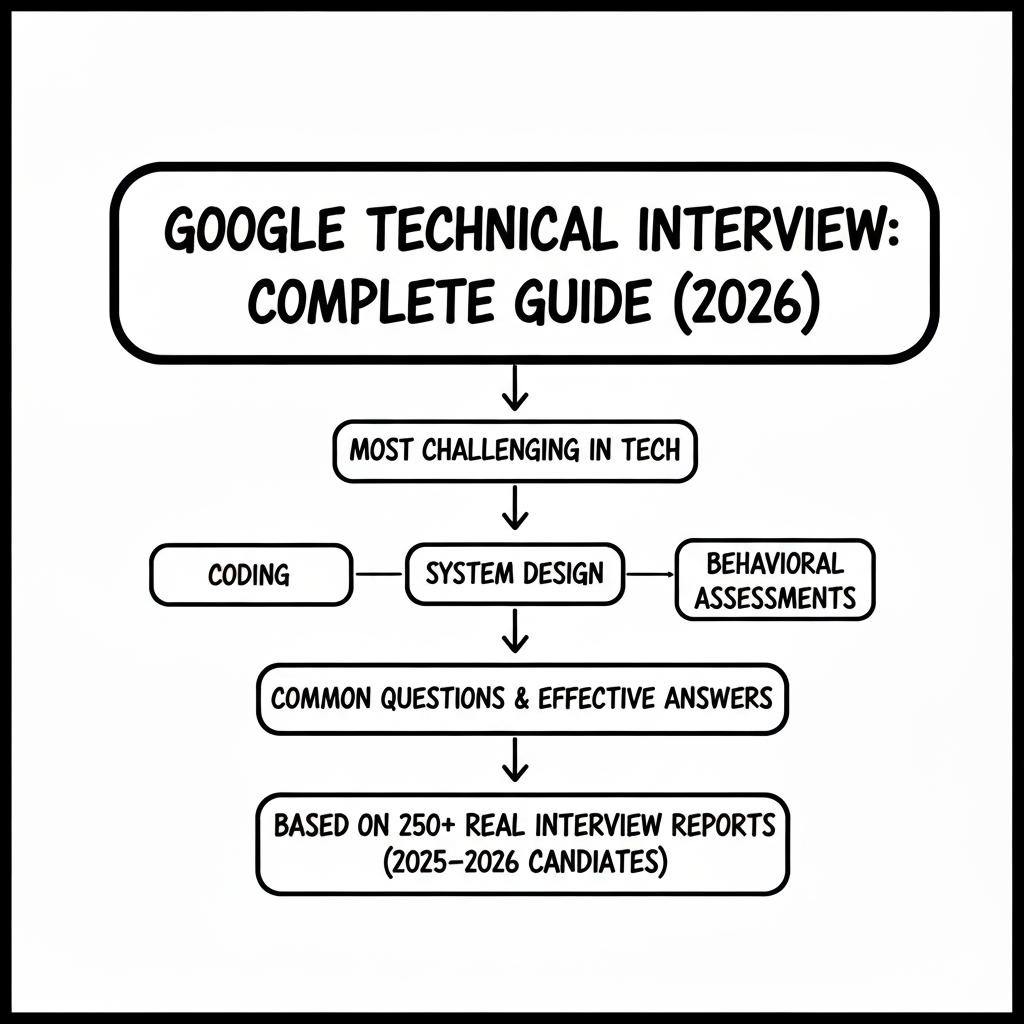
No matter what level you’re targeting, Google software engineer interviews are among the most challenging in the tech industry. The questions are difficult, highly specific to Google’s engineering culture, and cover a wide range of technical and conceptual topics spanning coding, system design, and behavioral assessments. This guide covers the most common Google interview questions and how to answer them effectively, based on analysis of over 250 real interview reports from 2025-2026 candidates.
1. Google Software Engineer Role
1.1 What Does a Google Software Engineer Do?
At Google, software engineers work on products and services that impact billions of users worldwide—from Google Search and Gmail to YouTube and Android. Your responsibilities vary significantly based on your level in Google’s engineering ladder:
(1) Level Structure:
- L3 (SWE II – Entry Level): Recent graduates or engineers with 0-2 years of experience. You’ll work on well-defined features under mentorship, focusing on code quality and learning Google’s tech stack.
- L4 (SWE III – Mid-Level): Engineers with 2-5 years of experience. You’ll own complete features, participate in design discussions, and mentor junior engineers.
- L5 (Senior SWE): Senior engineers with 5+ years of experience. You’ll lead projects, make architectural decisions, and influence team direction.
- L6+ (Staff+ Engineers): Principal-level roles requiring extensive experience and demonstrated impact at scale.
(2) Core Responsibilities:
- Designing, developing, testing, and deploying scalable software systems
- Writing production-quality code in languages like C++, Java, Python, Go, or JavaScript
- Collaborating with cross-functional teams including product managers, designers, and other engineers
- Conducting code reviews and maintaining high engineering standards
- Solving complex algorithmic and system design problems
- Contributing to Google’s massive shared codebase with efficient code review processes
1.2 Required Skills
To succeed as a Google software engineer, you need:
(1) Technical Skills:
- Strong proficiency in at least one major programming language (C++, Java, Python, Go)
- Deep understanding of data structures and algorithms
- Experience with system design and distributed systems (for L4+)
- Solid grasp of computer science fundamentals
- Ability to write clean, efficient, production-quality code
(2) Soft Skills:
- Strong problem-solving and analytical thinking
- Excellent communication and collaboration abilities
- “Googleyness” traits: humility, intellectual curiosity, comfort with ambiguity, and a growth mindset
- Leadership potential (especially for senior roles)
2. Google Software Engineer Interview Process and Timeline
Understanding Google’s interview process helps you prepare strategically. The entire process typically takes 6-8 weeks from application to offer and consists of several distinct stages.
2.1 Resume Screen
First, recruiters review your resume to assess if your experience matches the open position. This is the most competitive stage—millions of applications don’t make it past this point.
(1) To stand out, you need a strong resume highlighting:
- Relevant technical projects with measurable impact
- Proficiency in programming languages and technologies
- Problem-solving achievements
- Open-source contributions or notable work
(2) Pro tip:
- Employee referrals significantly increase your chances. According to data, referred candidates are 5x more likely to receive an interview.
2.2 Recruiter Phone Screen
If your resume passes, a recruiter will contact you for an initial 30-45 minute phone conversation. This call assesses:
- Your background and experience
- Interest in Google and specific teams
- General fit for the role
- Availability and timeline
Be prepared to discuss why you want to work at Google and what types of problems you’re passionate about solving.
2.3 Technical Phone Screen
This is where technical evaluation begins. You’ll have 1-2 phone/video interviews (45-60 minutes each) covering:
- Coding questions: Data structures and algorithms problems you’ll solve in a shared Google Doc (no syntax highlighting or autocomplete)
- Problem-solving approach: How you break down problems and communicate your thinking
- Code quality: Writing clean, bug-free code
- Basic behavioral questions: “Tell me about yourself,” “Why Google?”
The technical phone screen focuses primarily on coding—system design questions are rare at this stage.
2.4 Onsite Interviews
If you pass the phone screens, you’ll be invited to onsite interviews (currently conducted virtually via Google Meet). The typical breakdown is 4-5 rounds of 45-60 minutes each:
- 2-3 Coding interviews: Algorithmic problems involving data structures, similar to phone screen but potentially harder
- 1 System Design interview: Designing scalable systems (L4+, optional for L3)
- 1 Googleyness & Leadership interview: Behavioral questions assessing cultural fit and leadership potential
Each interviewer independently evaluates you on specific competencies and submits feedback to the hiring committee.
2.5 Hiring Committee Review
After onsite interviews, your interview packet (all feedback, resume, and assessments) goes to a hiring committee—a group of senior Googlers who’ve never met you. This ensures unbiased evaluation. They review:
- Technical skills (40% weight)
- Googleyness/cultural fit (30%)
- Leadership and impact (20%)
- Role-specific expertise (10%)
The committee makes a hire/no-hire recommendation.
2.6 Team Matching
If the hiring committee approves you, Google’s team matching process begins. You’ll have conversations with potential managers to find the right team fit based on your interests and their needs.
2.7 You Get an Offer
Once you match with a team, you’ll receive an official offer, typically within 1-2 weeks. L3 (entry-level) total compensation ranges from $180,000-$220,000, while L5 (senior) exceeds $350,000. Remember, compensation is negotiable!
3. What Google Is Looking For
Google evaluates candidates on four key dimensions:
General Cognitive Ability (Problem-Solving)
- Can you break down complex problems?
- Do you ask the right clarifying questions?
- Can you think through trade-offs and edge cases?
Coding Skills
- Strong understanding of data structures and algorithms
- Ability to write clean, efficient, bug-free code
- Good coding practices and production-quality standards
System Design Expertise (L4+)
- Understanding of distributed systems, scalability, and performance
- Ability to make architectural trade-offs
- Knowledge of databases, caching, load balancing, etc.
Googleyness & Leadership
- Humility and willingness to learn
- Comfort with ambiguity
- Collaborative mindset
- Growth mindset and resilience
- Taking ownership and showing initiative
4. Top 5 Google Interview Questions and Example Answers
Based on analysis of hundreds of candidate reports, here are the most common questions you’ll encounter.
4.1 Why do you want to work at Google?
Why interviewers ask this:
Google needs engineers excited about solving problems at unprecedented scale and who align with their mission. This reveals your motivation, cultural fit, and whether you’ve researched Google’s products and challenges.
How to answer:
Be specific about Google’s products, culture, or engineering challenges that excite you. Connect your experience to Google’s work and demonstrate genuine interest.
Example answer:
“I’m excited about Google for three reasons. First, the scale—serving billions of users presents unique challenges I haven’t encountered in my current role. I’ve followed your work on Search optimization, particularly the engineering blog post about reducing latency by 30%, which resonates with my experience optimizing distributed systems. Second, Google’s culture of innovation aligns with my approach. I thrive in environments that encourage experimentation and rapid iteration. Finally, Google’s impact on technology advancement excites me. Your contributions to open-source projects like TensorFlow and Kubernetes are advancing the entire industry, and I want to contribute to that impact.”
4.2 Tell me about a challenging project you led and the impact it had.
Why interviewers ask this:
Google wants to understand how you handle complex problems, drive meaningful impact, lead others, and measure results. This assesses end-to-end ownership and cross-functional navigation.
How to answer:
Use the STAR method (Situation-Task-Action-Result) to structure your response. Focus on your specific contributions, quantifiable outcomes, and lessons learned.
Example answer:
“At my previous company, we had a critical performance issue—our API response times increased to 3+ seconds during peak traffic, affecting 40% of our users. I led a team of four engineers to investigate and resolve this. We discovered our database queries weren’t optimized for scale. I designed a caching layer using Redis and implemented database query optimization. The result: we reduced average response time from 3 seconds to 200ms—a 93% improvement. Monthly active users increased by 25% after the fix. This taught me the importance of proactive monitoring and designing for scale from the beginning.”
4.3 Implement an LRU Cache
Why interviewers ask this:
This classic problem tests data structures knowledge (hash maps, doubly linked lists), O(1) time complexity optimization, code clarity, and communication. Caching is critical for serving billions of users with low latency.
How to answer:
Explain your approach first:
use a hash map for O(1) lookup and a doubly linked list to track access order. Walk through get() and put() operations, handling capacity limits.
class Node:
    def __init__(self, key, value):
        self.key = key
        self.value = value
        self.prev = None
        self.next = None

class LRUCache:
    def __init__(self, capacity: int):
        self.capacity = capacity
        self.cache = {}
        self.head = Node(0, 0)
        self.tail = Node(0, 0)
        self.head.next = self.tail
        self.tail.prev = self.head

    def _remove(self, node):
        prev_node = node.prev
        next_node = node.next
        prev_node.next = next_node
        next_node.prev = prev_node

    def _add_to_head(self, node):
        node.next = self.head.next
        node.prev = self.head
        self.head.next.prev = node
        self.head.next = node

    def get(self, key: int) -> int:
        if key not in self.cache:
            return -1
        node = self.cache[key]
        self._remove(node)
        self._add_to_head(node)
        return node.value

    def put(self, key: int, value: int) -> None:
        if key in self.cache:
            node = self.cache[key]
            node.value = value
            self._remove(node)
            self._add_to_head(node)
        else:
            if len(self.cache) >= self.capacity:
                lru = self.tail.prev
                self._remove(lru)
                del self.cache[lru.key]
            new_node = Node(key, value)
            self.cache[key] = new_node
            self._add_to_head(new_node)
Time Complexity:
O(1) for both get() and put() operations. Space Complexity: O(capacity).
4.4 Design Google Search
Why interviewers ask this
Search is core to Google’s business with complex engineering challenges at massive scale. This assesses your ability to design for billions of users, reason about trade-offs, handle distributed systems, and connect technical decisions to user experience.
How to answer
Start by clarifying requirements: scale (billions of web pages, millions of queries per second), latency requirements (milliseconds), and key features (relevance ranking, freshness, personalization).
High-level architecture:
[Web Crawlers] → [Document Processing] → [Inverted Index]
                                              ↓
[User Query] → [Query Processing] → [Index Lookup] → [Ranking] → [Results]
                                                         ↓
                                              [Machine Learning Models]
Core Components:
- Web Crawlers: Distributed crawlers that fetch and update billions of web pages
- Indexing System: Build inverted index mapping terms to documents
- Query Processing: Parse queries, handle spelling correction, understand intent
- Ranking System: Machine learning models considering relevance, authority (PageRank), freshness, personalization
- Distributed Storage: Sharded storage across thousands of servers for massive scale
Key Trade-offs:
- Freshness vs. computational cost (how often to re-crawl)
- Precision vs. recall in search results
- Personalization vs. privacy
- Latency vs. result quality
This design demonstrates understanding of Google-scale systems.
4.5 Tell me about a time you failed. What happened, and what did you learn?
Why interviewers ask this
Google wants engineers who can handle setbacks, learn from mistakes, and demonstrate growth mindset—core Googleyness traits.
How to answer
Choose a real failure where you took responsibility, learned concrete lessons, and applied those learnings. Show humility and self-awareness.
Example answer:
“Early in my career, I led a feature launch that completely failed. We built a recommendation system for our e-commerce platform, but after launch, user engagement actually decreased by 15%. I was devastated. In retrospect, I made two critical mistakes: First, I didn’t validate our assumptions with user research—we built what we thought users wanted, not what they actually needed. Second, I rushed the launch without proper A/B testing. After the failure, I led a comprehensive post-mortem with the team. We rolled back the feature, conducted user interviews, and discovered users wanted simpler, not more complex, recommendations. We rebuilt with a data-driven approach and extensive testing. The second version increased engagement by 30%. This experience taught me the importance of user research, iterative development, and the courage to admit when something isn’t working. Now I always start with user validation and rigorous testing.”
5. Real Google Interview Questions from Recent Candidates
To give you a concrete sense of what to expect, here are real questions asked in Google interviews during 2025-2026, shared by recent candidates.
5.1 Longest Increasing Subarray with Modification
Problem: “Find the longest increasing subarray. Follow-up: If you can replace one element in each subarray, how would you modify your solution?”
Why interviewers ask this
This question tests your understanding of both array manipulation and dynamic programming concepts. The initial problem is straightforward, but the follow-up significantly increases complexity by introducing an optimization element.
How to answer
Start with the basic solution using a single pass to track increasing sequences. For the follow-up, use dynamic programming to track states: longest increasing sequence ending at position i with 0 modifications vs. 1 modification.
Key Skills Tested:
- Array traversal and tracking state
- Dynamic programming for optimization
- Ability to adapt solutions to follow-up constraints
- Communication of approach and trade-offs
Similar Problems for Practice:
This type of question is common in Google’s technical phone screens because it starts simple but can be extended to test deeper algorithmic thinking.
5.2 Optimal Meeting Point Problem
Problem: “Two people A and B need to reach a destination. They can meet at one location and take a bus together to the destination. Find the minimum time/steps required.”
Why interviewers ask this
Google’s products like Maps require sophisticated optimization algorithms. This question assesses your ability to model real-world scenarios as computational problems and apply graph algorithms.
How to answer
Model the problem as a graph where locations are nodes and paths are edges. Calculate shortest paths from A and B to all possible meeting points using BFS or Dijkstra’s algorithm. For each meeting point, compute total time and return the minimum.
Approach:
- Model the problem as a graph where locations are nodes and paths are edges
- Calculate shortest paths from A and B to all possible meeting points
- For each potential meeting point, compute total time (A→meeting point + B→meeting point + meeting point→destination)
- Return the minimum total time
Similar Problems for Practice:
- Shortest Path in Binary Matrix
- Study BFS and Dijkstra’s algorithm implementations
This question exemplifies Google’s preference for problems that mirror real-world engineering challenges.
5.3 Hypothetical Leadership Scenarios
During the Googleyness and Leadership interview, candidates reported facing rapid-fire hypothetical questions:
- “If you are a team leader, how would you handle a situation where someone on your team misses a deadline?”
- “How would you assign roles within your team when starting a new project?”
- “What would you do when your team encounters a new problem that no one is familiar with?”
Why interviewers ask this
These questions assess leadership potential, conflict resolution, handling ambiguity, collaborative problem-solving, and growth mindset.
How to answer
Use the STAR method even for hypothetical scenarios. For missed deadlines, show empathy—understand root causes while ensuring project success. For role assignment, consider individual strengths and development goals. For unfamiliar problems, emphasize learning and collaboration.
Googleyness Traits to Demonstrate:
- Intellectual humility: Admitting when you don’t have all answers
- Comfort with ambiguity: Showing confidence in navigating uncertain situations
- Collaborative mindset: Focusing on team success over individual achievement
- Growth mindset: Viewing challenges as learning opportunities
6. Google Coding Interview Questions by Category
Based on analysis of 250+ interview reports, here’s the breakdown of coding question types:
- Arrays/Strings (35% – most frequent)
- Trees/Graphs (25%)
- Dynamic Programming (15%)
- Linked Lists (12%)
- Search/Sort (8%)
- Hash Tables/Heaps (5% – least frequent)
6.1 Arrays/Strings Questions
- Longest Substring Without Repeating Characters: “Find the length of the longest substring without repeating characters.”
- Merge Intervals: “Given a collection of intervals, merge all overlapping intervals.”
- Trapping Rain Water: “Given an elevation map, compute how much water it can trap after raining.”
6.2 Trees/Graphs Questions
- Binary Tree Level Order Traversal: “Return the level order traversal of a binary tree’s nodes’ values.”
- Validate Binary Search Tree: “Determine if a binary tree is a valid binary search tree.”
- Number of Islands: “Count the number of islands in a 2D grid map.”
- Serialize and Deserialize Binary Tree: “Design an algorithm to serialize and deserialize a binary tree.”
6.3 Dynamic Programming Questions
- Longest Increasing Subsequence: “Find the length of the longest strictly increasing subsequence.”
- Word Break: “Given a string and a dictionary, determine if the string can be segmented into dictionary words.”
For comprehensive coding preparation, check out Google’s coding interview guide and LeetCode’s Google question collection.
7. Google System Design Interview Questions
Google’s products—Search, Gmail, YouTube, Android, Google Maps—serve billions of users worldwide. Engineers must be able to design systems that are highly scalable, reliable, and performant. System design interviews are mandatory for L4+ roles and optional for L3.
7.1 Common System Design Questions
- Design Google Search: How would you design a web search engine that can index billions of pages and return results in milliseconds?
- Design YouTube: Design a video streaming platform that handles billions of views per day. Consider video upload, storage, transcoding, CDN, and recommendations.
- Design Google Drive: Create a cloud storage system supporting file upload/download, sharing, real-time collaboration, and synchronization across devices.
- Design Gmail: Design an email service handling billions of emails with features like search, spam detection, and real-time delivery.
- Design URL Shortener: Create a service like bit.ly that shortens URLs and tracks analytics.
- Design Google Maps: Design a navigation system with routing, traffic updates, and location search.
- Design Distributed Cache: Implement a distributed caching system like Memcached or Redis for high-throughput applications.
- Design Rate Limiter: Create a rate limiting system for Google’s APIs to prevent abuse.
- Design News Feed: Build a social media feed system that scales to billions of users (like Facebook or Twitter).
- Design Web Crawler: Design a system that crawls and indexes billions of web pages for search engines.
7.2 Preparation Resources
8. Google Behavioral Interview Questions
Google places significant emphasis on “Googleyness”—a unique blend of traits that define Google’s culture. Unlike some companies that focus primarily on technical skills, Google dedicates entire interview rounds to assessing whether you’ll thrive in their collaborative, innovation-driven environment.
8.1 What Is Googleyness?
Googleyness encompasses several key traits:
- Intellectual humility: Admitting when you don’t know something and being open to learning
- Comfort with ambiguity: Thriving in uncertain situations without clear answers
- Collaborative spirit: Working effectively in teams and valuing others’ contributions
- Growth mindset: Viewing challenges and failures as learning opportunities
- Conscientiousness: Taking ownership and following through on commitments
- Courage: Taking calculated risks and trying innovative approaches
8.2 Common Behavioral Questions
Failure and Learning:
- “Tell me about a time you failed. What happened, and what did you learn?“ This is one of the most common Googleyness questions.
- “Describe a project that didn’t go as planned. How did you handle it?”
Collaboration and Conflict:
- “Tell me about a time you disagreed with a team member. How did you resolve it?”
- “Describe a situation where you had to work with a difficult colleague. What was your approach?”
- “Give an example of when you had to convince others to adopt your idea.”
Ambiguity and Problem-Solving:
- “How do you handle situations where you have incomplete information?”
- “Tell me about a time you had to make a decision without all the data you needed.“
Motivation and Culture Fit:
- “Why do you want to work at Google?” Be specific about Google’s products, culture, or engineering challenges that excite you.
- “What’s your favorite Google product and why? How would you improve it?”
- “Describe your ideal team environment. What makes you most productive?”
Leadership and Initiative:
- “Tell me about a time you took ownership of a project beyond your responsibilities.”
- “Describe a situation where you mentored or helped a colleague grow.”
- “Give an example of when you identified and solved a problem proactively.“
Handling Pressure:
- “Tell me about a time you had to work under a tight deadline. How did you prioritize?”
- “Describe a high-pressure situation and how you handled stress.”
8.3 Use the STAR Method
Structure your answers using Situation, Task, Action, Result:
- Situation: Set the context
- Task: Explain your role and the challenge
- Action: Describe what you did (focus on “I,” not “we”)
- Result: Share the outcome with metrics when possible
8.4 Preparation Resources
9. How to Prepare for Google Interviews
Success at Google interviews requires more than just technical knowledge. Here are proven strategies from engineers who’ve successfully navigated the process:
9.1 For Coding Interviews
Practice Strategy:
- Solve 100-150 LeetCode problems with this breakdown:
- 40% Easy (build confidence and fundamentals)
- 50% Medium (majority of Google questions)
- 10% Hard (stretch goals)
- Focus on Google-specific problems: LeetCode Google Tag
- Practice on Google Docs or plain text editors (no autocomplete)
- Time yourself: 30 minutes for medium problems, 45 minutes for hard
Problem Categories to Prioritize:
- Arrays/Strings (35% of questions)
- Trees/Graphs (25%)
- Dynamic Programming (15%)
- Linked Lists (12%)
Resources:
- LeetCode: Essential for problem practice
- NeetCode: Curated problem lists with video explanations
- Cracking the Coding Interview: Classic reference book
- Google Coding Interview Guide
9.2 For System Design Interviews
Learning Phase (2-3 weeks):
Study fundamental concepts:
- Scalability and performance optimization
- Load balancing and caching
- Database design (SQL vs. NoSQL)
- Microservices vs. monolithic architecture
- CAP theorem and consistency models
- Message queues and pub/sub systems
- CDNs and data replication
Practice Phase (2-3 weeks):
- Work through 15-20 system design problems
- Focus on Google-scale systems (billions of users)
- Practice whiteboarding or using diagramming tools
- Time yourself: 45-50 minutes per problem
Resources:
- Work through 15-20 system design problems
- Focus on Google-scale systems (billions of users)
- Practice whiteboarding or using diagramming tools
- Time yourself: 45-50 minutes per problem
9.3 For Behavioral Interviews
Story Development:
Write 6-8 STAR-format stories covering:
- A significant technical challenge you solved
- A time you failed and what you learned
- A conflict with a team member and resolution
- A project you led or took ownership of
- A time you helped/mentored someone
- A decision made with incomplete information
- A situation requiring innovation or creativity
- A mistake you made and how you handled it
Practice:
- Rehearse each story out loud
- Keep stories concise (2-3 minutes each)
- Include specific metrics and outcomes
- Adapt stories to different question formats
9.4 General Tips
- Ask Clarifying Questions: Google interview questions are often intentionally ambiguous. Always clarify input/output formats, constraints, edge cases, and assumptions.
- Think Out Loud: Communicate your thought process throughout the interview. Explain your approach before coding, walk through your reasoning, and discuss trade-offs.
- State Assumptions Explicitly: Don’t assume your interviewer knows what you’re thinking. Explicitly state any assumptions about the problem.
- Present Multiple Solutions: When possible, discuss multiple approaches. Start with brute-force, then optimize step-by-step.
- Write Production-Quality Code: Use meaningful variable names, follow proper coding conventions, handle edge cases, and write modular code.
- Practice Without Autocomplete: Google coding interviews use plain Google Docs. Practice writing code in a text editor without syntax highlighting.
- Manage Your Time: Spend 5-10 minutes understanding the problem, 25-35 minutes coding, and 5-10 minutes testing.
- Do Mock Interviews: Schedule 1-2 mock interviews per week as your actual interview approaches. Use platforms like Pramp, Interviewing.io, or professional coaches.
10. Preparation Timeline
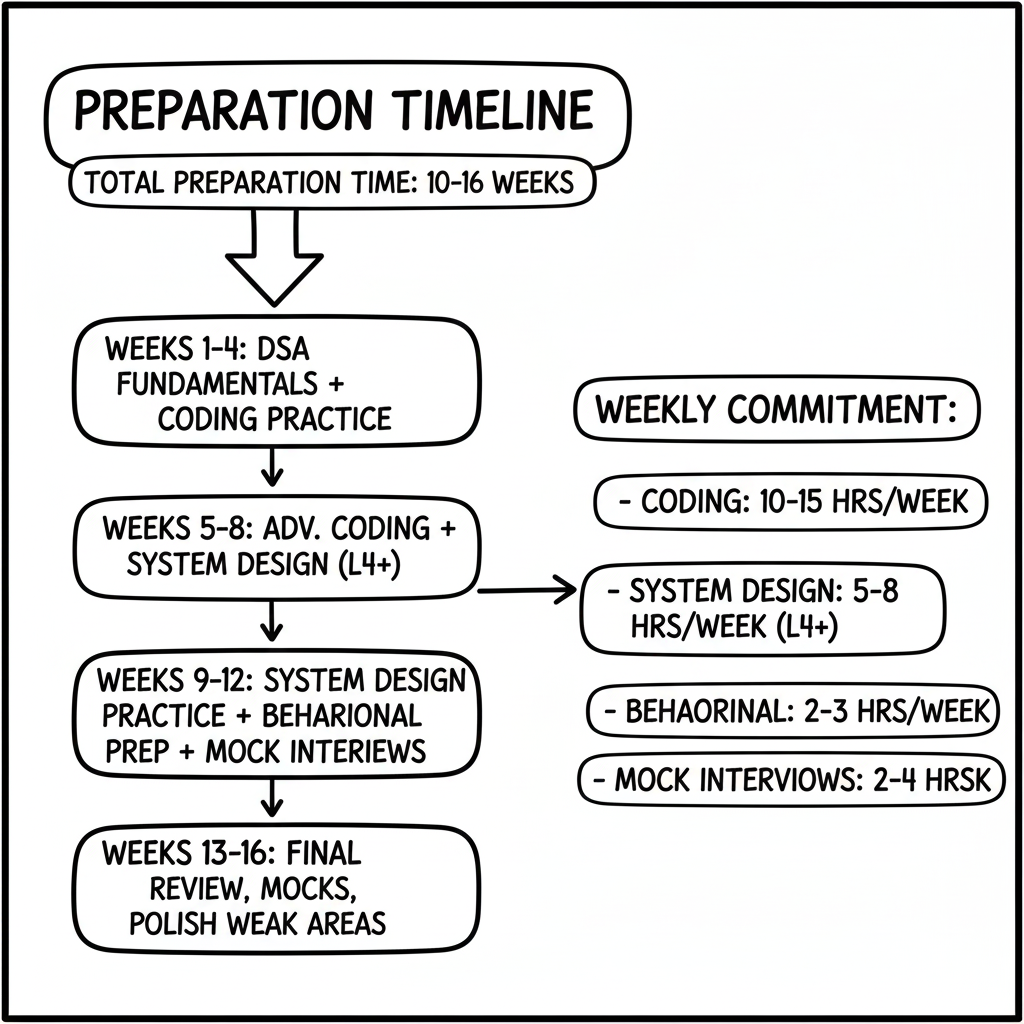
Total Preparation Time: 10-16 weeks
- Weeks 1-4: Data structures & algorithms fundamentals + coding practice
- Weeks 5-8: Advanced coding problems + system design learning (L4+)
- Weeks 9-12: System design practice + behavioral prep + mock interviews
- Weeks 13-16: Final review, additional mocks, polish weak areas
Weekly Commitment:
- Coding: 10-15 hours/week
- System Design: 5-8 hours/week (L4+)
- Behavioral: 2-3 hours/week
- Mock Interviews: 2-4 hours/week
10.1 Final Preparation Checklist
One Week Before:
- Review common problem patterns and solutions
- Redo problems you struggled with
- Do 2-3 final mock interviews
- Prepare questions to ask your interviewers
- Research your interviewers on LinkedIn (if names shared)
One Day Before:
- Review your STAR stories
- Get good sleep (minimum 7-8 hours)
- Test your technology setup (camera, mic, internet)
- Prepare quiet interview space
- Review Google’s values and recent news
Interview Day:
- Eat a healthy meal beforehand
- Arrive/log in 10 minutes early
- Stay calm and confident
- Treat interviewers as colleagues, not judges
- Ask thoughtful questions at the end
11. Accelerate Your Google Job Search with Jobright
Landing a role at Google requires more than just technical excellence—it demands a strategic approach to finding the right opportunity. While this guide prepares you for the interview, a platform like Jobright gives you a crucial advantage in the job search itself.
11.1 Get Personalized Job Recommendations
Instead of manually sifting through listings, Jobright learns from your profile to deliver tailored recommendations. Whether you’re targeting an L3 Software Engineer, L4 Mid-Level, L5 Senior Engineer, or Staff+ role, our platform identifies the best-fit Google opportunities for your background.
11.2 Optimize Your Resume & Gain Team Insights
Our AI analyzes specific Google job descriptions to provide actionable insights on how to optimize your resume, significantly increasing your chances of passing the initial screen. You can also gain intelligence on specific teams—Search, YouTube, Cloud Platform, Android, Maps, and more—including their projects and tech stacks, so you can go into interviews fully prepared.
11.3 Start Your Strategic Search Today
Combine the interview preparation strategies in this guide with an intelligent job search platform to maximize your chances of success. Your career at Google starts with finding the right opportunity. Visit Jobright now to start your AI-powered job search, get matched with curated opportunities, and track your progress toward landing your dream offer.