
ChatGPT Prompt for Resume Based on Job Description (2026 Template)
Table of Contents
Last Updated: Feb 5, 2026 Applicable to 2026 hiring season
Stop blaming the job market. The problem isn’t the economy—it’s your optimization strategy.
Most candidates treat ChatGPT like a ghostwriter, asking it to “write me a resume.” This is the fastest way to get flagged as spam. In 2026, generic AI resumes are the new typos—recruiters spot them instantly (and discard them just as fast).
Real optimization isn’t about letting AI take the wheel; it’s about using it as a precision instrument.
In this guide, we are moving beyond basic prompting. I’m Dora, and today I’m sharing the specific workflow I use to help clients bypass ATS filters and hit an 80%+ keyword match score. We aren’t just “polishing” your resume; we are engineering it to survive the algorithms that blocked your last 87 applications.
Before You Start – What to Paste (and What NOT to)
Here’s the harsh truth: if you paste your entire life into a random prompt, you risk both privacy and sloppy output. You need signal, not noise.
Information Safe to Include
What’s safe and useful to paste into ChatGPT?
Include:
- The full job description, including responsibilities and qualifications.
- A clean text version of your resume (no columns, no icons).
- Your tech stack and tools, even if they’re not in the resume yet.
- Measurable outcomes: metrics, timelines, scope.
Example of safe resume content to paste:
- Role: Backend Engineer, 3 years, Python + Django.
- Metrics: Reduced API latency by 35%, handled 2M+ daily requests.
- Outcomes: Shipped billing API used by 4 global regions.
This gives the model enough signal to do keyword match optimization and alignment with the role.
For international and visa-dependent candidates, you can also include:
- Current status (F-1 OPT, STEM OPT, H-1B, etc.).
- Target: “Seeking H-1B sponsor” or “Open to cap-exempt H-1B roles.”
That context matters because some employers explicitly mention visa sponsorship in the job description. Aligning your value prop with those lines boosts your conversion rate with recruiters who filter for sponsorship-readiness.
Personal Data to Remove First
Recruiters won’t tell you this, but: most ATS don’t need your sensitive data to run a keyword match. And cybersecurity experts warn against sharing high-risk data in any online tool.
Before you paste, delete:
- Full address (keep city/metro at most).
- Phone number and personal email.
- Date of birth, nationality, passport numbers.
- Last 4 digits of SSN or any ID.
- Exact student ID or immigration receipt numbers.
Think in terms of risk vs ROI. Your impact bullets and tech skills offer high ROI for optimization. Your legal IDs add risk with zero benefit.
If you want a quick rule: anything you’d be nervous to post in a private Slack channel, don’t paste into a resume prompt either.
The Master Prompt (Copy-Paste Ready)
Now to the part you came for: the ChatGPT prompt for a resume based on a job description that actually passes the ATS stress test.
Prompt Template with Placeholders
You can copy this and swap in your details.
To save you time, we packaged this exact workflow into a custom GPT so you don’t have to copy-paste manually. You can run your resume through our optimizer here.
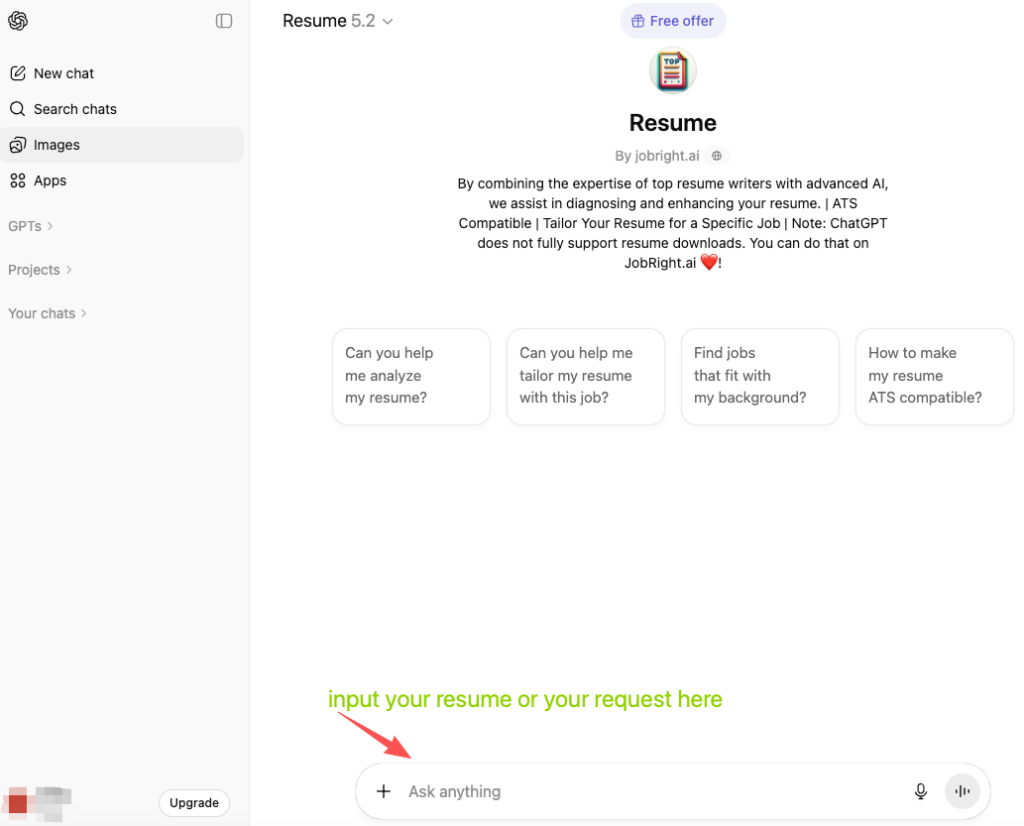
Prompt:
I'll give you (1) my resume and (2) a target job description.
Goals:
Optimize my resume for ATS parsing and keyword match without inventing experience.
Keep all bullets truthful and based on what I've done.
Maintain a simple, single-column format (no tables, columns, icons, text boxes).
Steps:
Read my resume and summarize my top 5 value props for this role.
Identify the top 15–25 keywords and phrases from the job description (skills, tools, frameworks, domains).
Suggest updated bullets that align my experience to the job description using those keywords, but only where truthful.
Quantify impact by adding or improving metrics (time saved, revenue impact, performance, scale) based on what I already mention.
Output:
A revised, ATS-friendly resume in plain text.
A short summary of which keywords were matched and which gaps remain.
Here is my resume:
[PASTE CLEAN TEXT RESUME]
Here is the job description:
[PASTE JOB DESCRIPTION]
This structure forces the algorithm to act like a careful editor, not a fiction writer.
Example Output Walkthrough
Let me show you a quick before/after example for a Data Analyst.
Before (common noise):
- Responsible for creating dashboards and reports for leadership.
After (signal-focused, ATS aware):
- Built and maintained 12+ Tableau dashboards and SQL reports that tracked product KPIs (DAU, retention, churn), improving executive decision speed by 30%.
Notice the changes:
- Added specific tools: Tableau, SQL.
- Added metrics: 12+ dashboards, 30% faster decisions.
- Added domain keywords: DAU, retention, churn.
Jobscan-style tools show higher keyword match when you mirror language from the description. For example, if the posting says “retention” and “churn,” you want those exact phrases if they’re true for your work.
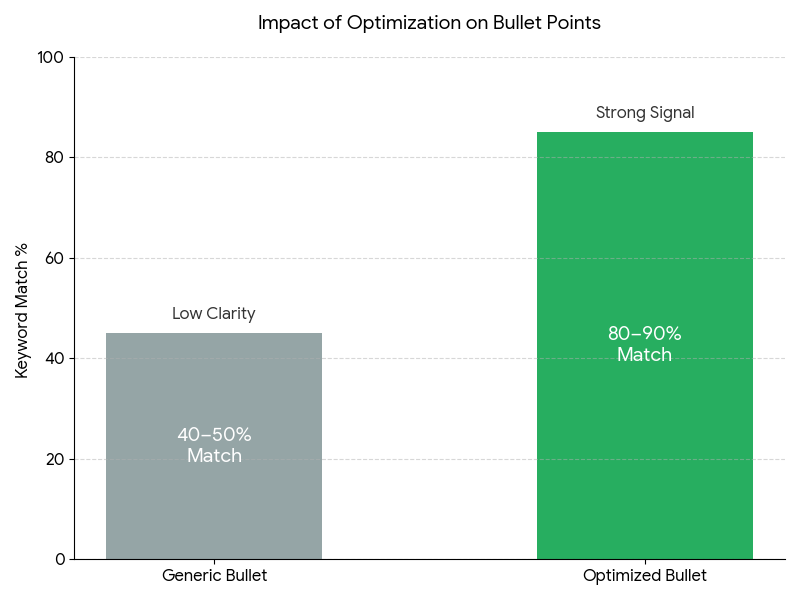
That difference is often the gap between the application black hole and an actual phone screen.
How to Compare Resume to Job Description
Here’s the harsh truth: if you don’t compare your resume to each target job, you’re gambling your time away. Mass applying without alignment has a terrible ROI.
We developed the JobRight.ai scanner to instantly detect these blind spots for you. Instead of guessing, let our tool verify your match score before you risk another rejection.
Gap Analysis Prompt
Use this prompt first to diagnose misalignment:
Prompt:
Compare my resume to this job description.
List the top 10 responsibilities and required skills from the job description.
For each one, tell me:
‘Covered strongly', ‘Covered weakly', or ‘Not covered' in my resume.
Suggest 1–2 resume bullet improvements for each ‘Covered weakly' area, using only experience I already have.
If something is ‘Not covered', suggest ways I can gain that experience in 30–60 days (projects, certifications, open-source contributions). Keep suggestions realistic for someone working full-time.
Resume:
[PASTE]
Job Description:
[PASTE]
This gap analysis makes your missing skills explicit. For international candidates, you can also ask:
Flag if the employer mentions visa sponsorship, H-1B, or work authorization requirements, and summarize them in 2–3 lines.Then you know if it’s even worth applying.
Keyword Match Check Prompt
Once you adjust your bullets, you want an ATS-style keyword match check.
Prompt:
Extract the top 30 keywords and phrases (skills, tools, domains) from this job description. Then check which ones already appear in my resume.
Output a 2-column text table:
Column 1: Keyword or phrase.
Column 2: Status = ‘In resume' or ‘Missing'.
Do not invent experience. Only mark ‘In resume' if the exact or a clear synonym appears.
You’ll get something like this (example for a backend role):
| Keywords | Status |
| Python | In resume |
| Django | In resume |
| REST APIs | In resume |
| PostgreSQL | Missing |
| AWS | Missing |
| CI/CD | In resume |
| Docker | In resume |
| Microservices | Missing |
| Caching | In resume |
| Kubernetes | Missing |
Now you can take action:
- If you’ve used PostgreSQL but only wrote “SQL,” you can rewrite a bullet to say “PostgreSQL” where truthful.
- If you’ve touched AWS through a small side project, you can add that in a concise projects section.
Stop guessing. Let’s look at the data: when tech candidates add missing but truthful keywords, I often see a 20–30% bump in response rate within 4–6 weeks, especially for roles where the stack is strict (FAANG, fintech, or cloud firms).
For salary alignment later, platforms like Levels.fyi and public LCA data from the US Department of Labor help you quantify your value prop, but first your resume has to clear the ATS gate.
Output Checklist – Verify Before Sending
While AI-written resumes are popular now, data from recruiters shows that obvious AI tone lowers conversion rates. You need to pass the ATS and also sound like a human.
Truthfulness Check (No Fabrication)
Recruiters won’t tell you this, but: they know when the bullet points read like a corporate ad, not a human story.
Before you send anything, ask ChatGPT:
“Highlight any bullet points in this resume that might sound exaggerated or fabricated. For each one, suggest a more grounded version that still shows impact but stays realistic.”
Then, do your own manual pass:
- Can you back every bullet with a story in an interview?
- Can you name exact metrics, tools, and teammates if asked?
- Could a former manager confirm this in a reference check?
If the answer is “I’m not sure” for any line, fix it now. Over-claiming might win you an interview, but it collapses in the first technical screen.
This matters more for international candidates. If you need H-1B sponsorship (see USCIS and DOL guidance for employer obligations), employers are extra cautious about skill claims because the hiring risk is higher for them.
ATS Compatibility Check
Finally, run the ATS stress test. You want >80% keyword match and zero formatting corruption.
Checklist:
- Format: single column, no tables, no text boxes, no images or icons.
- File type: PDF or DOCX, but always test both in an online ATS checker.
- Headings: simple labels like “Experience”, “Education”, “Skills”.
- Links: GitHub, portfolio, LinkedIn as plain hyperlinks (no fancy buttons).
You can ask ChatGPT:
“Review this resume for ATS compatibility.
- List any formatting elements that might break parsing (columns, tables, icons, images, charts, headers/footers).
- Rewrite the resume as plain text with clear section headings and consistent bullet formatting.
- Keep the content identical: do not add or remove experience.”
Then drop that plain-text version into an ATS simulation tool and look at the parsing result:
- Does it read your name and contact info correctly?
- Does it detect your recent roles with correct dates?
- Does it see your skills as a clear list?
If the parser can’t read it, most ATS can’t either.
Action Challenge: right now, pick one live job description, paste your resume and the posting into the master prompt from this article, and run the gap and keyword checks. Don’t apply to another role until you’ve seen the before/after data on your own resume. That single change can pull you out of the application black hole and into real conversations with hiring managers and insider connections.
You can also explore AI resume builders that automate some of these optimization steps, but remember: the best results come from understanding the process yourself.
Frequently Asked Questions
What is the best ChatGPT prompt for a resume based on a job description?
Use a structured prompt that gives ChatGPT both your clean-text resume and the full job description. Ask it to identify key keywords, rewrite bullets using only your real experience, quantify impact with metrics, and output an ATS-friendly, single-column resume plus a summary of keyword matches and gaps.
How does a ChatGPT prompt for resume based on job description improve ATS keyword match?
A targeted prompt makes ChatGPT extract top skills, tools, and domain keywords from the job description, then align them with your existing experience. When truthful keywords are added or clarified in your bullets, ATS keyword match can jump from around 40–50% to 80–90%, significantly improving your chances of getting seen.
What information should I avoid pasting into a ChatGPT resume prompt?
Remove high-risk personal data: full address, phone number, personal email, date of birth, nationality, passport or ID numbers, SSN fragments, and exact student or immigration IDs. Focus instead on roles, responsibilities, tech stack, and measurable outcomes—these improve optimization while minimizing privacy and security risks.
Can ChatGPT write my entire resume from scratch for any job description?
You shouldn’t rely on ChatGPT to invent a resume from scratch. Use it as an optimizer, not a ghostwriter. Provide your real experience, projects, and metrics, then have ChatGPT tailor bullets and keywords to a specific job description. Everything on the resume must be truthful and defensible in interviews.
How can I check if my AI-optimized resume will pass an ATS scan?
First, ensure simple formatting: single column, no tables, icons, images, or text boxes, and clear section headings. Then ask ChatGPT for a plain-text version and run it through an ATS simulation or keyword-matching tool. Verify that names, roles, dates, and skills are parsed correctly and that keyword match exceeds roughly 80%.
Recommended Reads