
How to Get an Internship on LinkedIn
Table of Contents
The internship market in 2026 is not just “competitive” — it is hyper-saturated. If you have spent the last few weeks clicking the ‘Easy Apply’ button, only to receive a generic rejection email three hours later — or worse, complete silence — you aren’t alone.
Today, a single remote marketing or software engineering internship on LinkedIn can attract 100–300+ applicants within the first 24–48 hours. By the time you see the ‘Promoted’ post in your feed, the recruiter’s interview slots for the week will probably already be filled.
The reality is this: Applying blindly is a recipe for invisibility. To secure a top-quality internship in this environment, you need to stop viewing LinkedIn as a static job board and start treating it as a sophisticated search and ranking system.
This guide provides a step-by-step system to help you bypass the ‘application black hole’, optimise your digital presence for the 2026 360Brew algorithm, and use AI to gain a decisive timing advantage.
Why You’re Not Getting Internships on LinkedIn in 2026 (Top Mistakes to Fix)
Before we build your system, we have to identify the “leaks” in your current strategy. Most students fail not because they lack talent, but because they fall into the same four traps as everyone else.
The 4 Biggest Mistakes
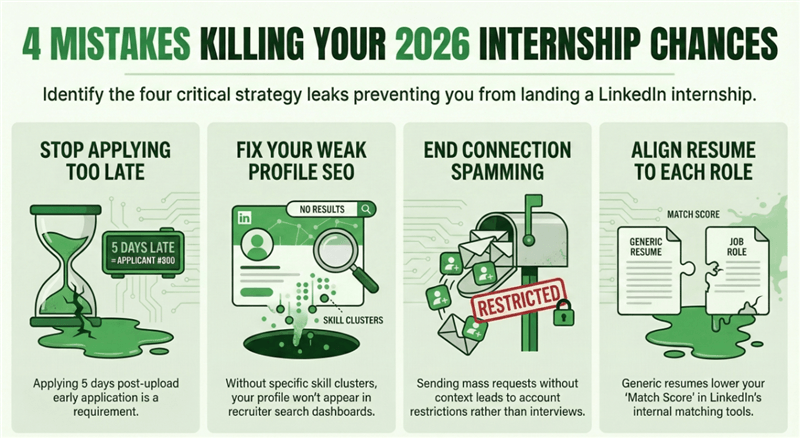
- Applying Too Late: In 2026, “Early Bird” isn’t a suggestion; it’s a requirement. If you apply 5 days after a post goes up, you are likely applicant #800.
- Weak Profile (No SEO): Recruiters search for interns using specific skill clusters. If your profile doesn’t “match” their search string, you don’t even exist in their dashboard.
- No Networking Strategy: “Connection spamming” is not networking. Sending 50 requests a day with no context often leads to account restrictions, not interviews.
- No Resume Alignment: Using one generic resume for 50 different roles. LinkedIn’s internal matching tools see the discrepancy between your LinkedIn profile and your uploaded PDF, lowering your “Match Score.”
Real Job Seekers’ Experiences with LinkedIn Internships (Reddit Insights 2026)
The frustration is palpable across professional communities. On Reddit, users are increasingly vocal about the “numbers game” required to succeed today:
“147 apps/1 offer… the market is cooked, but literally anything can happen. You just have to be the first one in the door for the right role.” — A user from r/EngineeringStudents
Another user highlighted the futility of relying solely on the “Easy Apply” button without a secondary strategy:
“LinkedIn is a black hole if you just apply. I wouldn’t depend on it… both of my offers came from referrals or catching the recruiter in the DMs within an hour of the post.” — A user from r/csMajors
How LinkedIn’s Job Matching Algorithm Works
To win the game, you must understand the rules. In 2026, LinkedIn uses the 360Brew Algorithm, which prioritizes semantic relevance and verified intent.
3 LinkedIn Ranking Factors That Determine Internship Visibility
- Profile Keyword Relevance: It’s not just about having the word “Intern” in your bio. The algorithm looks for “Skill Clusters.” For example, if you want a Data Science internship, it looks for the presence of Python, SQL, Tableau, and Machine Learning across your Headline, About, and Experience sections.
- Activity & Engagement: LinkedIn favors “active” users. If you post, comment, and engage with industry leaders, your profile is more likely to appear at the top of a recruiter’s search results when they use LinkedIn Recruiter.
- Application Timing: LinkedIn tracks “Speed to Interest.” Users who apply within the first 24 hours of a job posting are flagged as “High Interest” candidates.
How Recruiters Filter Internship Candidates on LinkedIn
Recruiters don’t sit and read 500 resumes. They use filters.
- They filter by “Top Match” (based on LinkedIn’s AI scoring).
- They filter by “Verified Skills” (those who have passed Skill Assessments or have endorsements).
- They filter by “Recent Applicants.”
If you don’t pass these three filters, a human being will never even see your name.
How to Get an Internship on LinkedIn (Step-by-Step)
Landing an internship on LinkedIn in 2026 requires more than just applying—it demands a clear, strategic system. Follow these step-by-step actions to boost your visibility, beat the competition, and secure interviews faster.
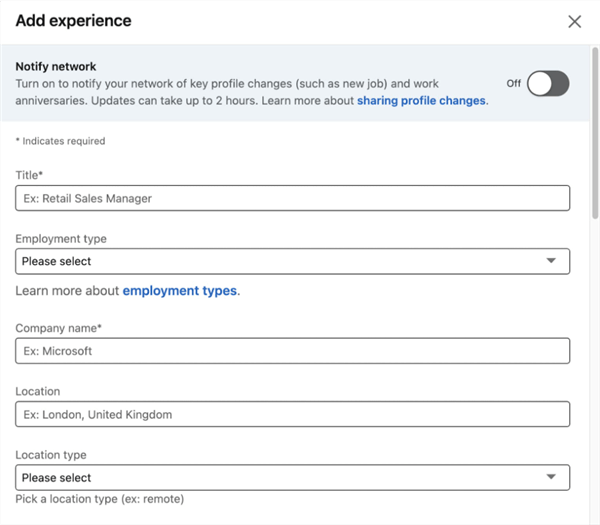
Step 1: Optimize Your LinkedIn Profile (LinkedIn SEO)
Your profile is your 24/7 salesperson. If it’s not optimized, every connection request you send is a wasted opportunity. Follow the tips below to optimize your LinkedIn profile easily:
Headline Formula
Stop using “Student at [University].” It tells a recruiter nothing about what you can do. Use this formula instead:
[Target Role] | [Core Technical Skill] | [Specific Achievement or Project Success]
Example: “Aspiring Product Management Intern | SQL & Agile Certified | Lead 5-person team to launch ‘Campus Eats’ App (500+ users)”
About Section Strategy: Keyword Clustering
Use the “About” section to tell a story while hitting SEO marks. Don’t just list skills; group them.
- Tech Stack: Python, Java, AWS.
- Soft Skills: Cross-functional collaboration, Agile methodology.
- Interests: FinTech, Sustainability, AI Ethics.
Skills & Experience Matching
Ensure your “Skills” section has at least 20 entries relevant to your target internship. In 2026, Verified Identity (The Blue Check) and Skill Badges are the top-tier ranking signals. If LinkedIn offers a quiz for a skill you have, take it.
Step 2: Find the Right Internships (Beyond the Jobs Tab)
The “Jobs” tab is the most competitive place on the internet. To find less crowded opportunities, you must look where others aren’t.
- Smart Job Search Techniques: Use boolean operators in the search bar. Instead of just “Internship,” try: “Marketing Intern” AND “Remote” NOT “Unpaid”.
- Hidden Job Market Strategy: Search for Posts, not just Jobs. Many founders and hiring managers post a status update like “We’re looking for a summer intern, DM me” before they ever pay for a formal job listing.
- Hashtag Strategy: Follow specific tags like #hiringinterns, #2026internships, and #startupjobs. This puts fresh opportunities directly into your home feed.
Step 3: Apply Before Everyone Else (Critical Advantage)
Timing is the difference between an interview and “ghosting.”
The “72-Hour Rule”
Most recruiters for competitive internships decide on their “First Batch” of interviews within the first 72 hours. After that, the odds of your resume being opened drop by over 70%.
The Daily Routine
- Morning (8:00 AM): Check “New Jobs” posted in the last 24 hours.
- Evening (6:00 PM): Search for “Posts” from the last 24 hours containing the keyword “Intern.”
- Alerts: Set up highly specific job alerts (e.g., “UX Design Intern San Francisco”) and ensure notifications are pushed to your phone instantly.
Step 4: Build a Networking Funnel (Not Just Messages)
Networking is not asking for a job; it’s asking for perspective.
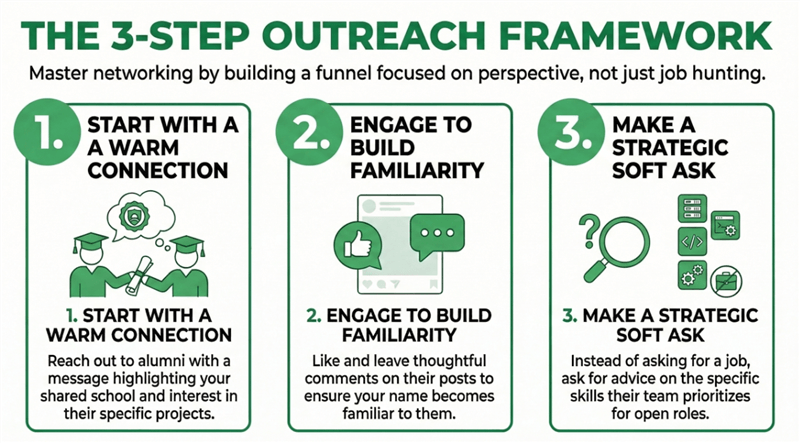
The 3-Step Outreach Framework
- The “Warm Connection”: Send a request to an alum from your school working at the company. Message: “Hi [Name], I’m a fellow [University] student. I saw your work on [Project] and would love to follow your journey!”
- Engage: Like and leave a thoughtful comment on their next post. This makes your name familiar.
- The Soft Ask: * “Hi [Name], I noticed a Summer Intern role opened at [Company]. As an alum, do you have any advice on the specific skills the team prioritizes? I’d love to make sure my application is a good fit.”*
Message Templates (High Value)
Connection Request to Recruiter:
“Hi [Name], I’m applying for the [Role] at [Company]. I’ve spent the last year building [Project], which aligns perfectly with your team’s focus on [Specific Goal]. I’d love to connect and stay updated on your team’s growth!”
Step 5: Align Your Resume with LinkedIn
Your LinkedIn profile is for discovery; your resume is for selection. If they don’t say the same thing, you look inconsistent.
- Mirroring: If your LinkedIn says you are an expert in “Data Visualization,” but your resume only mentions “Excel,” you will fail the automated screening.
- Customization: Use a tool to compare your resume against the job description. If the job asks for “Strategic Communication,” ensure that exact phrase appears in your bullet points.
Step 6: Use AI to Apply Smarter (Not Harder)
In 2026, the sheer volume of listings makes manual searching inefficient. This is where Jobright.ai becomes your unfair advantage.
Manually searching for internships for hours every day is not just inefficient—it’s a strategic mistake. By the time you find a relevant role, hundreds of candidates may have already applied.
How Jobright AI Solves This
- AI-Powered Job Matching (Not Just Job Search): Instead of endless scrolling, Jobright analyzes your skills, experience, and goals to surface only highly relevant roles—eliminating noise and helping you focus on high-probability opportunities.
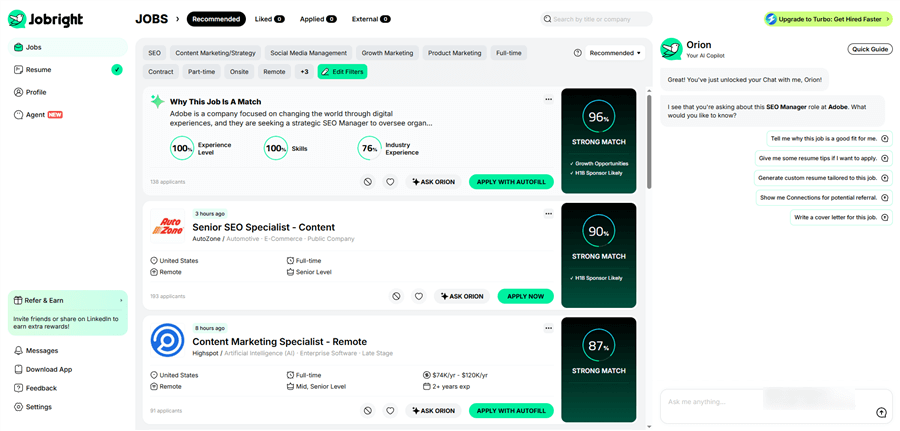
- Real-Time Alerts for the “Early Bird” Advantage: With access to millions of listings and hundreds of thousands of new jobs daily, Jobright alerts you the moment a matching role is posted—so you can consistently apply within the critical first 24 hours.
- AI Resume Builder & Tailoring (ATS Optimization at Scale): Jobright doesn’t just review your resume—it rebuilds and tailors it for each job description.
- Instantly analyzes your resume
- Suggests keyword improvements
- Generates ATS-friendly versions in seconds
- Aligns your experience with specific role requirements
This ensures your resume passes automated filters and matches recruiter expectations.
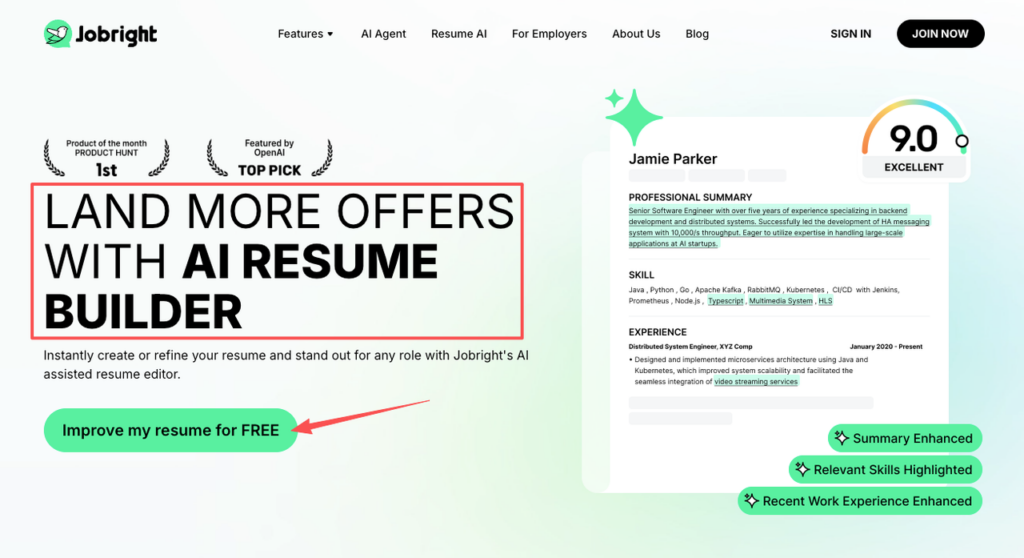
- Match Scoring (Apply with Precision, Not Guesswork): Before applying, Jobright gives you a Match Score—showing how well you fit a role and what’s missing. Instead of applying blindly, you can:
- Identify gaps instantly
- Adjust keywords or skills
- Apply only when your chances are strong
- 1-Click Application Autofill (Speed at Scale): Applying manually wastes time. Jobright automates repetitive steps by autofilling applications across major ATS platforms—saving up to 80% of application time.
- Insider Connections & Referral Discovery: One of Jobright’s strongest advantages is identifying alumni and internal connections at target companies—helping you move beyond cold applications and into referral-based hiring (which significantly increases interview chances).
- AI Career Copilot (24/7 Guidance): With its built-in AI assistant, Jobright provides continuous support—from resume optimization to interview prep—so you’re never stuck during your job search.
Advanced LinkedIn Internship Strategies Most Candidates Ignore
Create Content to Attract Recruiters
You don’t need to be an “influencer.” Just document your learning.
- The “Proof of Work” Post: “Just finished a 4-week sprint on a Python-based weather app. Here is what I learned about API integration…”
- Why this works: It provides “Social Proof.” When a recruiter clicks your profile, they see you are actually doing the work, not just claiming the skill.
Alumni Leverage
Reddit users consistently report higher success rates through alumni:
“Reach out to alumni… some of these companies have a referral program… don’t be shy. A referral is basically a guaranteed resume read.” — (Source: r/Big4)
Common LinkedIn Internship Mistakes to Avoid (And How to Fix Them Fast)
| Mistake | Why Does It Kill Your Chances | Fix |
| “Give me a job,” DMs | It feels transactional and desperate. | Ask for advice or “the team’s culture” instead. |
| Ignoring the 24h Rule | You become a needle in a haystack of 500+ apps. | Use Jobright.ai to get instant alerts. |
| Ghosting your own profile | No activity = “Inactive” signal to the algorithm. | Comment on 3 industry posts per week. |
| Generic Resumes | ATS (Applicant Tracking Systems) will auto-reject low matches. | Tailor your top 3 bullet points for every single app. |
Realistic Timeline & Expectations
Landing an internship is a marathon, not a sprint. Here is what a successful 2026 timeline looks like:
- Weeks 1–2: The Foundation. Optimize your profile, get your “Blue Check” verification, and set up your Jobright.ai dashboard.
- Weeks 2–4: The Hunting Phase. Start applying to 3–5 high-quality matches per day. Focus on roles posted within the last 24 hours. Begin sending 5 “Warm” connection requests per week.
- Month 1+: The Interview Phase. As your “Match Score” improves and your networking pays off, you should see a 10–20% response rate for interviews.
Conclusion: Apply Smarter, Not Harder
Getting an internship on LinkedIn in 2026 isn’t about being the smartest person in the room—it’s about being the most visible and the most timely. By moving away from the “apply and pray” method and moving toward a system of LinkedIn SEO, early application, and AI-driven networking, you put yourself in the top 1% of applicants.
Stop wasting hours on manual searches. Let technology do the heavy lifting so you can focus on what matters: preparing for the interview.
Ready to find your next internship before the crowd does? Try Jobright today and land your interview faster.
LinkedIn Internship FAQs (2026): Answers to Common Job Search Questions
Is LinkedIn still good for internships in 2026?
Yes—but only if you use it as more than a job board. The most successful candidates treat LinkedIn as a networking and visibility platform, not just a place to apply. Combining early applications with outreach and profile optimization dramatically increases your chances.
How many internships should I apply to daily?
Quality beats quantity. Aim for 3–5 highly relevant roles per day, especially those posted within the last 24 hours. Pair each application with a follow-up message or connection request to stand out.
Do recruiters actually check LinkedIn profiles?
Yes. The majority of recruiters review LinkedIn profiles after screening resumes. An incomplete or inactive profile can hurt your chances, while an optimized, active profile can push you into the “Top Match” category.
Can I get an internship with no experience?
Yes. Focus on “Proof of Work” instead of formal experience. Showcase:
- Personal projects (e.g., apps, case studies)
- GitHub portfolios
- Volunteer work
- Coursework with measurable outcomes
Recruiters care more about what you can do than job titles.
How do I stand out among 200+ applicants on LinkedIn?
You need three advantages:
- Speed – Apply within the first 24 hours
- Relevance – Match keywords in the job description
- Visibility – Message recruiters or employees
Most candidates only apply. Very few combine all three.
What is the best time to apply for internships on LinkedIn?
The best window is within the first 24–72 hours after a job is posted.
For daily timing:
- Morning (8–10 AM): New postings
- Evening (6–9 PM): Hiring manager posts
Applying early significantly increases your chances of being seen.
Is “Easy Apply” worth using in 2026?
Only as a starting point. “Easy Apply” alone has a very low success rate.
To improve results:
- Always customize your resume
- Message the recruiter or hiring manager
- Engage with company content before applying
Should I message recruiters after applying?
Yes—but do it strategically. Avoid generic messages like “I applied.”
Instead, send a short message highlighting:
- Your relevant project or skill
- Why you fit the role
- A polite request for advice or next steps
This can dramatically increase your visibility.