
Meta Technical Interview Questions: Complete Guide (2025)
No matter what role you’re applying for, Meta technical interview questions are exceptionally challenging. As the parent company of Facebook, Instagram, WhatsApp, and Reality Labs, Meta operates at a scale serving billions of users globally. This guide covers the most common Meta interview questions and how to answer them effectively.
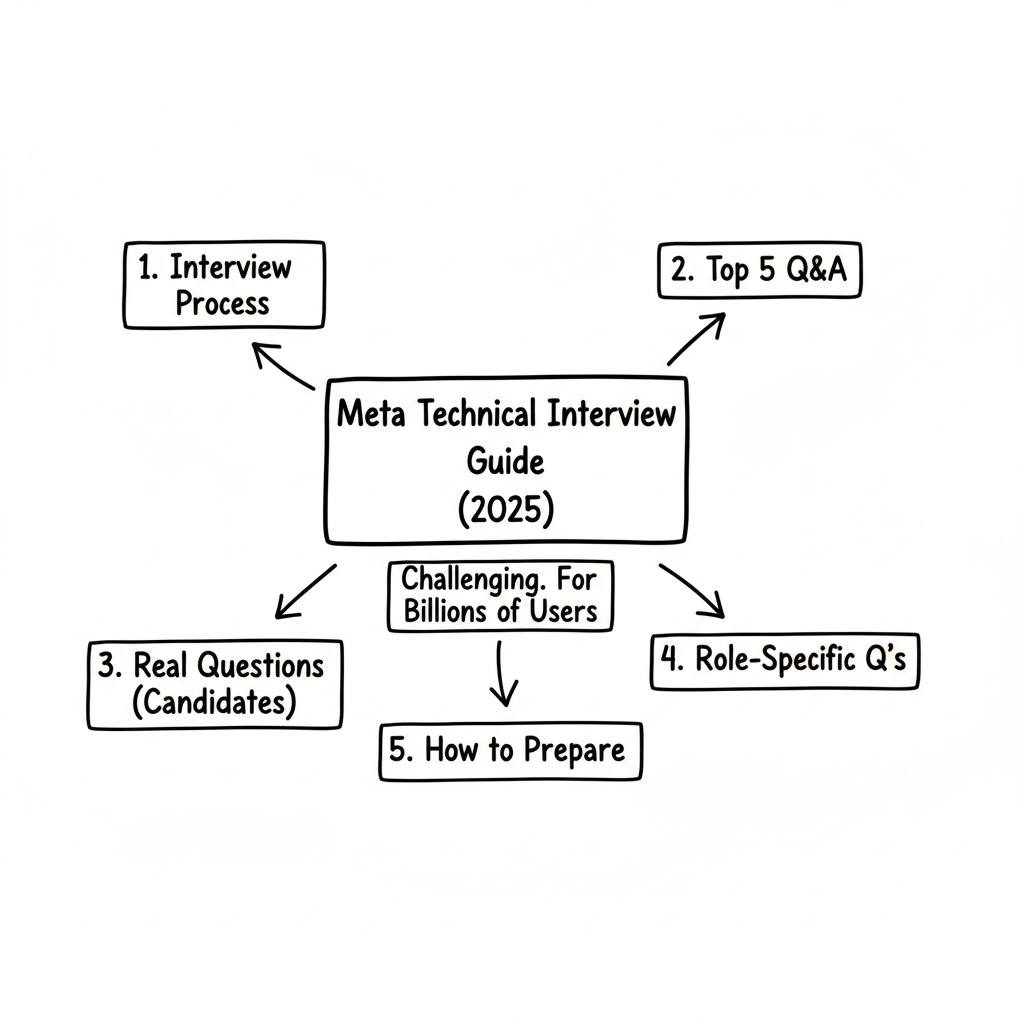
1. Meta Interview Process
1.1 Resume Screen
After submitting your application through Meta’s careers portal or being contacted via LinkedIn, recruiters evaluate if your experience aligns with the role. Focus on quantifiable achievements, large-scale system experience, and alignment with Meta’s values. This typically takes 1-2 weeks.
1.2 Recruiter Call
A 20-30 minute call covering your background, interest in Meta, role fit, and interview logistics. Familiarize yourself with Meta’s recent product updates and engineering blog beforehand.
1.3 Technical Phone Screen
1-2 video interviews (45 minutes each) featuring coding problems of LeetCode medium difficulty. You’ll use a simple online editor, so practice in that environment.
1.4 Skills-Based Assessment
Depending on your role, you may receive take-home projects, system design exercises, ML case studies, or data analysis challenges between phone screen and final interviews.
1.5 Virtual Onsite Interviews
The most intensive stage: 4-5 interviews over one or two days (45-60 minutes each).
For software engineering roles:
- 2-3 Coding Interviews: Algorithmic problems harder than phone screen questions
- 1-2 System Design Interviews: Design large-scale distributed systems (E4+)
- 1 Behavioral Interview: Cultural fit and alignment with Meta’s values
1.6 You Get an Offer
Feedback typically arrives within one week. E4 (mid-level) total compensation ranges from $270,000-$330,000, while E5 (senior) exceeds $400,000.
2. Top 5 Meta Interview Questions and Example Answers
Based on analysis of hundreds of candidate reports on Glassdoor and other platforms.
2.1 Why are you interested in working at Meta?
Why interviewers ask this
Meta needs engineers excited about solving problems at unprecedented scale and who align with their mission. This reveals your motivation, cultural fit, and whether you’ve researched Meta’s products and challenges.
How to answer
- Be specific about products, teams, or technical challenges
- Connect to Meta’s values like “Move Fast” or “Build Awesome Things”
- Show authenticity based on your career goals
- Demonstrate research through recent initiatives or blog posts
Example answer:
“I’m excited about Meta for three reasons. First, the scale—serving over 3 billion users presents unique challenges. I’ve followed your News Feed optimization work, particularly the engineering blog post about reducing latency by 30%, which resonates with my experience optimizing distributed systems.Second, Meta’s ‘Move Fast’ culture aligns with my approach. At my previous role, I shipped a complete payment system refactor in six weeks through rapid iteration.Finally, Meta’s AI research excites me. Your work with PyTorch and large language models is advancing the entire field, and I want to contribute to that impact.”
2.2 Tell me about a challenging project you led and the impact it had.
Why interviewers ask this
Meta wants to understand how you handle complex problems, drive meaningful impact, lead others, and measure results. This assesses end-to-end ownership and cross-functional navigation.
How to answer
Use the SPSIL framework (Situation-Problem-Solution-Impact-Lessons).
Example answer:
- Situation: At my previous company, I led migrating our monolithic recommendation system to microservices. 10 million users, but response times exceeded 2 seconds during peak hours, causing 15% drop-off.
- Problem: The monolithic system couldn’t scale horizontally, and tight coupling prevented rapid iteration.
- Solution: I designed a phased migration with clear service boundaries, implemented feature flags for gradual traffic routing, and established weekly stakeholder syncs. I collaborated with three senior engineers and two product managers.
- Impact: P95 latency dropped from 2 seconds to 300ms (85% improvement), increasing user engagement by 12%. Deployment times fell from 2 hours to 15 minutes, enabling 3x faster feature shipping. Project took 4 months.
- Lessons: Incremental migration strategies and upfront investment in monitoring are crucial. Over-communicating during major architectural changes builds trust.
2.3 Implement an LRU Cache
Why interviewers ask this
This classic problem tests data structures knowledge (hash maps, doubly linked lists), O(1) time complexity optimization, code clarity, and communication. Caching is critical for serving billions of users with low latency.
How to answer
- Clarify: “We need a cache with fixed capacity supporting get(key) and put(key, value) in O(1) time. When at capacity, evict the least recently used item. Correct?”
- Plan: “I’ll use a hash map for O(1) lookup and doubly linked list for order maintenance. Most recently used at head, least recently used at tail.”
- Implement:
class Node:
    def __init__(self, key, value):
        self.key = key
        self.value = value
        self.prev = None
        self.next = None

class LRUCache:
    def __init__(self, capacity: int):
        self.capacity = capacity
        self.cache = {}
        self.head = Node(0, 0)
        self.tail = Node(0, 0)
        self.head.next = self.tail
        self.tail.prev = self.head

    def _remove(self, node):
        prev_node = node.prev
        next_node = node.next
        prev_node.next = next_node
        next_node.prev = prev_node

    def _add_to_head(self, node):
        node.next = self.head.next
        node.prev = self.head
        self.head.next.prev = node
        self.head.next = node

    def get(self, key: int) -> int:
        if key not in self.cache:
            return -1
        node = self.cache[key]
        self._remove(node)
        self._add_to_head(node)
        return node.value

    def put(self, key: int, value: int) -> None:
        if key in self.cache:
            node = self.cache[key]
            node.value = value
            self._remove(node)
            self._add_to_head(node)
        else:
            if len(self.cache) >= self.capacity:
                lru = self.tail.prev
                self._remove(lru)
                del self.cache[lru.key]
            new_node = Node(key, value)
            self.cache[key] = new_node
            self._add_to_head(new_node)
- Complexity: Both operations O(1) time, O(capacity) space.
2.4 Design the Instagram News Feed
Why interviewers ask this
News Feed is core to Meta’s products with complex engineering challenges at massive scale. This assesses your ability to design for billions of users, reason about trade-offs, handle real-time processing, and connect technical decisions to user experience.
How to answer
Clarify Requirements:
- “Are we focusing on feed generation and ranking? What’s the scale—users and posts? Latency requirements? Real-time or delayed feed acceptable?”
- Assume: 1 billion DAU, < 2 seconds load time, text/images/videos, personalized ranking.
Requirements
- Functional: View personalized feed, ranked order, refresh capability, multiple content types
- Non-Functional: < 2 seconds latency, 99.9% uptime, billions of users, personalized content
Scale
- 1B DAU × 10 refreshes × 50 posts = 500B reads/day
- ~6M QPS (peak 3-5x higher)
Architecture
[Clients] → [Load Balancer] → [API Gateway] → [Feed Service] ←→ [Redis Cache]
                                                ↓         ↓
                                        [Fanout Service]  [Ranking Service]
                                                ↓              ↓
                                        [Post Service]    [ML Models]
                                                ↓
                                        [Databases: User/Post/Social Graph]
Core Components
- Fanout Service: Push model for most users, pull for celebrities (hybrid approach). Use Kafka for async processing.
- Ranking Service: ML models score posts by engagement likelihood, recency, post type, preferences. Cache predictions.
- Storage: Cassandra for posts, graph DB for relationships, S3/CDN for media.
- Caching: Redis with 5-minute TTL for pre-generated feeds.
Ranking Algorithm
- Retrieve last 1000 posts from followed accounts
- Extract features (interactions, characteristics, preferences)
- Score with neural network
- Select top 50 posts
- Adapt with online learning
Trade-offs
- Push vs. Pull: Hybrid—push for most users, pull for > 1M followers
- Consistency: Eventual consistency acceptable for low latency
- Ranking: Simpler models for initial load, sophisticated for updates
2.5 How do you handle conflict with a teammate?
Why interviewers ask this
Meta operates through extensive collaboration. This question assesses interpersonal skills, emotional intelligence, and ability to navigate disagreements productively.
How to answer
Use a specific example showing you can disagree professionally while maintaining relationships and focusing on outcomes.
Example answer:
“On a recent project, a teammate and I disagreed on our API design approach. He preferred REST while I advocated for GraphQL given our complex data requirements. Rather than escalating, I scheduled a one-on-one where we each presented our reasoning with concrete examples. I acknowledged the valid concerns about GraphQL’s learning curve while sharing data showing it could reduce our API calls by 60%. We agreed to prototype both approaches with a small feature. The GraphQL prototype demonstrated clear benefits for our use case. My teammate appreciated the collaborative approach, and we now work well together on complex decisions. This taught me that most conflicts stem from different information or priorities rather than incompetence. Taking time to understand the other perspective and using data usually leads to better outcomes.”
3. Real Meta Interview Questions from Recent Candidates
3.1 Design an In-Memory Key-Value Store with Rollback Capability
This system design question tests your understanding of data structures, versioning, and memory management—critical for Meta’s infrastructure systems.
Why interviewers ask this
Meta’s systems require sophisticated state management and the ability to recover from errors. This question assesses your ability to design storage systems with version control, optimize for memory usage, and handle concurrent operations. Understanding version control concepts is fundamental to building reliable distributed systems.
How to answer
Clarify Requirements
- “Should we support multiple key-value pairs? How many versions should we keep—unlimited or a fixed number? What operations: get, put, rollback? Should rollback be to a specific version or just the previous one? Do we need to handle concurrent operations?”
- Assume: Multiple keys, rollback to any previous version, thread-safe operations, memory-efficient storage.
Design Approach
- Use a combination of HashMap for current state and a versioning mechanism. Consider these strategies:
- Option 1: Copy-on-Write
- Store complete snapshot for each version
- Fast rollback but high memory usage
- Good for few versions
- Option 2: Delta-based (Recommended)
- Store only changes between versions
- Memory-efficient, slightly slower rollback
- Better for many versions
- Option 1: Copy-on-Write
Implementation
from typing import Any, Dict, Optional
from collections import defaultdict

class VersionedKVStore:
    def __init__(self):
        # Current state: key -> value
        self.current: Dict[str, Any] = {}
        # Version history: version -> {key -> (old_value, operation)}
        self.versions: Dict[int, Dict[str, tuple]] = defaultdict(dict)
        self.current_version = 0
        # Track which keys were added in each version
        self.version_keys: Dict[int, set] = defaultdict(set)

    def put(self, key: str, value: Any) -> None:
        """Set key to value, creating a new version."""
        self.current_version += 1

        # Store old value for rollback
        if key in self.current:
            old_value = self.current[key]
            self.versions[self.current_version][key] = (old_value, 'UPDATE')
        else:
            self.versions[self.current_version][key] = (None, 'INSERT')
            self.version_keys[self.current_version].add(key)

        # Update current state
        self.current[key] = value

    def get(self, key: str) -> Optional[Any]:
        """Get current value for key."""
        return self.current.get(key)

    def delete(self, key: str) -> bool:
        """Delete key, creating a new version."""
        if key not in self.current:
            return False

        self.current_version += 1
        old_value = self.current[key]
        self.versions[self.current_version][key] = (old_value, 'DELETE')
        del self.current[key]
        return True

    def rollback(self, target_version: int) -> bool:
        """Rollback to a specific version."""
        if target_version < 0 or target_version > self.current_version:
            return False

        # Apply versions in reverse order
        for version in range(self.current_version, target_version, -1):
            if version not in self.versions:
                continue

            for key, (old_value, operation) in self.versions[version].items():
                if operation == 'UPDATE':
                    self.current[key] = old_value
                elif operation == 'INSERT':
                    if key in self.current:
                        del self.current[key]
                elif operation == 'DELETE':
                    self.current[key] = old_value

            # Clean up version history
            del self.versions[version]
            if version in self.version_keys:
                del self.version_keys[version]

        self.current_version = target_version
        return True

    def get_version(self) -> int:
        """Return current version number."""
        return self.current_version

# Example usage
store = VersionedKVStore()

# Version 1
store.put("name", "Alice")
store.put("age", 30)
print(f"Version {store.get_version()}: name={store.get('name')}")

# Version 2
store.put("age", 31)
store.put("city", "NYC")

# Version 3
store.delete("name")

# Rollback to version 1
store.rollback(1)
print(f"After rollback: name={store.get('name')}, age={store.get('age')}")
Optimizations
- Memory Management:
- Implement version pruning: keep only last N versions
- Use weak references for rarely accessed versions
- Compress version history periodically
- Performance:
- Add caching for frequently rolled-back versions
- Implement lazy rollback: defer changes until next operation
- Use copy-on-write data structures for large values
- Thread Safety:
- Add locks for concurrent operations
- Use atomic operations for version incrementing
- Consider MVCC (Multi-Version Concurrency Control) for better concurrency
Complexity Analysis
- put(key, value): O(1) time, O(1) space per operation
- get(key): O(1) time
- delete(key): O(1) time
- rollback(version): O(k) where k = number of operations between versions
- Space: O(n × m) where n = number of keys, m = number of versions
Trade-offs
- Memory vs. Speed:
- Delta-based: Low memory, slower rollback
- Snapshot-based: High memory, faster rollback
- Hybrid: Keep snapshots every N versions + deltas
- Consistency vs. Performance:
- Strong consistency requires locking (slower)
- Eventual consistency enables better concurrency
This design balances memory efficiency with rollback performance, suitable for Meta-scale systems requiring audit trails and error recovery.
3.2 Find the Host with Highest BPS from a Text File
This is a real Meta coding question testing file I/O, data parsing, and hash map usage—essential skills for infrastructure work at scale.
Problem: Given a text file containing host entries with bandwidth information, find which host has the highest bits per second (BPS).
Example input format:
2023-01-01 10:00:01 host1.meta.com 1000000
2023-01-01 10:00:02 host2.meta.com 2500000
2023-01-01 10:00:03 host1.meta.com 1500000
2023-01-01 10:00:04 host3.meta.com 3000000
2023-01-01 10:00:05 host2.meta.com 2000000
Why interviewers ask this
This tests your ability to process large log files efficiently, aggregate data, and handle real-world data formats—critical for Meta’s observability and monitoring systems described in their infrastructure blog posts.
How to answer
Clarify requirements:
“Should we sum the BPS for each host or find the single highest entry? How large is the file—can it fit in memory? What’s the file format—fixed or variable?”
Use hash map for aggregation:
Track total BPS per host
Handle edge cases:
- Invalid entries, missing fields, malformed data
- Implementation:
from typing import Dict, Optional
from collections import defaultdict

def find_highest_bps_host(file_path: str) -> Optional[str]:
    """
    Find the host with highest total BPS from a log file.

    Args:
        file_path: Path to the log file

    Returns:
        Hostname with highest BPS, or None if file is empty
    """
    host_bps: Dict[str, int] = defaultdict(int)

    try:
        with open(file_path, 'r') as file:
            for line_num, line in enumerate(file, 1):
                try:
                    # Parse line: timestamp timestamp hostname bps
                    parts = line.strip().split()

                    if len(parts) < 4:
                        print(f"Warning: Skipping malformed line {line_num}")
                        continue

                    # Extract hostname and BPS
                    hostname = parts[2]
                    bps = int(parts[3])

                    # Aggregate BPS per host
                    host_bps[hostname] += bps

                except (ValueError, IndexError) as e:
                    print(f"Warning: Error parsing line {line_num}: {e}")
                    continue

        # Find host with maximum BPS
        if not host_bps:
            return None

        max_host = max(host_bps.items(), key=lambda x: x[1])
        return max_host[0]

    except FileNotFoundError:
        print(f"Error: File {file_path} not found")
        return None
    except PermissionError:
        print(f"Error: Permission denied for file {file_path}")
        return None

# Optimized version for very large files
def find_highest_bps_host_streaming(file_path: str) -> Optional[str]:
    """
    Memory-efficient version using streaming processing.
    Good for files larger than available RAM.
    """
    max_host = None
    max_bps = 0
    current_host_bps: Dict[str, int] = {}

    with open(file_path, 'r') as file:
        for line in file:
            parts = line.strip().split()
            if len(parts) < 4:
                continue

            hostname = parts[2]
            try:
                bps = int(parts[3])
                current_host_bps[hostname] = current_host_bps.get(hostname, 0) + bps

                # Track maximum as we go
                if current_host_bps[hostname] > max_bps:
                    max_bps = current_host_bps[hostname]
                    max_host = hostname
            except ValueError:
                continue

    return max_host

# Example usage
if __name__ == "__main__":
    result = find_highest_bps_host("host_logs.txt")
    if result:
print(f"Host with highest BPS: {result}")- Alternative: Using pandas for complex analysis
import pandas as pd

def find_highest_bps_host_pandas(file_path: str) -> Optional[str]:
    """
    Using pandas for more complex analysis scenarios.
    """
    try:
        # Read file into DataFrame
        df = pd.read_csv(
            file_path,
            sep=r'\s+',
            header=None,
            names=['date', 'time', 'hostname', 'bps'],
            on_bad_lines='skip'
        )

        # Group by hostname and sum BPS
        host_totals = df.groupby('hostname')['bps'].sum()

        # Find maximum
        max_host = host_totals.idxmax()

        return max_host
    except Exception as e:
        print(f"Error: {e}")
return None- Complexity Analysis:
- Time Complexity: O(n) where n is the number of lines in the file
- Space Complexity: O(h) where h is the number of unique hosts
- For streaming version: O(h) space regardless of file size
- Discussion points:
- How to handle files larger than RAM? (Streaming, external sorting)
- How to parallelize for distributed processing? (MapReduce, Spark)
- How to handle concurrent file updates? (File locking, event-driven processing)
- Production considerations: logging, monitoring, error handling, retry logic
This problem relates to LeetCode 347 (Top K Frequent Elements) and demonstrates practical file I/O operations that are crucial for Meta’s infrastructure systems.
4. Role-Specific Interview Questions
4.1 Software Engineer (SWE)
Common Questions:
- Implement a function to find the k most frequent elements in an array
- Design a URL shortening service like bit.ly
- Given a binary tree, find the lowest common ancestor of two nodes
Focus Areas: Algorithms, data structures, system design (E4+), coding best practices
4.2 Engineering Manager (EM)
Common Questions:
- How do you handle underperforming team members?
- Describe your approach to technical strategy and roadmap planning
- How do you balance technical debt with feature development?
Focus Areas: People management, technical leadership, cross-functional collaboration, strategic thinking
4.3 Machine Learning Engineer
Common Questions:
- Design a recommendation system for Instagram Reels
- Explain how you would handle class imbalance in a dataset
- How would you deploy a model to production serving millions of users?
Focus Areas: ML algorithms, model deployment, data pipelines, A/B testing, scalability
5. How to Prepare for Meta Interviews
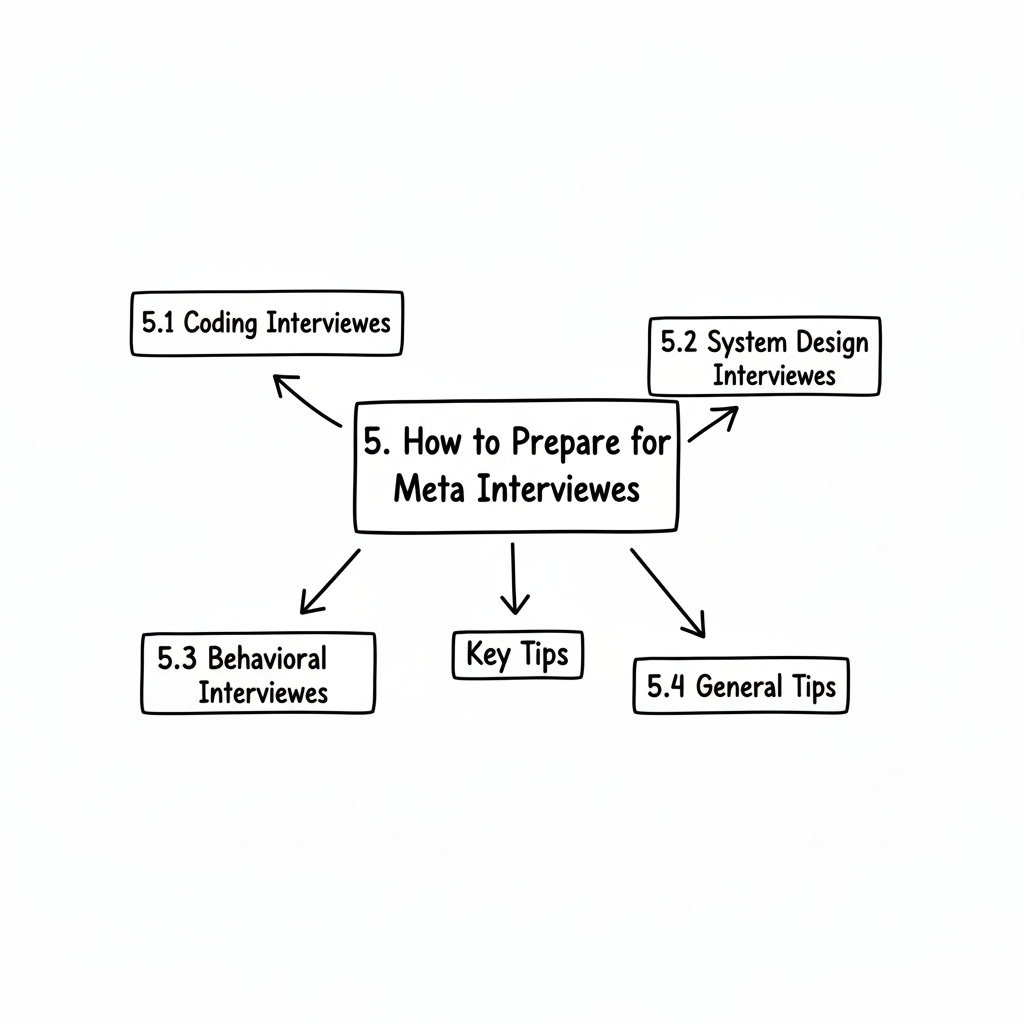
5.1 For Coding Interviews
- Practice extensively: Solve 150-200 LeetCode problems focusing on Meta’s frequent patterns: arrays, strings, trees, graphs, dynamic programming.
- Master fundamentals: Hash maps, linked lists, trees, graphs, sorting algorithms.
- Time yourself: Practice under pressure with 45-minute limits.
- Communicate clearly: Explain your thought process out loud.
5.2 For System Design Interviews
- Study Meta’s architecture: Read Meta’s engineering blog to understand their systems.
- Practice common patterns: Design News Feed, Messenger, Instagram Stories, notification systems.
- Learn fundamentals: Caching, load balancing, databases, message queues, CDNs.
5.3 For Behavioral Interviews
- Prepare 8-10 stories using STAR/SPSIL framework covering:
- Leadership and initiative
- Handling conflict
- Project challenges
- Impact and results
- Failure and learning
- Align with Meta’s values: “Move Fast,” “Build Awesome Things,” “Focus on Long-Term Impact,” “Be Bold,” “Build Social Value”
- Quantify impact: Use specific metrics and numbers
5.4 General Tips
- Timeline: Start preparing 2-3 months before interviews.
- Mock interviews: Practice with peers or use platforms like Pramp.
- Stay current: Follow Meta’s product launches and engineering initiatives.
- Ask questions: Prepare thoughtful questions about team, projects, and culture.
- Follow up: Send thank-you notes after interviews.
6. Accelerate Your Meta Job Search with Jobright
Landing a role at Meta requires more than just technical preparation, it demands a strategic job search approach. Jobright is an AI-powered job search copilot designed to help you navigate competitive tech hiring processes more effectively.
Key features for Meta candidates:
- AI Job Matching: Get personalized Meta role recommendations based on your skills and experience, with real-time alerts for new openings
- Application Tracking: Organize your Meta applications and follow-ups in one place with intelligent reminders
Whether you’re targeting software engineering, ML, or product roles at Meta, Jobright streamlines your search so you can focus on interview preparation. Start your free trial today to get matched with relevant Meta opportunities.