
3 Remote Jobs (No Experience) That Actually Hire
Table of Contents
Last Updated: January 08, 2026
Why do 90% of remote applications get ignored? Because they all look exactly the same.
In the 2026 hiring surge, clicking “Easy Apply” on generic job boards is the fastest way to remain unemployed. If you are applying for “data entry” or “support” roles alongside 5,000 other people using the same generic templates, you are blending in when you need to stand out.
The harsh truth is that remote work for beginners isn’t about finding a job; it’s about auditioning for one through your application materials.
We are going to tear down your current approach and rebuild it to signal competence, reliability, and value—the three things recruiters actually care about.
Inside this guide, you’ll find:
- The new definition of “No Experience” for 2026.
- High-probability remote roles that most people overlook.
- Resume templates that frame your potential as experience.
- Strategic answers for remote-specific interview questions.
Stop guessing what they want. Here is exactly what they are looking for.
What “No Experience” Really Means for Remote Jobs (How Employers Actually Evaluate Beginners)
When you see “remote jobs no experience,” you probably think: “I have zero relevant background. I’m starting from nothing.”
Recruiters don’t see it that way.
They don’t care if you’ve never had a remote job before. They care about three signals:
- Proof you can do the core tasks.
- Proof you can work independently and communicate clearly.
- Proof you won’t disappear after two weeks.
Everything else is noise.
How hiring managers filter beginners in 10 seconds
Recruiters won’t tell you this, but for entry-level remote roles they often skim your resume for three things only:
- Role keywords (“customer support,” “data entry,” “virtual assistant,” “ticketing system”).
- Evidence of self-management (shifts, deadlines, async work, side projects).
- Written communication (clean bullets, no walls of text, no chaos formatting).
If they can’t see those signals at a glance, they close the tab.
Now add the ATS layer.
Most mid-to-large companies use ATS systems that rank you based on keyword match and formatting. Your resume has to survive what I call the ATS Stress Test:
- 80%+ keyword match vs. the job description.
- Zero formatting corruption (no tables, no text in images, no funky columns).
Stop doing this immediately, sending a “pretty” resume full of text boxes and icons. Data from multiple ATS vendors shows that complex formatting causes parsing errors, which can drop your conversion rate from application → interview by 20–30%.
A quick signal vs. noise check
Here’s a simple comparison.
Table: Signal vs. Noise in “No Experience” Remote Resumes
| “Signal” Behaviors | “Noise” Behaviors |
| Plain PDF or .docx, single column, standard fonts. | Canva templates, multi-column layouts, text inside shapes. |
| Bullets with measurable outcomes (e.g., “Handled 40+ chats/day”). | Vague claims (e.g., “Helped with many tasks online”). |
| Keywords from the job description woven into bullets. | Generic responsibilities copied from old job postings. |
When employers say “no experience required,” they assume you’ll still show signals like these. They’re not promising to train you from zero signal to full signal.
If you’re an international candidate, there’s another filter: sponsorship risk. Many US-based remote roles don’t mention H-1B sponsorship clearly. You need to check:
- USCIS rules and timelines for H-1B visa requirements
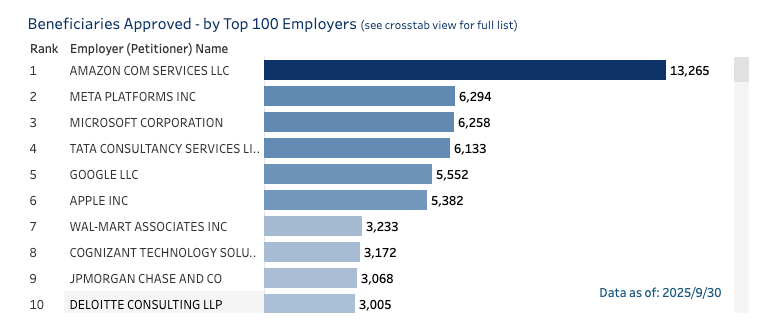
- Employer’s past H-1B filings in LCA databases or the DOL’s data tools
Companies that have never filed an H-1B are unlikely to sponsor for a remote beginner role. That doesn’t mean impossible, but your ROI is low. Focus your energy on firms with a history of filings.
Entry Level Remote Jobs That Hire With No Experience
Stop applying to random job postings. Here’s why: job boards are full of “entry level” roles that secretly want 2–3 years of experience. You waste hours and get nothing back.
Instead, aim at roles where the business modeldepends on fast beginner hiring. These jobs care more about your learning curve and reliability than your past titles.
Customer Support Remote Jobs (Beginner-Friendly, Script-Based)
Customer support is one of the most common on-ramps to remote work.
Why? Most teams use scripts, macros, and help centers. That means they can onboard beginners in weeks, not months.
Common titles:
- Customer Support Representative
- Chat Support Agent
- Email Support Specialist
- Technical Support Associate (Level 1)
What employers actually care about:
- Can you type fast enough (40–60 wpm)?
- Can you follow a script and not go off-track?
- Can you handle upset users without losing your cool?
- Can you work fixed shifts in your timezone?
Here’s the harsh truth: if your resume shows zero user-facing work, no retail, no tutoring, no school helpdesk, you’ll be outranked by someone who has it. But you can still win if you highlight:
- Group projects using Slack/Teams.
- Any role where you solved problems for people.
- Clear writing samples (portfolio, GitHub README, blog posts).
For tech folks, support roles at product companies can be a bridge into engineering, PM, or UX. Read internal mobility stories on official engineering blogs like the Google Engineering Blog to see how support and operations can feed into technical tracks.
Data Entry & Content Moderation Remote Jobs (Low Barrier Roles)
These roles have a lower skill barrier but higher competition.
Common titles:
- Data Entry Specialist
- Content Moderator
- Operations Assistant
- Annotation / Labeling Specialist (for ML data)
Signals that help you stand out:
- Accuracy metrics: error rate below 1–2%.
- Speed metrics: number of records reviewed per hour.
- Consistency: ability to do focused work for long blocks.
Stop guessing. Let’s look at the data: in internal ops teams I’ve worked with, top data entry contractors process 20–30% more items per hour with lower error rates than the average hire. That’s why numbers on your resume matter so much.
If you’re a visa-dependent candidate, note this: many of these roles are contract-based and US-only without sponsorship. They’re useful if you’re already authorized (OPT/CPT, H-4 EAD, etc.), but they rarely justify H-1B sponsorship under current rules from USCIS.
Virtual Assistant Roles for Your First Remote Job
Virtual assistant (VA) work can be a mix of all of the above: light project management, inbox triage, scheduling, data entry, research.
Titles you’ll see:
- Virtual Assistant
- Executive Assistant (Remote, Junior)
- Operations Coordinator
- Admin Assistant (Remote)
What clients and founders care about most:
- Responsiveness across time zones.
- Clear written updates.
- Ability to learn new tools fast (Notion, Asana, HubSpot, etc.).
Think about this role as a signal amplifier. Every task you complete on time, every small process you clean up, that’s a signal that you can be trusted with more.
Here is a simple process diagram for this path:
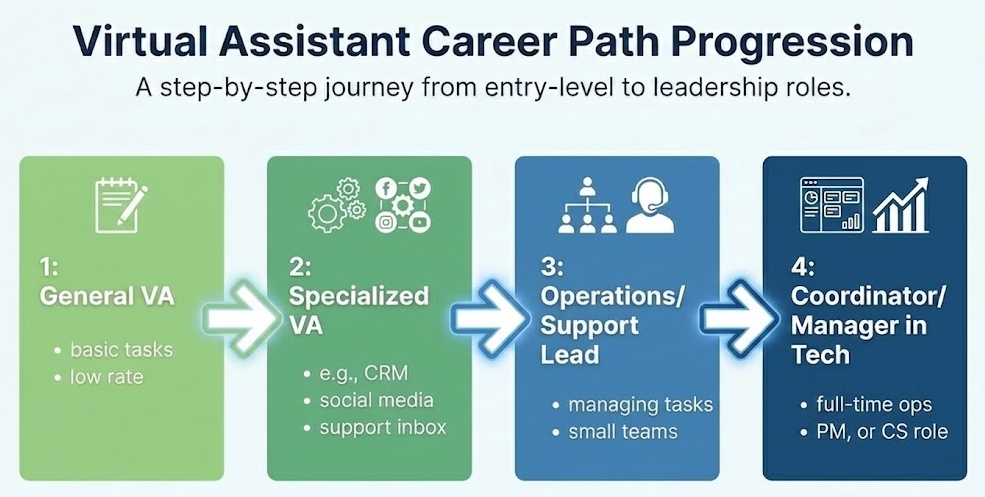
For international candidates, VAs often work with global clients. But if your long-term plan is a US work visa, keep an eye on employers who have US entities and appear in H-1B or LCA filings: that’s where progression plus sponsorship is possible.
Resume Bullet Examples for Remote Jobs With No Experience
If your resume says “Remote work” once and “hard-working” five times, you’re sending noise.
Your goal: align your bullets with the job description and pass an ATS keyword match of 80% or higher without keyword stuffing.
Here’s the harsh truth: copying responsibilities from the posting gives you keywords, but it kills credibility. Recruiters can spot it in seconds.
Instead, use a simple formula:
Action verb + task (with role keywords) + metric or concrete outcome
Below are example bullets you can adapt. They’re written to be ATS-friendly and to survive basic parsing.
For Customer Support Remote Roles
Target keywords: “customer support,” “ticketing system,” “chat,” “email,” “SLA,” “response time.”
Examples:
- “Handled 40–60 customer support chats per shift using [tool name], maintaining 95%+ satisfaction scores from post-chat surveys.”
- “Resolved 20+ email support tickets per day by following documented workflows and updating the ticketing system with clear summaries.”
- “Collaborated with a remote team across 3 time zones to meet response-time SLAs while sharing product feedback with the engineering team.”
For Data Entry & Content Moderation
Target keywords: “data entry,” “quality check,” “review,” “annotation,” “moderation,” “guidelines.”
Examples:
- “Completed 250+ data entry records per day from PDF to spreadsheet with <1% error rate, confirmed during weekly quality checks.”
- “Reviewed 300+ user-generated posts per shift for policy violations, applying written moderation guidelines and escalating edge cases.”
- “Annotated 1,000+ images for a machine learning project using defined tags, helping improve model accuracy measured by the data science team.”
For Virtual Assistant / Admin Roles
Target keywords: “calendar,” “scheduling,” “inbox management,” “research,” “reports,” “remote team.”
Examples:
- “Managed a busy calendar with 20–30 weekly meetings, scheduling across 4 time zones and preventing double-bookings.”
- “Reduced inbox backlog by 60% in 3 weeks by creating simple labels, rules, and canned responses for common questions.”
- “Prepared weekly status reports for a remote team of 8, summarizing tasks, deadlines, and blockers from project tools.”
What about “no experience” at all?
Even if you’ve never had formal employment, you can still send a strong signal. Use:
- School projects (remote teams, GitHub, shared docs).
- Volunteering (hotlines, tutoring, community support).
- Freelance gigs (Upwork, Fiverr, direct clients).
Example bullets:
- “Worked with a remote project team of 5 to deliver a class project on time, coordinating tasks by email and Slack.”
- “Provided online tutoring sessions to 3 high school students each week, tracking their progress in shared spreadsheets.”
- “Managed basic customer support via email for a small online shop, answering questions about orders and refunds.”
To sanity-check your resume, run it through a free ATS-style keyword scanner. Your goal: strong keyword alignment, clean parsing, no broken sections. Aim for signal, not decoration.
Common Remote Interview Questions + Sample Answers for Beginners
Once your resume passes the ATS and parsing tests, the next filter is your interview.
Here’s the harsh truth: most beginners lose remote roles here because they ramble, they don’t quantify their past work, and they fail to show they can manage themselves without someone over their shoulder.
We’ll walk through core questions and sample answers you can adapt.
1. “Have you worked remotely before?”
What they’re testing: self-management, communication, and reliability, not whether you had a fancy remote job title.
Weak (noise) answer:
“No, I haven’t, but I think I’ll be good at it.”
Stronger (signal) answer:
“I haven’t had a formal remote job yet, but I’ve worked in remote settings. In my last role, our team rotated between office and home, and I handled our support inbox during remote shifts. I used Slack, email, and simple daily check-ins to stay aligned. I plan my day with a task list, block time for deep work, and send short end-of-day updates so my manager knows what’s done and what’s next.”
2. “How do you stay focused when working from home?”
What they’re testing: distraction control and process.
Sample answer:
“I treat remote work like going into an office. I start by planning 3 priority tasks for the day in my task tool. During focus blocks, I turn off non-essential notifications and keep only the tools I need open. I check Slack and email at set times, not constantly. At the end of the day, I review what I finished and adjust my plan for tomorrow. This routine helped me finish school and freelance work on time while sharing a small apartment.”
3. “Tell me about a time you dealt with an upset customer or stakeholder.”
This matters even for data entry or VA roles because remote work is communication-heavy.
Sample answer (adapt for your story):
“In my last support role, a customer wrote in upset about a delayed order. First, I acknowledged the frustration and restated the problem so they knew I understood. Then I checked the order status and saw a shipping delay. I explained the cause in simple terms, offered a timeline update, and gave them a small discount on the next order following our policy. By the end of the chat, they thanked me for being clear and left a positive rating.”
Notice the signal: clear steps, empathy, outcome.
4. “Why do you want a remote role?”
Many beginners blow this question. If you say “so I can travel” or “so I can work in pajamas,” you’re done.
Sample answer:
“Remote work fits how I like to work: focused, documented, and async. I’ve already been using tools like Notion and Slack for school and freelance projects. I’m drawn to your team because you’ve invested in remote-first processes, like clear documentation and structured onboarding. I want to grow in a support/operations path, and I think a remote environment where communication is written and transparent helps me do my best work.”
5. “What are your salary expectations?”
This one causes anxiety, especially for international candidates.
Stop guessing. Look at the data:
- For US roles, use sites like Levels.fyi for tech-adjacent roles and major city
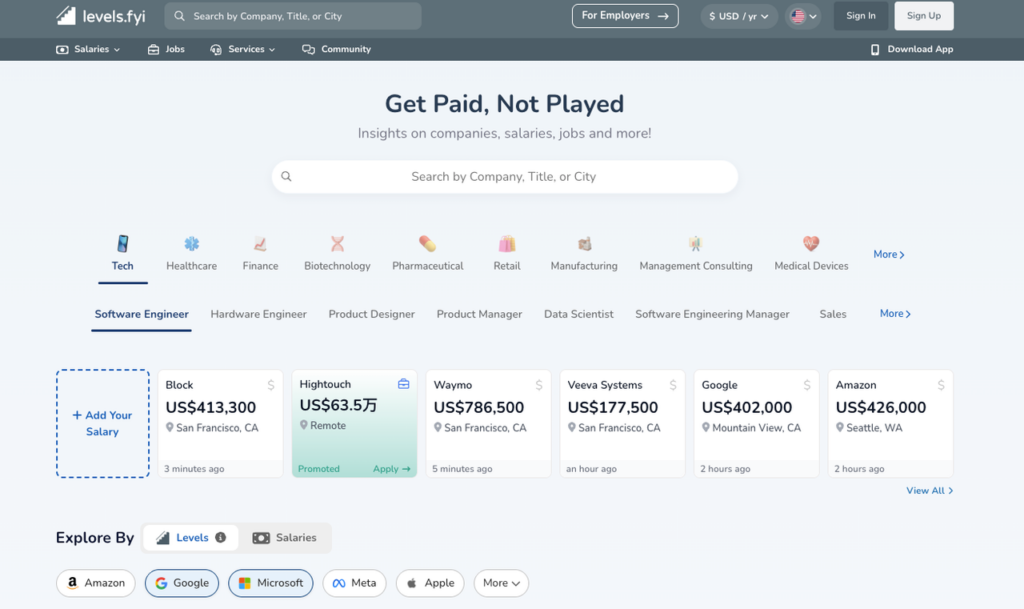
- For support/ops, combine Glassdoor ranges with your local market.
Simple script for beginners:
“Based on my research on Levels.fyi and similar roles in [region], entry-level remote [role] positions seem to fall in the $X–$Y range. Given my background in [relevant experience], I’d be comfortable in that range, but I’m open to discussing the total compensation and growth path.”
If you’re on OPT/CPT or need sponsorship later, don’t hide it. But explain your value first, then your status:
“I’m currently on OPT, valid until [date]. I’m looking for a remote role where I can contribute long-term and eventually grow into positions that qualify for H-1B under current USCIS guidance. I know this adds complexity, so I’m focused on bringing measurable value quickly, like [metric] and [metric] in my last role.”
Your Action Challenge (Do This Today)
Reading about remote jobs won’t get you hired. Action will.
Here’s your one-task challenge for today:
- Pick one remote role type from this article: support, data entry/moderation, or VA.
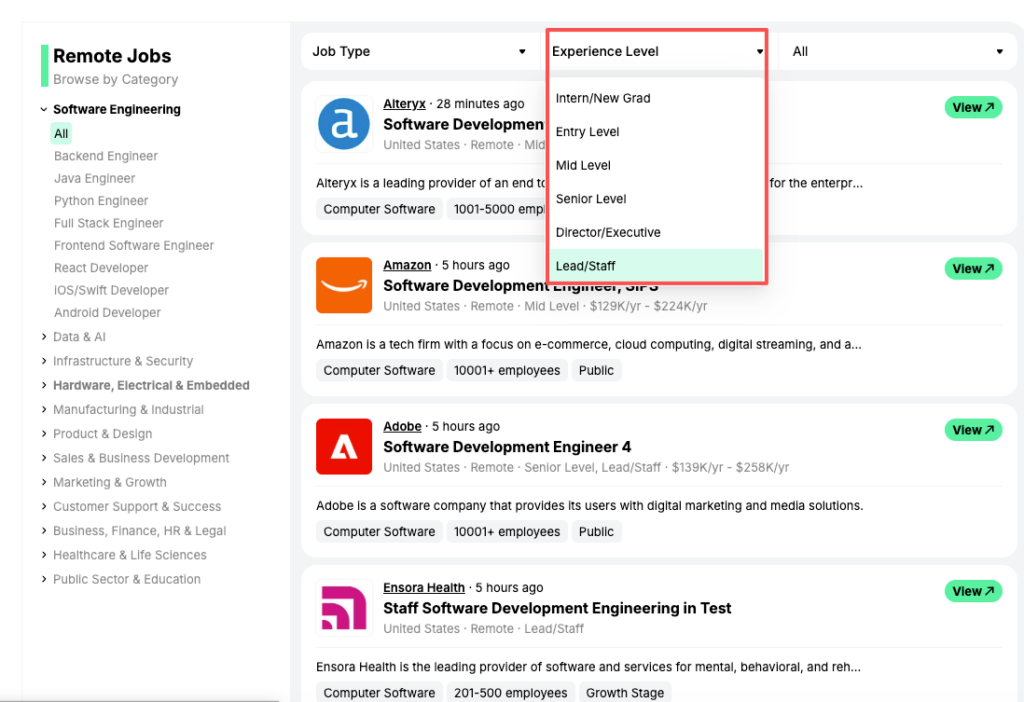
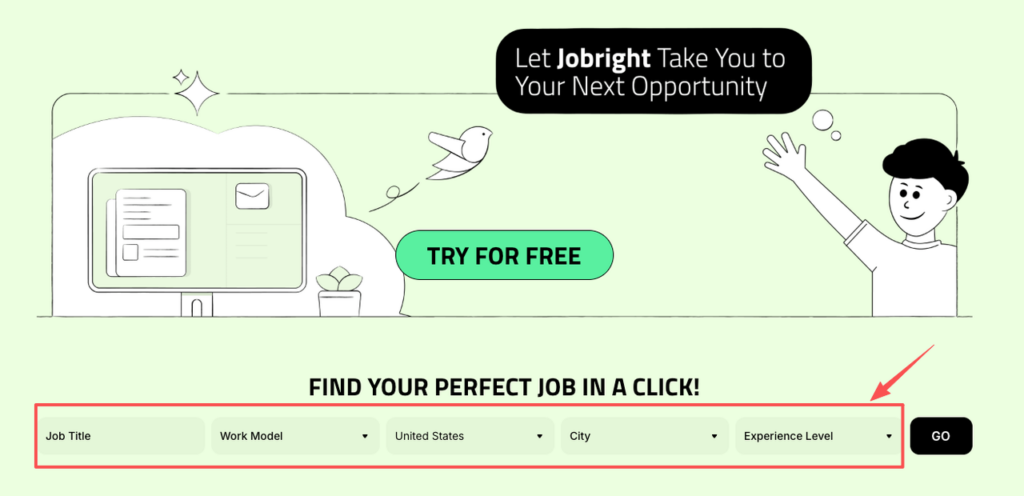
- Find the right job faster: Don’t waste hours scrolling. I recommend you use JobRight.ai to instantly filter for ‘Remote’ + ‘Entry Level’ roles that fit your skills.
- Rewrite 3 resume bullets using the formula: action verb + task (with role keywords) + metric.
Then run your resume through an ATS-style keyword scanner and check:
- Keyword match ≥ 80% for that posting.
- No broken sections after parsing.
Important: Be cautious of scams when searching for remote opportunities. The FTC provides guidance on how to avoid work-from-home job scams that can help you identify legitimate opportunities.
Frequently Asked Questions
What does “no experience” really mean in remote job listings?
In most remote job listings, “no experience” doesn’t mean they’ll train you from zero. Employers still expect signals that you can do the core tasks, work independently, and communicate clearly. They look for relevant keywords, examples of self-management, and clean, well-written resume bullets—even from school, projects, or volunteering.
What entry-level remote jobs hire with no experience?
Beginner-friendly remote jobs include customer support roles (chat, email, level 1 tech support), data entry, content moderation, virtual assistant, and junior operations or admin positions. These roles rely on scripts, documented workflows, and repeatable processes, so they can onboard beginners quickly if you show reliability and basic communication skills.
How can I get remote jobs with no experience using my resume?
To stand out for remote jobs with no experience, use ATS-friendly formatting (single-column, standard fonts) and targeted keywords from each job description. Write bullets with this formula: action verb + task (with role keywords) + metric. Quantify volume, speed, and accuracy, and include any remote collaboration or user-facing experience you have.
How do I pass ATS filters for remote jobs with no experience?
Avoid fancy templates and tables that confuse applicant tracking systems. Save as a plain PDF or .docx with clear headings and bullet points. Mirror 80% or more of the relevant keywords in the posting—like “customer support,” “ticketing system,” “data entry,” or “virtual assistant”—inside real achievements instead of copying responsibilities word-for-word.
How can I avoid scams when searching for remote jobs with no experience?
Research the company’s website, LinkedIn presence, and reviews before applying. Be wary of roles that: ask for money or equipment purchases upfront, insist on using only messaging apps for interviews, or offer unusually high pay for simple tasks. Legitimate employers use company emails, clear contracts, and don’t ask for your banking details before hiring. For more detailed guidance, review the FTC‘s consumer alerts on work-from-home job scams.
Coming Up Next: Now that your resume is ready, where should you apply? Next time, we’ll reveal the highest-paying entry-level industries and provide a complete ATS keyword checklist to help you beat the system. Get ready for a 7-day application plan that turns these strategies into interviews.