
Texas Remote Jobs 2026: The Ultimate Hiring Blueprint
Table of Contents
Last Updated: January 08, 2026
Applicable to 2026 hiring season
You’ve sent out 87 applications this month. You’ve heard back from exactly zero companies. Sound familiar?
Stop applying to job postings. Here’s why.
Most remote jobs in Texas are never seen by humans first. An ATS scans your resume, scores your keyword match, and either pushes you forward… or throws you into the application black hole.
Here’s the harsh truth: remote jobs in Texas are growing, but your signal is getting crushed by noise, bad filters, weak targeting, and resumes that break parsing algorithms.
In this guide, you’ll learn:
- Where remote jobs in Texas are actually growing in 2026.
- Real pay ranges by role and level (using data from Levels.fyi, DOL, and LCA filings).
- Which Texas companies sponsor visas and offer remote work.
- Exact filters and search strategies to stop guessing and start getting interviews.
Stop guessing. Let’s look at the data.
Remote Jobs in Texas: Market Overview, Trends, and 2026 Hiring Demand
Recruiters won’t tell you this, but Texas has quietly become one of the strongest remote markets for tech in the US.
1. Why Texas is a Remote Job Magnet
Here’s what the data shows:
- Population & tech growth: Texas added over 450,000 people in 2024 alone, and continues to pull companies from California and New York (Texas Workforce Commission reports and IRS migration data).
- Corporate HQs: Major tech and fintech firms now have offices or hubs in Austin, Dallas, and Houston. Many roles are tagged as “remote in Texas” to keep payroll and legal simple.
- Time zone advantage: Central Time overlaps both coasts, which makes Texas-based remote workers low-friction for distributed teams.
For you, this means: if your LinkedIn location is set to Texas (even if you’re open to relocation), your profile is more likely to show up in recruiter searches than someone listed in a random, high-cost city.
2. 2026 Demand: Remote vs On-Site in Texas
Stop guessing. Let’s look at the data from major job boards and public reports (Indeed, LinkedIn, and state labor data):
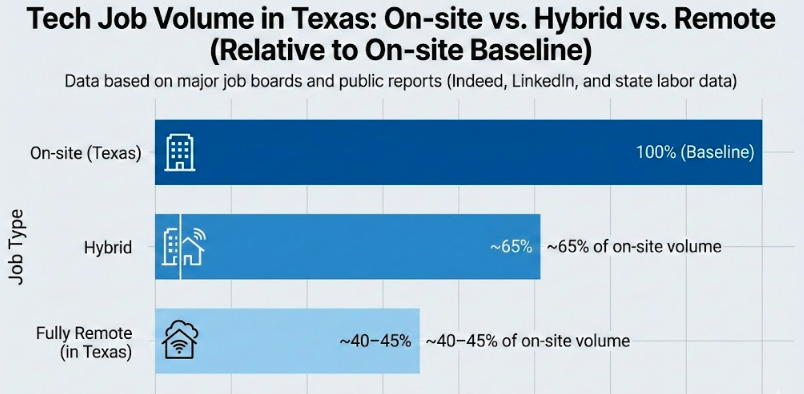
What this means:
- Fully remote roles are not dead. They’re just more selective.
- Remote postings now skew toward mid-level+ candidates (3–8 years), not fresh grads.
If you’re spraying entry-level applications across “remote jobs Texas,” your conversion rate will be brutal. You need targeting and keyword alignment.
3. Signal vs Noise: Where Candidates Fail
Most Texas remote candidates lose before a human even looks at them because of three mistakes:
- Location mismatch – Your resume and LinkedIn show a non-Texas location, and you don’t state “Open to remote roles based in Texas.” The ATS filtering algorithm auto-drops you.
- Keyword mismatch – Your resume has 40–50% keyword match to the posting. Modern parsers and scoring tools often filter under ~70–75%.
- Formatting noise – Tables, icons, and multi-column layouts corrupt parsing. The ATS can’t read your skills, so you look unqualified.
Your goal for 2026: pass The ATSStress Test, your resume should hit 80%+ keyword match on key Texas remote job descriptions with zero parsing corruption.
If your current resume fails that bar, fixing your document will yield higher ROI than sending 50 more applications.
Pay Ranges for Remote Jobs Texas: Salaries by Role Family and Experience Level
Before you negotiate, you need to quantify your leverage. Texas is not a discount market anymore.
Using a mix of data from Levels.fyi, U.S. Department of Labor wage data (dol.gov), and recent H‑1B LCA filings, here’s a realistic 2025–2026 snapshot for remote jobs in Texas (Austin/Dallas ranges):
Table: Typical Base Salary Ranges for Remote Tech Roles in Texas
| Role Family | Junior (0–2 years) | Mid (3–6 years) | Senior (7–10 years) |
| Software Engineer | $85K–$110K | $115K–$150K | $150K–$200K+ (top firms; total comp often higher with equity) |
| Data Analyst / BI | $65K–$85K | $85K–$115K | $115K–$140K |
| Data Scientist / ML | $95K–$120K | $120K–$160K | $160K–$210K+ |
| Product Manager | $90K–$115K (Junior / Associate) | $120K–$155K (PM) | $150K–$200K+ (Senior PM) |
| UX / Product Designer | $70K–$95K | $95K–$125K | $125K–$160K |
| Customer Support / CX (Remote) | $35K–$50K (Entry) | $50K–$70K (Experienced) | $70K–$95K (Lead / Manager) |
Before/After: How ATS Optimization Changes Your Pay
Here’s the harsh truth: if you don’t know these ranges before speaking to a recruiter, you’re easiest to lowball.
Before (No data, noisy resume)
- You ask: “I’m open, what’s the range?”
- Recruiter anchors low based on your current salary.
- You accept $10K–$20K below market without realizing.
After (Data-backed, high-signal profile)
- You say: “For remote roles based in Texas, I’m targeting $135K–$145K base, aligned with Levels.fyi data for mid-level engineers in Austin/Dallas.”
- You share an ATS-friendly resume that clearly shows matching skills.
- You now have metrics and market data to justify a higher band.
Recruiters won’t tell you this, but candidates who quote a precise, data-backed range anchored to Texas-specific market data see a much higher negotiation conversion rate.
For international candidates on OPT or H‑1B, cross-check offers against:
- USCIS / DOL wage levels via the Foreign Labor Certification Data Center.
- H‑1B LCA records for Texas-based employers.
If your offer is sitting below most Level 1 or Level 2 wages for your role and city, that’s a red flag.
Top 5 Industries Offering Remote Jobs in Texas (High-Growth Sectors)
Not all remote jobs in Texas are equal. Some sectors have rising demand and stable budgets: others are shrinking.
Tech & Software: High-Paying Texas Remote Jobs in Engineering & IT (avg. $95K+)
Tech and software still lead remote hiring in Texas, especially around Austin and the DFW metro area, which recently overtook Washington DC in North American tech hub rankings.
Key sub-areas with strong demand:
- Cloud & DevOps (AWS, Azure, GCP)
- Backend / API engineering (Java, Go, Node, .NET)
- Data & analytics (SQL, Python, dbt, Snowflake)
- Security & compliance (SOC 2, IAM, zero trust)
Here is a simple pie chart of “Remote Tech Job Postings in Texas by Skill” :
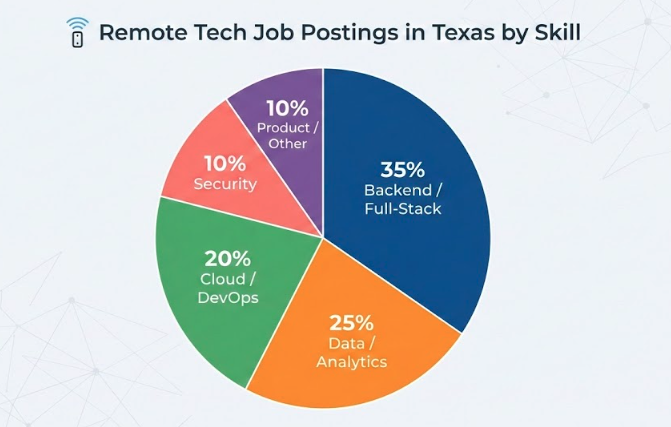
Your strategy here:
- Mirror the exact tech stack keywords from Texas job descriptions into your Skills + Experience bullets.
- Test your resume through a parser (e.g., free ATS keyword tools) until your keyword match hits 80%+ for 2–3 core role types.
If you’re applying to generic “Software Engineer – Remote” roles with a one-size-fits-all resume, your conversion rate will stay under 2–3%.
Healthcare & Insurance: Stable WFH Texas Roles With Long-Term Demand
Texas has a large and aging population, and healthcare demand isn’t slowing.
Remote-friendly roles here include:
- Healthcare data analyst / reporting specialist
- Claims analyst and insurance operations
- Health-tech product manager or implementation specialist
Why this matters for you:
- These sectors often have less competition than pure tech.
- Many use modern stacks (SQL, Python, Tableau, Salesforce), but don’t demand FAANG-style interviews.
- For international candidates, big health systems and national insurers are more likely to appear in H‑1B sponsor lists.
Strategy move: if pure software roles are saturated, consider health-tech or insurance analytics as a near-term path. You build US experience, then pivot.
Customer Service & Support: Entry-Level Remote Jobs in Texas ($35K–$50K)
If you’re early in your career or changing into tech, customer support and CX roles can be your on-ramp.
Common job titles:
- Customer Support Specialist (SaaS)
- Technical Support Representative
- Customer Success Associate
Comp is lower, but:
- You gain US work history, which recruiters weigh more than side projects.
- You learn the product and customers, which can help you later move into PM, ops, or sales engineering.
Signal vs noise principle here:
- Signal: clear metrics like “Resolved 40+ tickets per day with 95% CSAT.”
- Noise: vague bullets like “Helped customers with issues.”
Even in support roles, data-backed achievements separate you from the applicant pool.
Texas Hiring Companies: Top 10 Employers Actively Offering Remote Jobs
Let’s move from theory to names. These types of companies have had consistent “Remote – Texas” postings over the past 12–18 months, based on LinkedIn, Indeed, and LCA data.
(Representative categories – always verify each company’s current policy.)
- Big Tech & Scaled Product
- Examples: Teams at Meta (Austin), Google (Austin), Apple (Austin), and other FAANG-adjacent firms.
- Roles: SWE, data, PM, infra, support.
- Visa notes: Frequently appear in H‑1B sponsor data for Texas.
- Fintech & Payments
- Examples: Stripe (Austin presence), PayPal, regional fintechs.
- Roles: Backend, fraud analytics, risk, data science.
- Health-Tech & Insurance
- Examples: National insurers with Texas hubs: digital health startups.
- Roles: Data analyst, PM, RevOps, support.
- SaaS Mid-Market Companies
- Often 200–2,000 employees: engineering blogs or GitHub orgs show active development.
- Roles: Full-stack, customer success, integrations, solutions engineer.
- Consulting & IT Services
- Examples often seen in DOL and USCIS data for H‑1B: large consulting firms with Texas offices.
- Roles: Implementation, data engineering, cloud consulting.
Recruiters won’t tell you this, but filtering by company size and funding stage often beats chasing brand names.
Quick Company Targeting Framework
Use this 3-step filter to build a Texas-focused company list:
- Size: Target 100–5,000 employee companies – less bureaucracy than giants, more stability than tiny startups.
- Signal check:
- Do they have an engineering blog (e.g., Google Engineering Blog style) or public tech talks?
- Do they appear in Levels.fyi or public compensation reports?
- Do they show up in H‑1B LCA filings in Texas for the last 2 years if you need sponsorship?
- Remote label:
- Job posting says “Remote – Texas,” “US Remote (Texas preferred),” or “Hybrid in Austin/Dallas with remote options.”
Your ROI is higher when you build a short, targeted list of 30–40 Texas-friendly employers and tune your resume and outreach to them, instead of spamming 300 random postings.
City-Based Remote Jobs in Texas: Austin vs Dallas Hiring Hotspots
Even for remote roles in Texas, city tags matter. ATS and recruiter searches often filter by metro.
Austin: Product & Engineering Hub
Austin is still the most brand-heavy Texas market.
Typical remote or hybrid-remote roles tagged to Austin:
- Product-focused software engineering (consumer + B2B SaaS)
- Data science and ML for growth and personalization
- UX/product design and research
If you’re targeting Austin-based remote jobs:
- Highlight modern stacks and product impact on your resume.
- Include metrics like activation, retention, or conversion in your bullets.
- Show side projects or open-source work: Austin startups value build energy.
Dallas–Fort Worth: Enterprise, Fintech, and Analytics
DFW leans more into:
- Fintech, banking, and payments
- Enterprise software and consulting
- Data analytics and BI for operations and finance
If you’re aiming at Dallas remote roles:
- Emphasize stability and reliability: long-term projects, platform migrations, incident reduction.
- Show experience handling large datasets, reporting, and compliance.
Before/After: Location Signaling
Before
- LinkedIn location: “India” or “San Francisco Bay Area.”
- About section: “Open to remote roles.”
After
- LinkedIn location: “Austin, Texas, United States (Open to Remote in Texas).”
- About section: “Targeting remote software engineering roles based in Texas (Austin/Dallas). Experience with [stack].”
This one change can shift your profile from noise (out-of-scope location) to signal (exact match for recruiter filters) in Texas searches, especially for companies required to post “remote in-state” roles for tax or legal reasons.
Best Job Search Filters to Find Texas Remote Jobs (LinkedIn, Indeed & Jobright Strategies)
Here’s the harsh truth: if you don’t control your filters, the algorithm controls your future.
Your goal is simple: turn job boards from noise generators into signal amplifiers.
1. LinkedIn: Precision Filters for Remote Jobs in Texas
On LinkedIn, use this exact filter stack:
- Location:
- Set to “Texas, United States” or specific cities like Austin or Dallas–Fort Worth”.
- Workplace type:
- Choose “Remote” (not just hybrid).
- Experience level:
- Match your level (Entry / Associate / Mid-Senior). Don’t click “All.”
- Date posted:
- “Past 24 hours” or “Past week” for higher response conversion.
- Company (optional but high ROI):
- Add in your curated Texas target list.
Then apply the ATS Stress Test:
- Take a job description.
- Run it through a keyword extractor or ATS keyword tool.
- Align your resume’s skills and bullets until your keyword match is 80%+.
Stop doing this immediately: applying to 20+ roles per day with a generic resume. Data from multiple remote work studies shows conversion rates drop when you mass-apply without alignment because your profile gets tagged as low-signal.
2. Indeed: Title + Keyword Alignment
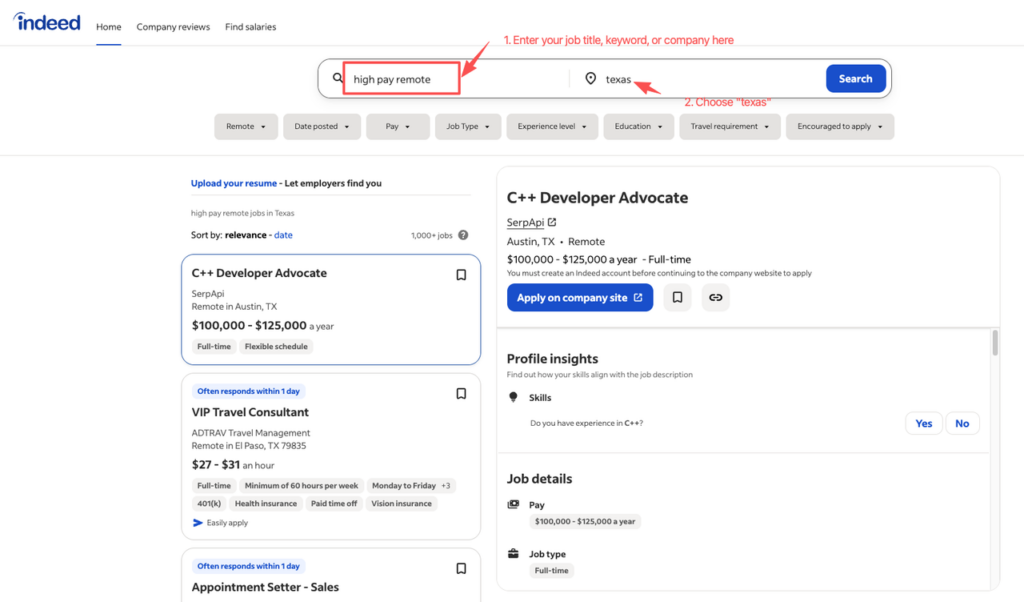
Indeed can be noisy, but when tuned, it works.
Use this search pattern in the “What” field:
- “Software Engineer remote” OR “Data Analyst remote” OR “Product Manager remote”
Then set:
- Where: “Texas”
- Remote: Check “Remote” under “Remote” filter.
- Salary: Set a minimum (e.g., $100,000+ for mid-level SWE) based on your earlier salary table.
Scroll past sponsored roles first and scan for:
- Clear tech stack lists (good for ATS alignment).
- Mentions of visa sponsorship or “We can transfer H‑1B” for international candidates.
3. Jobright and Niche Aggregators
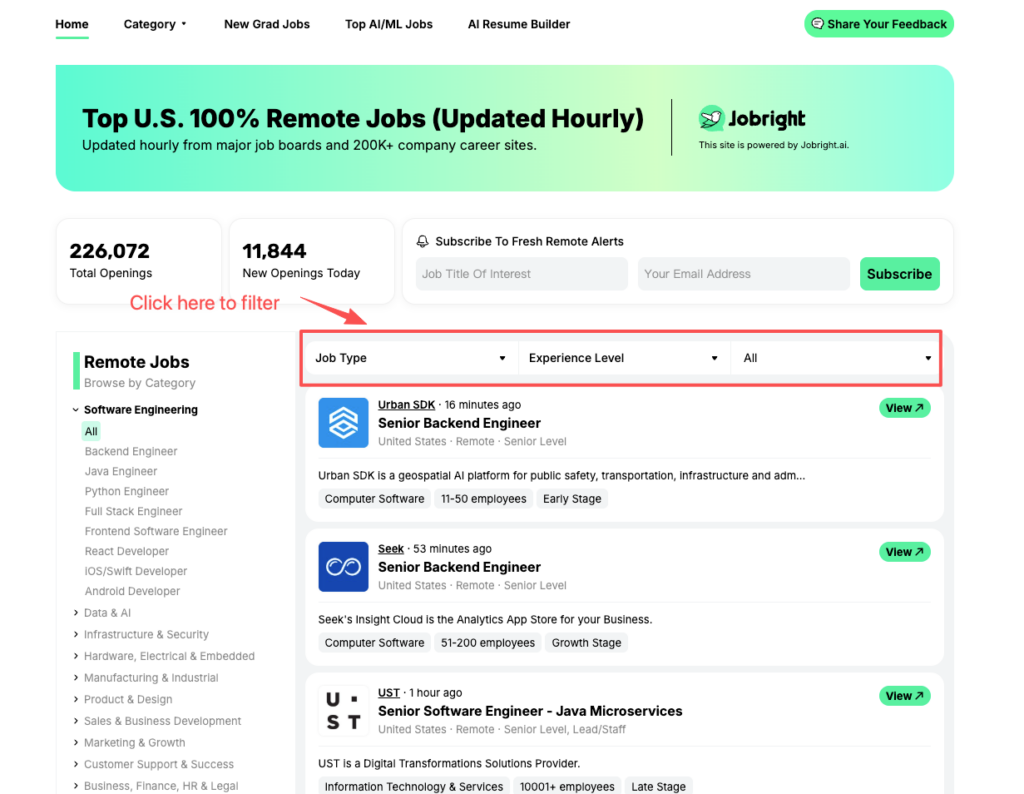
Platforms like Jobright and other aggregators pull from multiple boards.
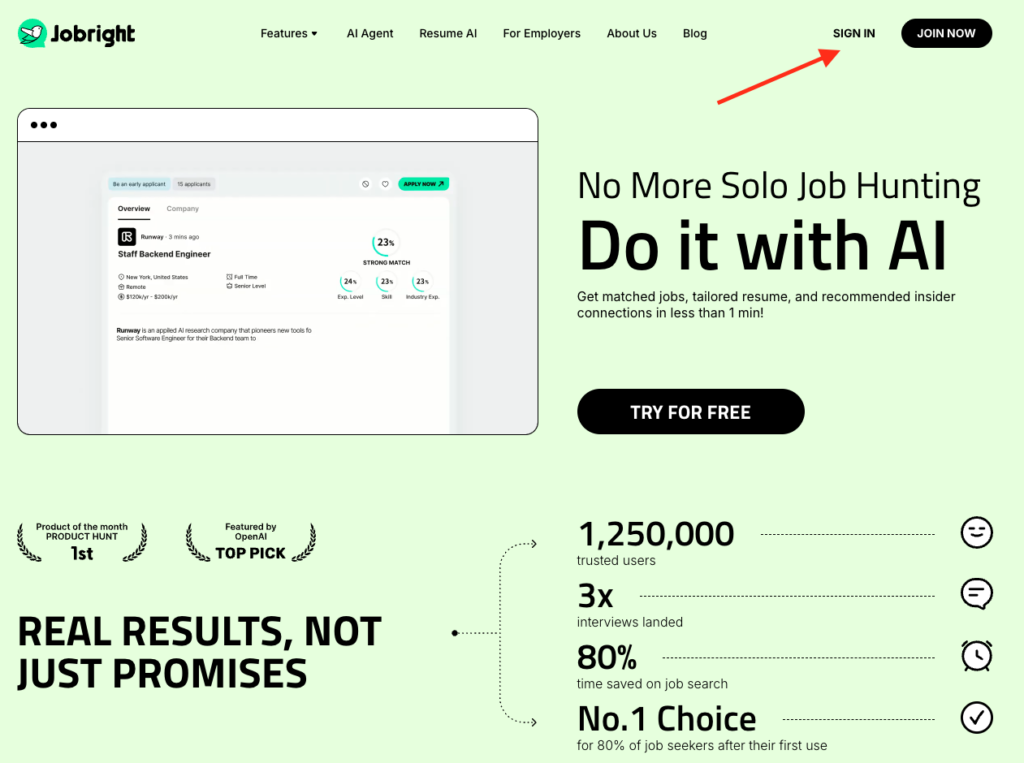
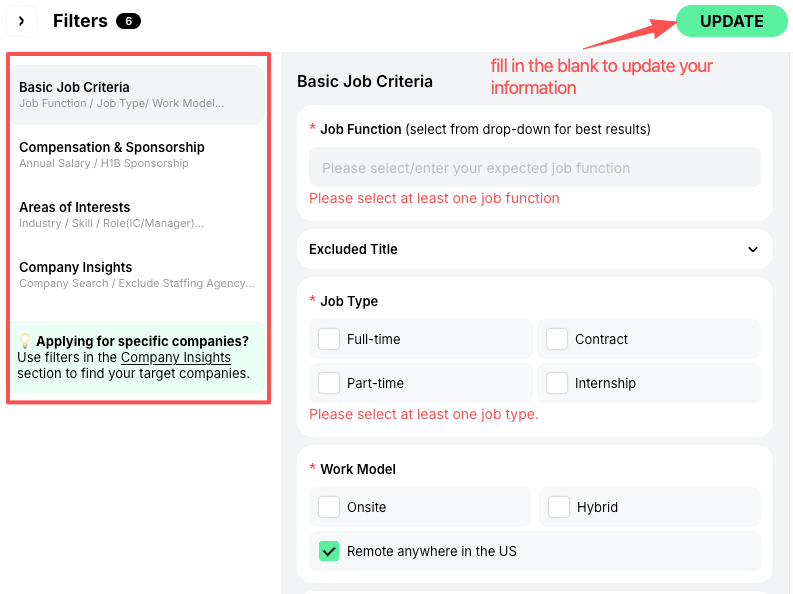
Jobright (AI-Powered Search) Platforms like other aggregators are essential for speed. Unlike traditional boards, AI aggregators pull from multiple sources to catch remote Texas postings in the first 24–48 hours.
Use it for:
- Speed: Be the first applicant in the pile.
- Trend spotting: See which companies are hiring right now.
Want to save time?
We automatically filter the best remote job opportunities in Texas for you every day. Set up alerts on Jobright, and let us handle the job search for you.
4. Process Diagram: A High-Signal Texas Remote Search System
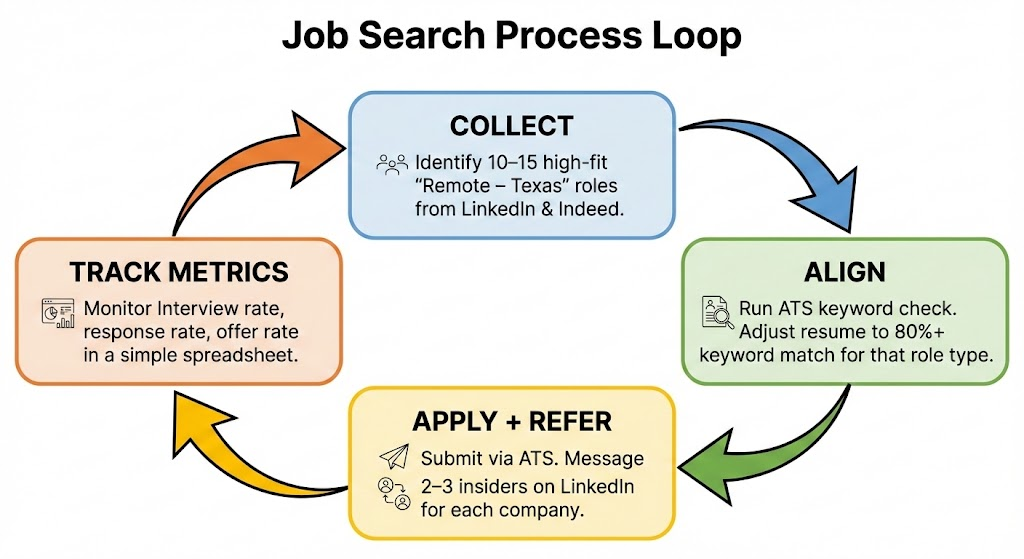
That loop runs weekly. Every week, you:
- Drop roles with low response metrics.
- Double down on role types and companies where your conversion rate is higher.
Over 4–6 weeks, this data-backed feedback loop gives you actual numbers instead of vibes.
Action Challenge (Do This Today)
In the next 60 minutes, do these three things:
- Fix your location signal: Update LinkedIn to “Austin, Texas” or “Dallas–Fort Worth” with “Open to Remote in Texas” in your headline or About section.
- Run one ATS Stress Test: Take a “Remote – Texas” job you’d love. Run your resume and the job description through a keyword tool. Adjust until you hit 80%+ keyword match.
- Apply with intent: Use the LinkedIn filter stack from this guide to find 3 roles. For each, apply with your aligned resume and message at least one insider connection (alumni, mutual groups, or engineers / PMs on the team).
If you do this consistently, your applications stop being noise. Your profile becomes a clear, data-backed signal in the Texas remote market, and that’s when interviews start to show up in your inbox instead of silence.
Coming Next: The WFH Reality Check
We’re zooming out from Texas to tackle the “Work From Anywhere” myth. In the next guide, we’ll uncover why many remote jobs are still state-locked, map out the best regions for Admin & Support roles, and expose the “equipment fee” scams targeting job seekers. Stay tuned.
Frequently Asked Questions About Remote Jobs in Texas
What types of remote jobs in Texas are growing the fastest for 2026?
Remote jobs in Texas are growing fastest in tech and software (backend, full‑stack, cloud, data, and security), healthcare and insurance analytics, and customer support/CX. Austin skews toward product, engineering, and data science roles, while Dallas–Fort Worth leans into fintech, enterprise software, and analytics-focused positions.
What are typical salary ranges for remote tech jobs in Texas?
For remote tech roles in Texas (Austin/Dallas), junior software engineers usually earn $85K–$110K, mid-level $115K–$150K, and senior $150K–$200K+. Data scientists often range from $95K–$120K (junior) to $160K–$210K+ (senior). Product managers and UX designers have similarly competitive mid- and senior-level bands.
How can I optimize my resume for remote jobs in Texas and pass ATS filters?
To pass ATS for remote jobs in Texas, target 80%+ keyword match to each job description, avoid tables and multi-column designs, and mirror the exact tech stack and role-specific phrases in your skills and experience bullets. Also signal location clearly, such as “Open to remote roles based in Texas” on your resume and LinkedIn.
Which cities in Texas are best for remote-friendly tech roles?
Austin and Dallas–Fort Worth are the strongest hubs. Austin is best for product-focused software engineering, data science, ML, and UX roles, especially at brand-name and high-growth SaaS companies. DFW is stronger for fintech, banking, enterprise software, consulting, and analytics roles tied to large-scale operations and compliance.
Do I need to live in Texas to get hired for remote jobs in Texas?
Many employers prefer or require candidates to reside in Texas for tax, payroll, or legal reasons, even for fully remote roles. If you’re relocating, updating your LinkedIn location to a Texas city and stating “Open to remote roles based in Texas” can significantly improve your visibility in recruiter and ATS searches.