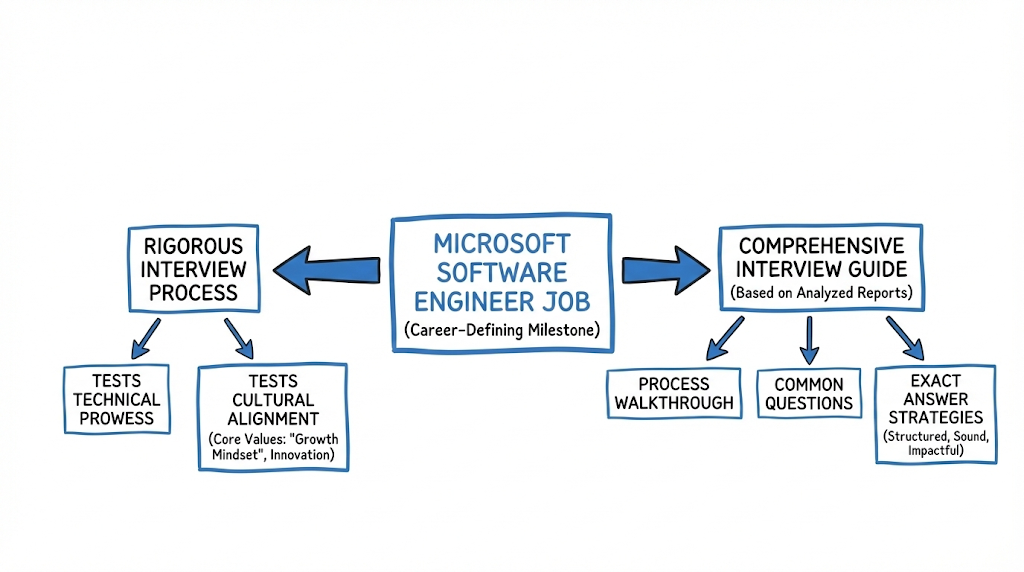
Getting a job at Microsoft is a career-defining milestone for many engineers and tech professionals. However, the interview process is known for being rigorous, testing not just your technical prowess but also your cultural alignment with the company’s core values like “Growth Mindset” and innovation. To secure an offer, your answers need to be well-structured, technically sound, and impactful.
If that sounds daunting, don’t worry. We have analyzed hundreds of interview reports and guides to provide you with a comprehensive resource. Microsoft software engineer interview guide Below, we’ll walk you through the Microsoft interview process, the most common questions you’ll face, and exactly how to answer them.
Here is what we will cover
1. Microsoft interview process
Before diving into specific questions, it is crucial to understand the landscape of the interview process. While it varies slightly by role and level, the general structure remains consistent.
1.1 Resume screen
The first step is the resume screen. Recruiters review applications submitted via the Microsoft careers portal, referrals, or LinkedIn. They are looking for specific keywords, technical skills (languages, frameworks), and experience that align with the job description. Microsoft recruiters often look for “impact” — not just what you did, but the measurable results of your work.
1.2 Recruiter call
If your resume passes the initial screen, a recruiter will contact you for a 30-minute introductory call. This is primarily a “fit” check. Expect questions like “Tell me about yourself,” “Why do you want to work at Microsoft?”, and high-level questions about your resume.
Tip: Be prepared to explain your timeline, visa status, and salary expectations. Familiarize yourself with Microsoft’s mission: “To empower every person and every organization on the planet to achieve more.”
1.3 Technical phone screen
This is the first real hurdle. It is usually a 45–60 minute video call (via Microsoft Teams) with a peer engineer or hiring manager. Interview Process Details
Content: Expect 1-2 coding problems (usually LeetCode Medium difficulty) and a few behavioral questions.
Platform: You will likely use an online code editor (like Codility, HackerRank, or a shared doc) which may not have syntax highlighting.
Goal: They are assessing your basic coding fluency, communication skills, and ability to translate thoughts into code.
1.4 Online Assessment (OA)
For some roles, especially interns and new grads, Microsoft utilizes an Online Assessment (often via HackerRank or Codility) instead of or in addition to the phone screen. You generally have 60–90 minutes to solve 2–3 algorithmic problems. Online Assessment Guide
1.5 Onsite / Virtual Loop
This is the final and most intense stage. It consists of 4–5 separate interviews, each lasting approximately 60 minutes. Onsite Interview Loop
Coding Rounds: 2-3 rounds focused on data structures and algorithms.
System Design: 1 round (for mid-level and above) focusing on designing scalable systems (e.g., “Design Azure Blob Storage”).
Behavioral / Culture: Behavioral questions are woven into every round, but there may be a dedicated session focusing on leadership and values.
The “As Appropriate” (AA) Interview: Historically, Microsoft had a unique final round called the “As Appropriate” interview with a senior leader. While less formal now, your final interviewer is often a hiring manager or Skip-Level manager who has veto power and makes the final call on the offer.
1.6 The Offer
After the loop, the interviewers debrief. If the consensus is positive, you can expect an offer within 1-2 weeks. Microsoft’s compensation packages are competitive, including base salary, signing bonus, and stock awards.
2. Top 9 Microsoft interview questions and example answers
We have curated the top most common questions based on recent interview reports. These cover behavioral, coding, and system design categories.
2.1 Why are you interested in working at Microsoft?
This is the quintessential behavioral question you will almost certainly be asked during the recruiter screen or the onsite loop.
Why interviewers ask this question
Interviewers want to know if you have done your research and if you are genuinely passionate about the company. Microsoft places a huge emphasis on culture and mission. They want candidates who are excited about their products (Azure, Office, Xbox, LinkedIn, GitHub) and align with their values of diversity, inclusion, and a “growth mindset.”
How to answer this question
Avoid generic answers like “It’s a big tech company.” Instead, connect your personal professional goals with Microsoft’s specific initiatives.
Structure your answer:
The Mission: Reference Microsoft’s mission to empower others.
The Tech: Mention specific products or technologies (e.g., OpenAI partnership, Azure’s growth) that interest you.
The Culture: Mention the “Growth Mindset” culture championed by Satya Nadella.
Example Answer Outline:
“I’ve been following Microsoft’s transformation under Satya Nadella, specifically the shift towards a growth mindset and open-source contribution. As a developer who relies heavily on VS Code and GitHub, I admire how Microsoft has embraced the developer community. professionally, I am looking for a role where I can work on cloud-scale problems, and Azure’s recent innovations in AI infrastructure make it the most exciting place for me to apply my background in distributed systems. I want to build tools that empower other developers, which aligns perfectly with the company’s mission.” Top 100 Microsoft Questions
2.2 Tell me about a challenging project you worked on.
Why interviewers ask this question
This behavioral question assesses your technical depth, problem-solving abilities, and how you handle adversity. They are looking for “technical complexity” and “ownership.”
How to answer this question
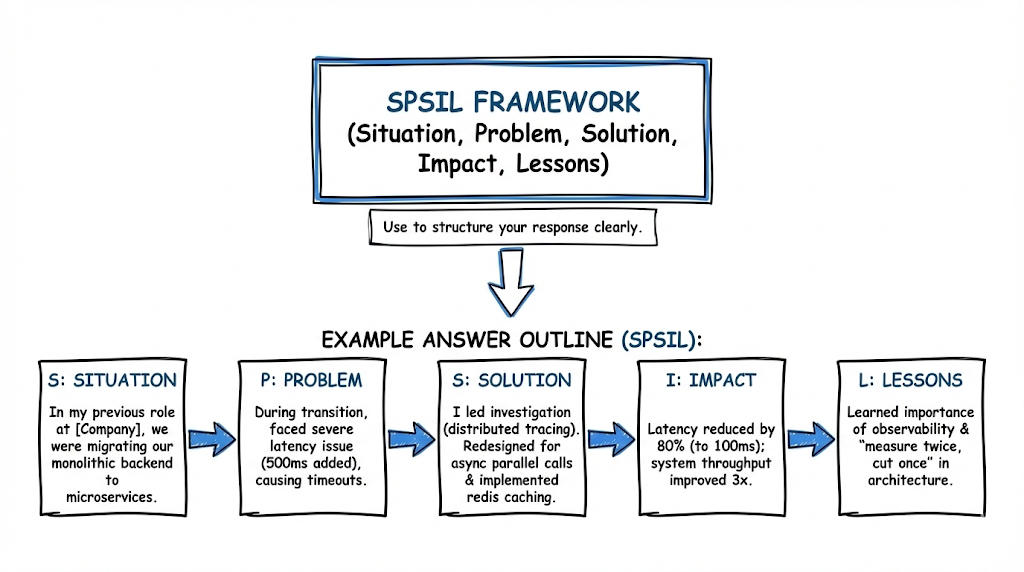
Use the SPSIL framework (Situation, Problem, Solution, Impact, Lessons) to structure your response clearly.
Example Answer Outline (SPSIL):
Situation: “In my previous role at [Company], we were migrating our monolithic backend to microservices.”
Problem: “During the transition, we faced a severe latency issue where inter-service communication was adding 500ms to user requests, causing timeouts.”
Solution: “I led the investigation using distributed tracing. I identified that we were making sequential blocking calls. I redesigned the service aggregation layer to use asynchronous parallel calls and implemented a redis caching strategy for static data.”
Impact: “This reduced latency by 80% (down to 100ms) and improved system throughput by 3x.”
Lessons: “I learned the importance of observability in distributed systems and that ‘measure twice, cut once’ applies to architecture changes.” Sample Answers
2.3 Implement an LRU Cache.
This is arguably the most common coding question at Microsoft (and many other tech giants). Software Engineer Guide
Why interviewers ask this question
It tests your knowledge of two fundamental data structures (Hash Map and Doubly Linked List) and your ability to combine them to achieve O(1) operations. It is a practical problem that relates to real-world systems.
How to answer this question
Use the 5-step coding interview approach:
Clarify: “We need a cache with a fixed capacity. get returns value or -1. put adds value or updates it. Both O(1)?”
Plan: Explain that you will use a Hash Map for fast lookups and a Doubly Linked List to track usage order (most recently used at head, least at tail).
Implement: Write the code. Test: Walk through with an example.
Implement: Write the code. Test: Walk through with an example. Optimize: Confirm space/time complexity.
Example Code (Python):
class Node:
    def __init__(self, key, val):
        self.key = key
        self.val = val
        self.prev = None
        self.next = None

class LRUCache:
    def __init__(self, capacity: int):
        self.capacity = capacity
        self.cache = {} # Map key to Node
        # Dummy head and tail for easy removal/insertion
        self.head = Node(0, 0)
        self.tail = Node(0, 0)
        self.head.next = self.tail
        self.tail.prev = self.head

    def _remove(self, node):
        prev, nxt = node.prev, node.next
        prev.next = nxt
        nxt.prev = prev

    def _add(self, node):
        # Add to right after head (most recently used)
        p, n = self.head, self.head.next
        p.next = node
        node.prev = p
        node.next = n
        n.prev = node

    def get(self, key: int) -> int:
        if key in self.cache:
            node = self.cache[key]
            self._remove(node)
            self._add(node)
            return node.val
        return -1

    def put(self, key: int, value: int) -> None:
        if key in self.cache:
            self._remove(self.cache[key])
        node = Node(key, value)
        self._add(node)
        self.cache[key] = node

        if len(self.cache) > self.capacity:
            # Remove from tail (least recently used)
            lru = self.tail.prev
            self._remove(lru)
            del self.cache[lru.key]
2.4 Design a messaging system like Microsoft Teams.
Why interviewers ask this question
This is a classic system design question relevant to Microsoft’s actual products. It tests your ability to handle real-time data, databases, and scalability.
How to answer this question
Use a standard System Design Framework:
Requirements: 1:1 chat, group chat, online status, file sharing. Low latency is critical.
Estimation: DAU (e.g., 100M), messages per day (e.g., 50 per user).
High-Level Design: Client -> Load Balancer -> WebSocket Server -> Message Service -> DB.
Deep Dive:
Real-time: Use WebSockets for persistent connections.
Storage: HBase or Cassandra for chat logs (write-heavy, huge volume). SQL for user profiles/friend lists.
Cloud computing (Azure) relies heavily on scheduling jobs. This question tests your understanding of concurrency, distributed consensus, and fault tolerance.
How to answer this question
Focus on reliability (tasks must run) and exactly-once (or at-least-once) semantics. Key Components to Discuss:
Task Submission: API to accept tasks (stored in a durable queue like Kafka or Azure Service Bus).
Worker Nodes: Servers that pull tasks and execute them.
Coordinator/Manager: Uses Zookeeper/Etcd for leader election to assign tasks to workers.
Heartbeats: Workers send heartbeats. If a worker dies, the coordinator reassigns the task. Distributed Systems Guide
2.6 Design a scalable storage system (like Azure Blob Storage).
Why interviewers ask this question
This tests deep knowledge of distributed file systems, partitioning, and replication.
How to answer this question
Interface: put(key, data), get(key).
Data Partitioning: Consistent Hashing to distribute data across nodes.
Replication: Store copies on 3 different nodes (across racks/zones) for availability.
Consistency Model: Discuss Strong vs. Eventual consistency (CAP theorem). For blob storage, we might favor availability.
Metadata: Separate Metadata service (Master node) to map keys to physical locations vs. Data nodes (Chunk servers) that store the actual bytes. Scalable Storage Design
2.7 Design an in-memory database (like Redis).
Why interviewers ask this question
This limits the scope to a single machine or cluster memory, focusing on data structures and thread safety rather than just “putting things in a database.”
How to answer this question
Core Structure: Hash Map for Key-Value storage.
Durability: Since it is in-memory, how do we prevent data loss on crash? Discuss WAL (Write Ahead Logging) or Snapshots (RDB/AOF in Redis terms).
Concurrency: How to handle simultaneous writes? Locks (Granular locking vs. Global lock) or Single-threaded event loop (like actual Redis).
Eviction: How to handle full memory? (Refer back to LRU Cache implementation). In-memory Database Design
2.8 Design a two-node RAID system.
Why interviewers ask this question
This question tests your understanding of data redundancy, fault tolerance, and low-level storage mechanics. Unlike high-level distributed systems, this focuses on the fundamentals of how data is persisted reliably across limited hardware.
How to answer this question
Focus on RAID 1 (Mirroring) since you have two nodes and likely want redundancy.
Core API:
write_byte(address, data) and read_byte(address).
Replication Strategy:
Synchronous: Write to Node A and Node B. Return success only when both acknowledge. Ensures Strong Consistency but higher latency.
Asynchronous: Write to Node A, return success, then background copy to Node B. Lower latency but risks data loss if Node A crashes before replication.
Failure Handling: What if Node B goes down?
Mark Node B as “stale” or “offline” in a metadata store.
Route all reads/writes to Node A (Degraded mode).
Recovery: When Node B comes back, use a Write-Ahead Log (WAL) or a Dirty Block Bitmap to resync only the changed data, rather than copying the entire disk.
This is a classic system design problem that tests concurrency handling in a real-world e-commerce scenario. The core challenge is the “Double Booking Problem”—preventing two users from buying the same seat simultaneously.
How to answer this question
Use the System Design Framework:
Requirements:
Users search movies, select specific seats, and pay. The system must handle high traffic during new releases.
Database Design:
Relational DB (SQL) is preferred for ACID compliance.
Race Condition: User A and User B select Seat 1A at the exact same millisecond.
Solution: Use Distributed Locking (e.g., Redis with TTL). When User A selects a seat, acquire a lock for 10 minutes. If User B tries, the lock check fails.
Payment Flow:
Use a Two-Phase Commit or State Machine. If payment succeeds -> Change status to “Booked”. If payment fails/times out -> Release lock and revert to “Available”.
Mark Integers in Circle: “Given an integer grid and a circle diameter, mark the integers within the circle diameter and return the updated grid.”
Approach: Use the circle equation $(x-center_x)^2 + (y-center_y)^2 \leq radius^2$. Iterate through the bounding box of the circle within the grid to optimize O(N*M) down to the circle’s area. Grid Problems
System Design: Read “Designing Data-Intensive Applications” by Martin Kleppmann or the “System Design Interview” by Alex Xu.
Company Research: Read the Microsoft Blog to understand current engineering challenges (e.g., AI integration in Office, Azure quantum computing).
Values: Memorize Microsoft’s cultural attributes: Growth Mindset, Customer Obsession, Diverse & Inclusive, One Microsoft. Preparation Guide
4.2 Practice with peers
Mock interviews are critical for getting over performance anxiety.
Find a friend and alternate roles.
Focus on communication. At Microsoft, a silent coder is a rejected candidate. You must “think out loud.”
Practice explaining why you chose a specific data structure or architectural pattern.
4.3 Practice with experienced interviewers
If possible, practice with someone who has interviewed at big tech companies. They can provide feedback on:
Code Quality: Microsoft values clean, production-ready code (variable naming, modularity) over just “working” code.
Edge Cases: Did you handle null inputs? Empty arrays? Integer overflow?
Behavioral Polish: Are your stories concise? Do they highlight your contribution specifically?
Preparing for Microsoft takes time, but the process is predictable. Focus on strong CS fundamentals, clear communication, and demonstrating a genuine passion for their mission to “empower every person.” Good luck!
5. Accelerate Your Microsoft Job Search with Jobright
Landing a role at Microsoft requires more than just technical excellence—it demands a strategic approach to finding the right opportunity. While this guide prepares you for the interview, a platform like Jobright gives you a crucial advantage in the job search itself.
5.1 Get Personalized Job Recommendations
Instead of manually sifting through listings, Jobright learns from your profile to deliver tailored recommendations. Whether you’re targeting an Entry-level Software Engineer, SDE II, Senior Engineer, or Principal Engineer role, our platform identifies the best-fit Microsoft opportunities for your background.
5.2 Optimize Your Resume & Gain Team Insights
Our AI analyzes specific Microsoft job descriptions to provide actionable insights on how to optimize your resume, significantly increasing your chances of passing the initial screen. You can also gain intelligence on specific Microsoft teams—LinkedIn, and more—including their projects and tech stacks, so you can go into interviews fully prepared.
5.3 Start Your Strategic Search Today
Combine the interview preparation strategies in this guide with an intelligent job search platform to maximize your chances of success. Your career at Microsoft starts with finding the right opportunity. Visit Jobright now to start your AI-powered job search, get matched with curated opportunities, and track your progress toward landing your dream offer.
Preparing for Microsoft takes time, but the process is predictable. Focus on strong CS fundamentals, clear communication, and demonstrating a genuine passion for their mission to “empower every person.” Good luck!