
Uber Technical Interview Questions: Complete Guide (2026)
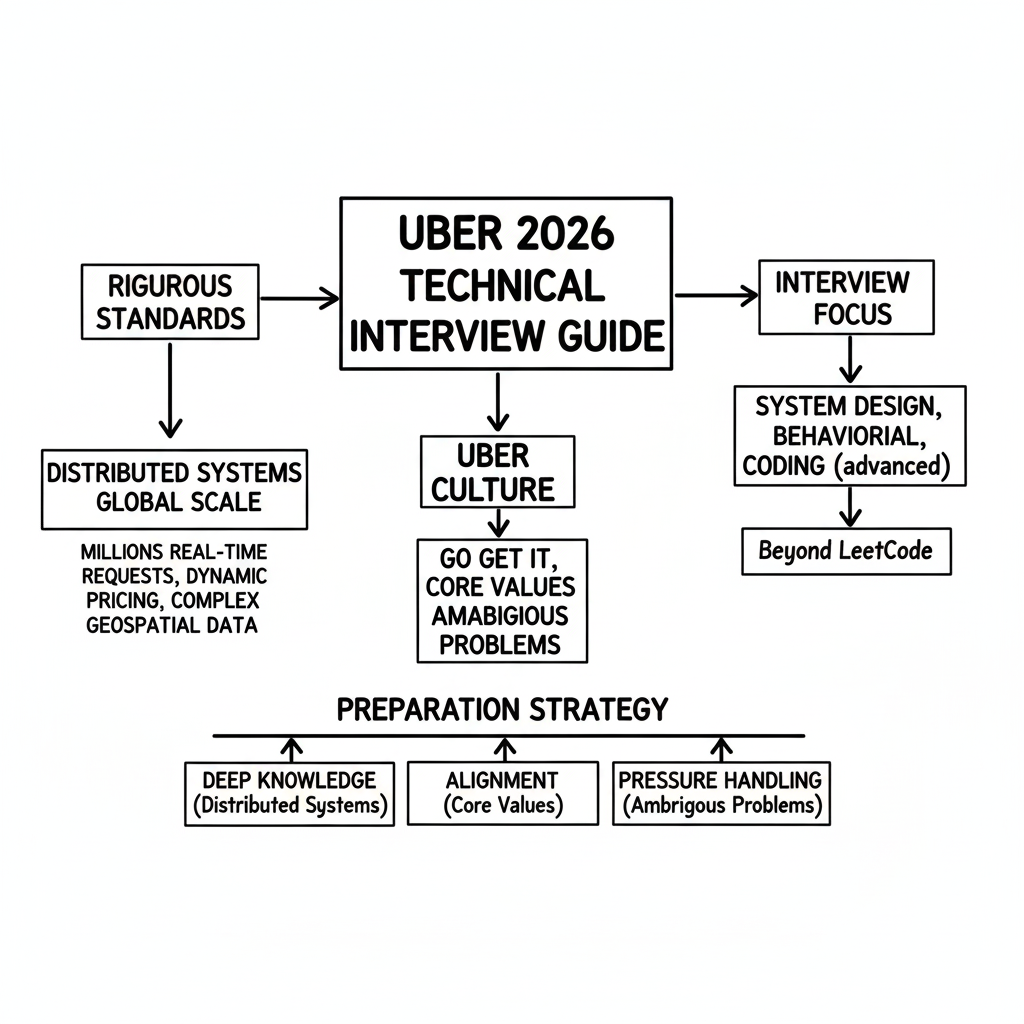
Getting an offer from Uber is no small feat. Known for its rigorous engineering standards and “Go Get It” culture, Uber’s interview process is designed to find candidates who can build systems that operate at a massive global scale—handling millions of real-time requests, dynamic pricing, and complex geospatial data.
If you’re preparing for an interview at Uber in 2026, you need to be ready for more than just standard LeetCode problems. You’ll need to demonstrate deep knowledge of distributed systems, alignment with Uber’s core values, and the ability to solve ambiguous problems under pressure.
Below is a complete guide to the Uber technical interview process, the most common questions you’ll face, and how to answer them effectively.
1. Uber Interview Process
The Uber interview process typically takes 4–6 weeks from application to offer. According to recent candidate reports and Uber’s engineering blog, the process is structured to assess technical depth, problem-solving speed, and cultural fit.
1.1 Resume Screen
Recruiters and hiring managers review resumes to look for specific keywords related to distributed systems, real-time data processing, and relevant languages (Go, Java, Python). To stand out, ensure your resume highlights impact—specifically using metrics like “reduced latency by X%” or “scaled system to Y users.”
1.2 Recruiter Call
If your resume passes the screen, a recruiter will reach out for a 30–45 minute introductory call. They will ask about your background, why you want to join Uber, and your timeline. This is also a check for cultural alignment. Be prepared to discuss your interest in the mobility/gig economy space.
1.3 Technical Phone Screen / Online Assessment
For most engineering roles, this stage involves a CodeSignal assessment. Candidates often report this as a critical filter—read more about recent CodeSignal experiences here.
- Format: Typically 4 coding questions.
- Duration: 70–90 minutes.
- Difficulty: The first two questions are usually easy/medium warm-ups. The final two are often LeetCode Medium-Hard or Hard, focusing on arrays, trees, or graphs.
- Goal: Speed and correctness are critical here. You need a high score (often above 800/840) to move forward.
For some senior roles, this might be replaced by a 45-60 minute live coding session with an engineer, often using a collaborative editor like CoderPad.
1.4 Hiring Manager Screen
Before the final loop, you may have a video call with a hiring manager. This focuses on your past projects, your interest in the specific team (e.g., Maps, Rider, Eats, Freight), and behavioral questions. They want to see if you have the “Go Get It” attitude and can communicate technical concepts clearly.
1.5 Final Interviews (Onsite/Virtual)
The “onsite” loop (often virtual) consists of 4–6 rounds, each lasting 45–60 minutes:
- Coding Rounds (2): Focus on algorithms and data structures. Expect graph traversals (BFS/DFS), sliding window, heaps, and recursion.
- System Design (1-2): Critical for L4+ roles. You will be asked to design complex systems like “Design Uber Eats” or “Design a Rate Limiter.”
- Behavioral / Bar Raiser (1): A dedicated round focusing on Uber’s cultural values. The “Bar Raiser” is an interviewer from a different team whose job is to ensure the candidate raises the overall talent bar of the company.
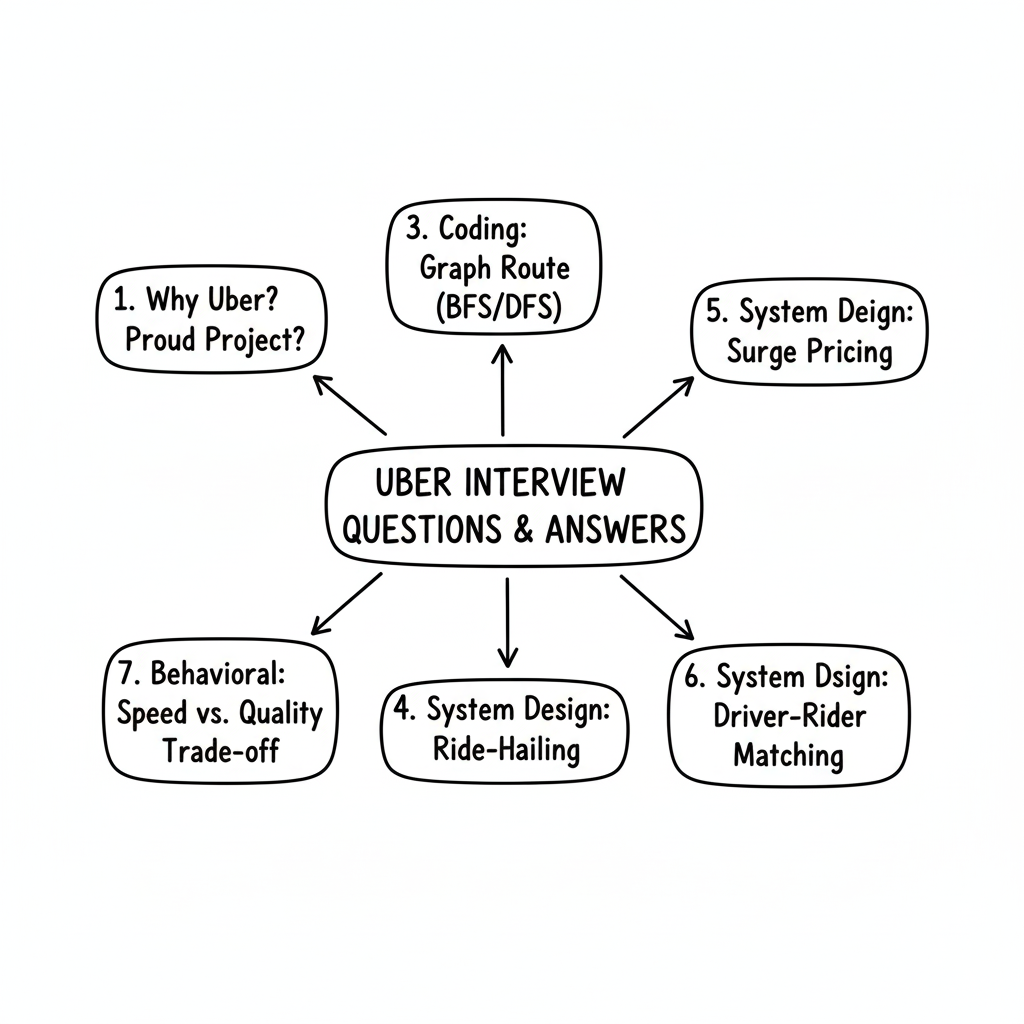
2. Top 7 Uber Interview Questions and Answers
We analyzed hundreds of interview reports to identify the most common questions asked at Uber.
2.1 Why are you interested in working at Uber?
Why interviewers ask this question
Uber wants missionaries, not mercenaries. They look for candidates who are genuinely excited about the complexity of moving people and things in the physical world. They want to know if you thrive in a fast-paced, sometimes chaotic environment.
How to answer this question
Avoid generic answers like “Uber is a big company.” Focus on specific engineering challenges (e.g., “I’m fascinated by the graph partitioning problems involved in Uber Pool”) or the company’s impact on the physical world.
Example Answer Outline:
- The Hook: Mention a specific product or technical challenge at Uber that intrigues you (e.g., real-time marketplace matching).
- The Connection: Relate it to your background (e.g., “In my previous role, I worked on low-latency systems…”).
- The Value: Explain how you align with their “Go Get It” value and want to solve problems at a global scale.
2.2 Name a project you’re most proud of
Why interviewers ask this question
This behavioral question tests your ability to deliver results and your technical depth. Interviewers look for “ownership”—did you just fix a bug, or did you drive a project from conception to launch?
How to answer this question
Use the STAR method (Situation, Task, Action, Result).
- Situation: Describe a complex problem.
- Action: Detail the technical decisions you made (not just the team).
- Result: Quantify the impact (e.g., “Improved throughput by 40%”).
2.3 Coding: Find the route in a directed graph (BFS/DFS)
Variation: “Given a list of driver locations and a rider location, find the k-nearest drivers.“ (See a candidate’s experience with this problem)
Why interviewers ask this question
Graph theory is fundamental to Uber’s business (routing, maps). You must demonstrate fluency in traversing data structures efficiently.
How to answer this question
- Clarify: Ask about constraints (directed vs. undirected, weighted edges, cycle detection).
- Plan: Propose BFS for shortest path in unweighted graphs, or Dijkstra/A* for weighted.
- Implement: Write clean, compilable code.
- Optimize: Discuss time complexity (e.g., O(V+E)) and space complexity.
2.4 System Design: Design Uber (Ride-Hailing System)
Why interviewers ask this question
This is the quintessential Uber question. It tests your ability to design a distributed system that handles high concurrency, real-time updates, and consistency. For a deep dive, check out this Uber system design guide.
How to answer this question
Use a structured approach:
- Requirements: Riders request rides, drivers accept, real-time location tracking.
- High-Level Design: Mobile App -> Load Balancer -> API Gateway -> Dispatch Service / Location Service.
- Deep Dive:
- Location Service: How to handle millions of driver pings every few seconds? (Hint: Use Geohash or Google S2 for spatial indexing—read about Uber’s architecture here).
- Dispatch Service: How to match riders to drivers efficiently?
- Trade-offs: Discuss Consistency vs. Availability (CAP theorem). For Uber, Availability is often prioritized (you always want to be able to request a ride).
2.5 System Design: Design a Surge Pricing System
Why interviewers ask this question
Surge pricing is a core business logic component. This question tests your ability to handle data aggregation and real-time decision-making. (See more on designing ride-sharing platforms).
How to answer this question
- Core Challenge: Aggregating demand (riders) and supply (drivers) in specific geofences in real-time.
- Architecture:
- Use a stream processing framework (e.g., Kafka + Flink) to ingest location events.
- Partition data by region (Geohash).
- Compute ratios of supply/demand over sliding windows (e.g., last 5 minutes).
- Push updated pricing to the client via WebSockets.
2.6 System Design: Design Real-Time Driver-Rider Matching
Why interviewers ask this question
Matching is computationally expensive if done naively. This tests your knowledge of spatial databases and optimization.
How to answer this question
- Naive approach: Query database for all drivers where distance < 5 miles. (Too slow).
- Optimized approach:
- In-memory storage (Redis) with geospatial support.
- Sharding by city or S2 cell ID.
- Locking: How to prevent two riders from booking the same driver? (Distributed locks or optimistic concurrency control).
2.7 Behavioral: Tell me about a time you had to make a trade-off between speed and quality
Why interviewers ask this question
This maps directly to Uber’s values like “Build with Heart” vs. “Go Get It.” They want to know if you can move fast without breaking critical safety or reliability features. Candidates often face questions aligned directly with these values.
How to answer this question
- Context: “We had a deadline for a feature launch…”
- Conflict: “Refactoring the code would take 2 weeks, but we needed to ship in 2 days.”
- Decision: Explain why you chose the path you did. Ideally, show that you incurred “technical debt” consciously and had a plan to pay it back, or that you prioritized the user experience over perfect code.
3. More Uber Interview Questions (By Role)
3.1 Software Engineer
- Coding: Implement a rate limiter.
- Coding: Serialize and deserialize a binary tree.
- Coding: Word Search II (Trie + Backtracking).
- System Design: Design a notification service that handles millions of messages.
- System Design: Design a distributed key-value store.
3.2 Engineering Manager
- Leadership: How do you handle a low-performing engineer?
- Leadership: Describe a time you disagreed with product management on the roadmap.
- System Design: Design the architecture for a new market expansion (considering latency and data residency).
3.3 Data Scientist
- Analytics: How would you measure the success of Uber Pool?
- Statistics: Explain the difference between L1 and L2 regularization.
- Case Study: Driver churn is increasing. How would you investigate the cause?
- SQL: Write a query to find the top 3 drivers by revenue in each city.
3.4 Product Manager
- Product Sense: How would you improve the pickup experience at airports?
- Metrics: What is the North Star metric for Uber Eats?
- Strategy: Should Uber launch a subscription service? Why or why not?
3.5 Machine Learning Engineer
- ML System Design: Design an ETA prediction system.
- Theory: How do you handle sparse data in location-based recommendations?
- Production: How do you monitor model drift for the pricing algorithm?
3.6 Data Engineer
- Architecture: Design a real-time analytics dashboard for city ops teams.
- ETL: How do you handle late-arriving data in a streaming pipeline?
- SQL/Coding: Optimize a slow-running Spark job.
4. Real Candidate Experiences
Reading about actual interview experiences can provide context that guides don’t capture. Here are a few recent stories from candidates:
- New Grad Software Engineer Experience: Tharun Kumar Reddy Polu shares a detailed breakdown of the CodeSignal assessment and behavioral rounds, highlighting the focus on simulation-based coding questions and the “Go Get It” value.
- Senior Software Engineer (L5A) Experience: A candidate on Reddit shares their experience interviewing for a senior role, noting that the coding problems involved geometry and spatial logic, and that clean code mattered more than “fancy algorithms.”
- Software Engineer I Experience: A candidate on GeeksforGeeks describes a tough problem-solving round involving GCD and the Sieve of Eratosthenes, emphasizing that interviewers were friendly and provided hints.
5. How to Prepare for an Uber Interview
5.1 Learn by yourself
Start by mastering the fundamentals.
- Algorithms: Focus heavily on Graphs (Dijkstra, A*, BFS/DFS), Heaps, Sliding Window, and Dynamic Programming. Practice Uber-tagged questions on LeetCode.
- System Design: Read the Uber Engineering Blog. It is a goldmine of information on how they built systems like “Schemaless” (their datastore) and their matching engine.
- Values: Memorize Uber’s cultural values: Go Get It, Trip Obsession, Build with Heart, Stand for Safety, Do the Right Thing, and Great Minds Think Unlike.
5.2 Practice with peers
Mock interviews are crucial for articulating your thoughts clearly.
- Practice CodeSignal assessments (timed, 4 questions).
- Role-play the “Bar Raiser” round with a friend who challenges your behavioral answers.
5.3 Practice with experienced interviewers
If possible, practice with engineers who have interviewed at Big Tech companies. They can give you feedback on:
- Communication: Are you driving the conversation?
- Code Quality: Is your code production-ready or just “LeetCode correct”?
- System Design Depth: Are you just drawing boxes, or are you discussing trade-offs, failure modes, and scalability?
6. Additional Resources and Tips
6.1 Key Preparation Resources
- Interview Kickstart: A detailed breakdown of the Uber tech interview process.
- Coding Interview Guide: What to expect in the Uber interview loop.
- System Design Handbook: A specific guide to the Uber system design interview.
- Interview Query: Comprehensive Uber software engineer interview guide.
6.2 Common Mistakes to Avoid
- Underestimating CodeSignal: The format differs from LeetCode. It’s often speed-focused with 4 questions in ~70 minutes.
- Ignoring System Design (New Grads): Unlike Google or Meta, Uber often asks system design questions even for entry-level roles.
- Neglecting the Bar Raiser: Failing the cultural values assessment is a common reason for rejection, even with strong coding skills.
- Generic Behavioral Answers: Ensure your stories align specifically with values like “Go Get It” and “Stand for Safety.”
6.3 Pro Tips from Successful Candidates
- Apply Early: For internships and new grad roles, the optimal window is August to October.
- Know the Stack: Uber heavily uses Go, Java, Python, and React. Familiarity with these can be a bonus.
- Think at Scale: Always mention how your solution handles millions of concurrent users or real-time constraints.
- Ask Smart Questions: Prepare questions about the specific team (e.g., Maps, Eats, Freight) to show genuine interest.
Preparing for Uber requires a balance of elite coding skills and practical system design knowledge. Focus on the real-world problems Uber solves—moving atoms with bits—and you’ll be well on your way to an offer.
7. Accelerate Your Uber Job Search with JobRight
Landing a role at Uber is highly competitive. JobRight is an AI-powered job search copilot that can help you save up to 80% of your job search time while increasing your chances of landing interviews by 3x.
Key Features
- AI Job Matching: Get personalized Uber job matches with compatibility scores based on your resume and skills.
- Resume Optimization: AI-powered resume tailoring for each specific role, with ATS compatibility checks.
- Orion AI Copilot: AI assistant for career guidance, interview prep, and job search strategy.
- JobRight Agent: Automates your entire job search—finds roles, customizes resumes, and submits applications. Early users report 2x more interviews.
- Autofill Extension: Complete applications across 90% of major ATS platforms in a fraction of the time.
JobRight offers a free tier with core features, plus a Turbo plan for advanced capabilities. Available on web and mobile. Visit jobright to get started.
Good luck with your Uber interview! Remember: preparation, persistence, and the right tools can make all the difference in landing your dream role at one of the world’s most innovative tech companies.