
Top Work From Home Jobs Near Me: Legit List (2026)
Table of Contents
Last Updated: January 08, 2026
Your remote job search is broken. Let’s fix it.
Sending out 80+ applications a month with no results isn’t a sign of persistence; it’s a sign that the system is rigged against the average applicant. The public job boards are saturated with noise, from low-pay traps to sophisticated scams.
Stop playing by their rules.
Instead of adding to the noise, let’s refine your signal. Here is the strategic breakdown of how to actually land a remote role this month:
- Why “Remote” Has Limits: Understanding location restrictions.
- Where to Look: The states with the highest volume of legitimate remote roles.
- Scam Spotting: A 10-second test to protect your time and data.
- The Green Flags: How to identify companies that value real talent.
Why Many Work From Home Jobs Near Me Are Location-Restricted
When you search for “work from home jobs near me,” you’d expect truly remote work. But you keep seeing “Remote – Colorado only” or “Remote – must live within 50 miles of Austin.” It feels random. It isn’t.
Here’s the harsh truth: companies design remote policies for risk and cost, not your convenience.
1. Tax and legal rules force location limits
Companies aren’t restricting you because they dislike your city. They’re doing it because every new state (or country) creates legal work.
Each state can trigger:
- New payroll tax rules.
- Different wage and hour laws.
- Separate worker’s comp and unemployment insurance.
The U.S. Department of Labor workplace poster requirements track many of these rules, and they aren’t simple. For smaller companies, adding even one new state can mean hiring a new payroll vendor or lawyer. So they pick a few states and lock in.
Stop guessing. Let’s look at the data.
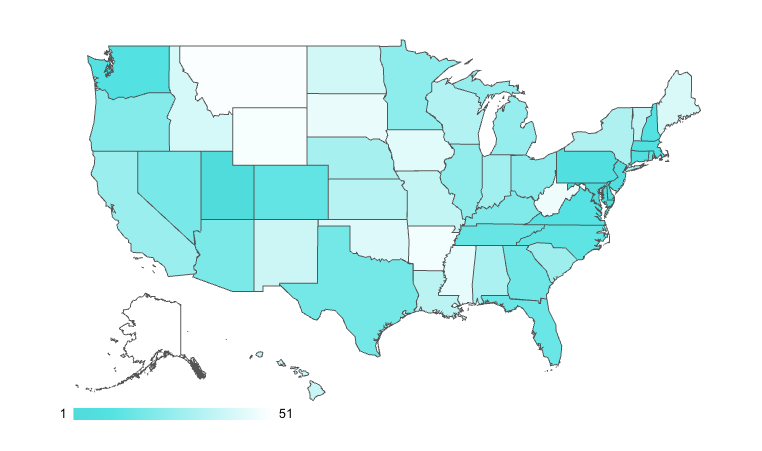
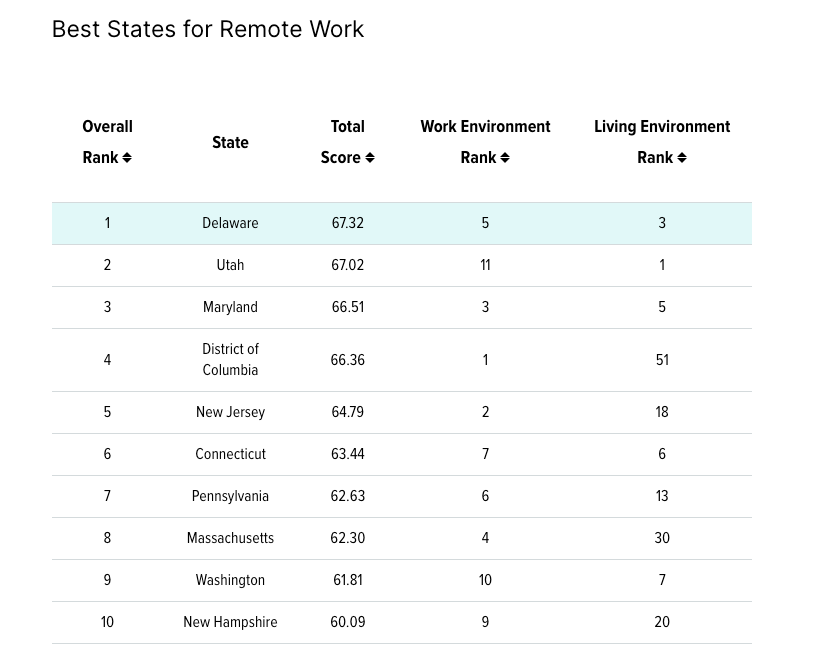
According to WalletHub’s analysis of the best states for working from home, if you’re outside those clusters, your conversion rate on “work from home jobs near me” drops fast, even if your skills are great.
2. Time zones are a quiet filter
Most job posts won’t say this clearly, but teams screen by time zone for collaboration.
Common patterns:
- “Core hours 9–3 PT” → They prefer Pacific or Mountain.
- “Must overlap 6 hours with CET” → US East Coast has an edge over West.
The 2025 Guide to Telework and Remote Work from the Office of Personnel Management outlines how federal agencies manage these coordination challenges, and private companies follow similar logic.
3. Visa and work authorization
For international candidates, “remote” doesn’t mean “from any country.” For U.S.-based roles, you still need valid work authorization.
- For H‑1B specialty occupation visa holders, USCIS rules apply, even if you’re at home on your couch.
- Many early-stage startups avoid new visa sponsorships because of cost and uncertainty.
If you’re on F‑1 OPT or STEM OPT, you need an employer that meets reporting rules and E-Verify in some cases. Remote-only consulting agencies with no clear office often fail that test.
4. What this means for your strategy
If you keep applying to “U.S. remote” roles without checking state eligibility, time zone, and work authorization, you’re throwing applications into the application black hole.
You need to:
- Filter jobs by states you’re allowed to work in.
- Prioritize companies that already employ people in your state.
- Target roles that explicitly mention your state or “anywhere in the U.S.”
Signal beats noise. The more aligned you are with location rules, the more often an ATS will pass you through to a human.
Best Work From Home Jobs Hiring by State (Legitimate Options Only)
Now let’s shift from diagnosis to action.
Instead of chasing every random posting, I want you to target job types that:
- Commonly hire fully remote.
- Use clear W‑2 employment (for stability and visas where possible).
- Show consistent hiring across multiple states.
I’ll also call out where international, visa-dependent candidates tend to have better odds.
To keep this structured, imagine a simple comparison table.
Visual: Remote Work Opportunities: Job Type vs. Hiring Patterns (2026)
| Role Type | Typical Pay Band | States Commonly Hiring | Visa-Friendly? | ATS Competition Level |
| Customer Support | $40K–$60K | TX, FL, GA, AZ, NC, OH, + many others | ✅ Many large companies sponsor H‑1B/OPT | Moderate |
| Data Entry / Administrative | $35K–$50K | Government agencies, healthcare, universities | ⚠️ Limited | Low–Moderate |
| Tech Support (Entry Level) | $45K–$65K | TX, FL, CA, remote-friendly companies | ⚠️ Limited | High |
| Entry-Level Data Analyst | $55K–$75K | TX, NY, CA, IL | ⚠️ Limited | Moderate–High |
| Junior Software Engineer | $85K–$110K | TX, CA, WA, remote-friendly tech hubs | ✅ Visa sponsorship possible | Very High |
Let’s walk through two of the most searched categories when people look for “work from home jobs near me.”
Customer Service & Support Roles (W-2, No Fees)
Many people skip customer support because they think it’s low skill. That’s a mistake.
Here’s the harsh truth: entry remote tech jobs are extremely saturated. But customer support and customer success roles often:
- Are fully remote across 20+ states.
- Provide W‑2 status (health insurance, 401(k), unemployment eligibility).
- Become launchpads into product, ops, or even junior PM roles.
Look at branded companies that have clear remote policies, like:
- Large retailers and fintechs with distributed support teams.
- SaaS companies with 24/7 chat or email support.
Data from public job boards plus company reports show that many big brands hire hundreds of remote support agents per year, across clusters like TX, FL, GA, AZ, NC, and OH, where labor markets are deep and time zones align with major hubs.
For international candidates on OPT or H‑1B:
- Some large employers sponsoring visas (based on LCA data and public filings) do hire into operations and support, not just engineering.
- Your best bet is a large, established company already listed in H‑1B data sets, not a tiny startup.
How to optimize your resume for these roles (ATS lens)
Stop using generic titles like “Remote Professional” or “Freelancer.” ATS parsing algorithms search for keyword match against the posting.
Pull 5–10 job descriptions for “Remote Customer Support” in your target states and look for repeated terms:
- “Ticketing systems (Zendesk, Freshdesk, Salesforce Service Cloud)”
- “Handle inbound calls, chat, email”
- “First-contact resolution, CSAT, response time”
Then build a simple, clean resume with:
- A single-column layout.
- Standard section headings (“Experience,” “Education,” “Skills”).
- Bullet points that mirror those keywords with measurable metrics.
Example bullet:
- “Resolved 60–80 customer tickets per day with a 92% CSAT score and <2% escalation rate.”
That line hits tickets, CSAT, and volume, all strong signals to ATS and recruiters.
Data Entry & Administrative WFH Jobs Near Me
Data entry and admin roles are the most abused search terms in this space. They’re also a favorite for scammers.
But there are still legitimate, W‑2 data entry and admin jobs, especially with:
- Healthcare systems.
- Universities.
- Local or state agencies with hybrid/remote policies.
For example, many U.S. government-related roles (see usa.gov job listings) list remote or telework options by state, with strict hiring rules and background checks. These are slow to move, but often safer.
Recruiters won’t tell you this, but pure typing speed is not the differentiator anymore. It’s data quality.
Better resume signals:
- “Maintained 99.5%+ data accuracy across 5,000+ monthly records.”
- “Digitized and indexed 1,200 paper records with a 3-day SLA.”
Again, stop guessing. Let’s look at the data pattern:
Visual: Before/After Resume Keyword Match Chart
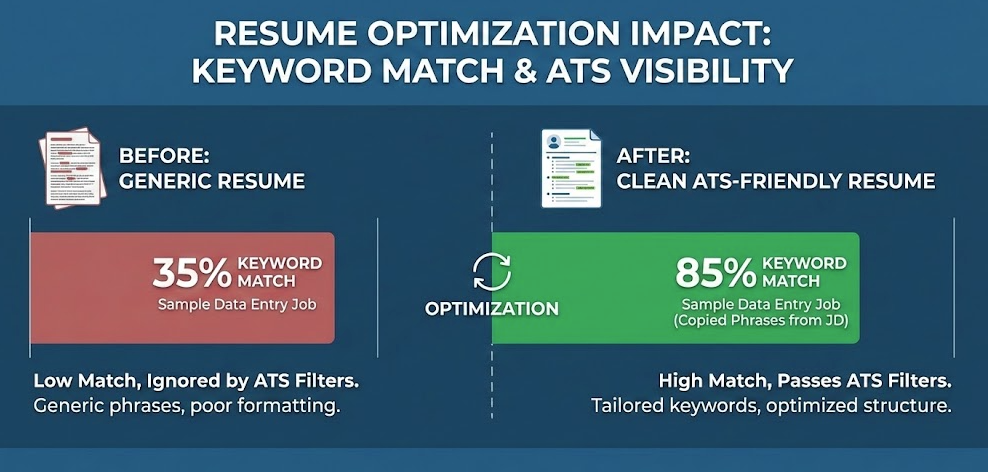
This is the ATS Stress Test I use: your resume should hit 80%+ keyword match in parsers like Jobscan or similar tools, with zero formatting corruption. If your conversion rate from application → interview is under 3–5%, you’re not passing this test yet.
Stop guessing if your resume works. Instead of rewriting it blindly for every application, use jobright.ai. We scan thousands of listings to find the ones your resume is already a 90%+ match for, saving you from the “application black hole.”
For visa-dependent candidates, admin and data entry roles rarely sponsor H‑1B. I’m not going to sugarcoat that. Use them as temporary OPT roles or remote experience builders while you aim for more sponsor-friendly paths like software, data, or specialized analyst roles.
WFH Scams to Avoid: Common Red Flags Job Seekers Miss
If you’re anxious and burnt out, you’re the perfect target for scammers. They know you’ll ignore small red flags because you want the role to be real.
Here’s the harsh truth: if you search “work from home jobs near me” and click the first 10 results, 3–4 will be low-quality or outright scammy.
Stop doing this immediately. The Federal Trade Commission’s guidance on avoiding job scams shows thousands of complaints per year about fake remote roles.
Here are the patterns I watch for.
1. Upfront fees or “equipment reimbursement” via check
Legit W‑2 employers do not ask you to:
- Pay for onboarding.
- Buy a “starter kit.”
- Cash a check and send money back.
If anyone wants bank info or crypto before an official offer letter with company domain emails and tax paperwork, treat it as noise and walk away.
2. No interview, instant “hire”
If they “hire” you in one chat interview that lasts 10 minutes with copy-pasted answers, run.
Real companies:
- Have at least one video call.
- Send you a written job description.
- Use a domain email (@company.com), not @gmail or @outlook for official HR.
3. Vague job description, extreme pay
“Make $3,000 a week from home.” with no clear tasks, tools, or manager? That’s noise.
Compare that to market data:
- Levels.fyi and public salary data show typical W‑2 customer support in the U.S. often pays in the $18–28/hr range depending on state and company.
- Admin roles may sit in a similar band, sometimes lower in smaller markets.
If the offer is 3–5x that norm with no experience required, you’re not lucky, you’re targeted.
4. No digital footprint
Before you engage, do a 5-minute background check:
- LinkedIn: Does the company have employees with reasonable histories?
- Company website: Is there a careers page and clear address?
- Glassdoor or similar: Do reviews mention remote scams, unpaid training, or chargebacks?
If you can’t link the recruiter to a real LinkedIn profile tied to that company, assume it’s fake until proven otherwise.
5. Before/After: A safer search pattern
Before
- You search “work from home jobs near me,” click random listings, and trust whoever messages you first.
- You reply using your main email and share full address, DOB, and maybe even SSN early.
After
- You filter for roles with known brands, clear W‑2 classification, and realistic pay.
- You only share sensitive info after an official offer, through secure portals.
The goal is to cut noise (scams, fake recruiters, shady intermediaries) so your energy goes to signal (real companies with clear hiring processes).
Legitimate WFH Companies: 3 Signals Recruiters Actually Look For
Now let’s flip the lens.
You don’t just want any “work from home jobs near me.” You want roles with real teams, stable pay, and growth paths, especially if you’re in tech or hoping to pivot into it.
Recruiters won’t tell you this, but they use a few quick signals to sort candidates and companies alike.
Here are three I focus on when I coach job seekers.
1. Clean, ATS-optimized resumes with measurable impact
If your resume uploads as a blank page in their ATS because of heavy design, you’ve already lost.
Your goal is signal clarity:
- Single column, no text boxes or images.
- Standard fonts (Arial, Calibri, Times New Roman).
- Clear role titles and dates.
Then you layer in data-backed impact:
- “Cut average handle time by 18% while maintaining 90%+ CSAT.”
- “Processed 1,500+ monthly invoices with <0.3% error rate.”
These metrics are your value prop. They’re what separate you from 200 other applicants with “strong communication skills.”
Do a quick test: run your resume through an online parser. If it can’t read your job titles or skills correctly, an ATS won’t either.
2. Companies with clear legal and hiring footprints
Legit remote-first companies tend to show up in:
- State business registries.
- Public job boards with consistent branding.
- Professional blogs or engineering blogs (for tech roles). For example, check the Meta or Google Engineering Blogs to see how established teams talk about remote and hybrid work structures.
For visa-dependent candidates:
- Cross-check employers against H‑1B LCA databases or USCIS disclosure data to see who actually files sponsorships.
- Focus your energy where the conversion rate from interview → visa is non-zero.
If you’re on OPT and join a company that has never sponsored before, your long-term odds are low.
3. Structured hiring process and written expectations
Real companies have process:
- Clear stages: application → recruiter screen → hiring manager → possibly panel.
- Written job descriptions with responsibilities, tools, and pay ranges (in many states, pay transparency is now law).
The U.S. Department of Labor and some state agencies have pushed for more clarity in postings. When you see detailed requirements, that’s usually a better sign than three vague lines and a giant pay band.
Visual: Process Diagram – Noise vs. Signal Applications
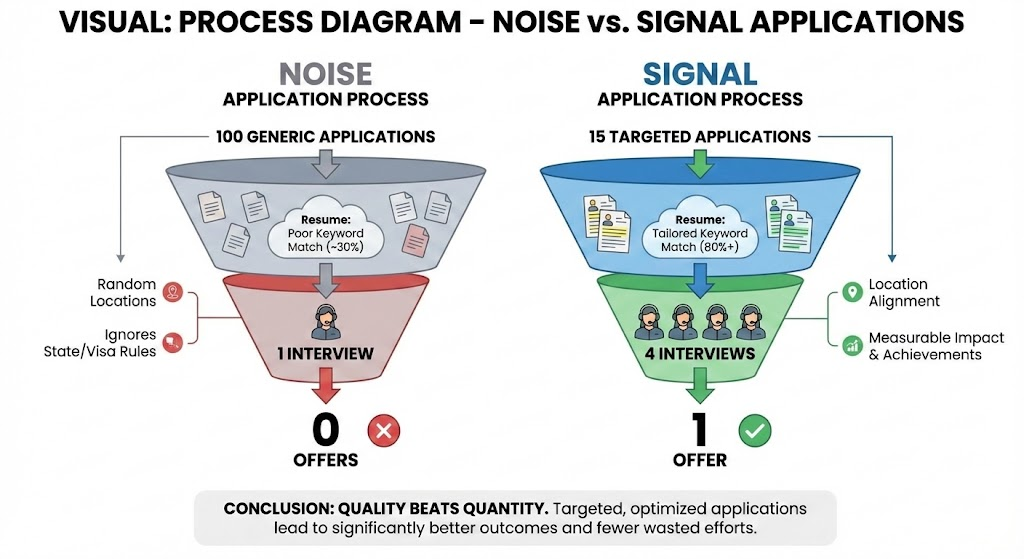
Same week of effort, but radically different ROI.
Your action challenge (do this today)
I’ll end with a small but sharp assignment.
- Pick one role type from this article (customer support, admin/data entry, or adjacent tech role).
- Find 3–5 job descriptions that:
- Are remote.
- Clearly list your state or “anywhere in the U.S.”
- Have W‑2 employment and realistic pay.
- Copy their common keywords into a simple text file.
- Rewrite only the top half of your resume (summary + most recent role) so it hits:
- At least 80% keyword match to those postings.
- At least one metric per bullet.
- Run your resume through a parser tool. If any field is scrambled, fix formatting until it’s clean.
Don’t send another 20 random applications until you’ve done this.
Your goal isn’t more noise. Your goal is a smaller number of data-backed, ATS-ready, location-aligned applications that convert.
That’s how you turn “work from home jobs near me” from a desperate search term into an actual offer in your inbox.
Frequently Asked Questions about Work From Home Jobs Near Me
Why are so many work from home jobs near me still location-restricted?
Many remote roles are limited by state because each new location can trigger separate payroll taxes, wage and hour laws, and insurance requirements. Smaller companies often register in only a few states to keep legal and admin costs down, so they hire only where they’re already set up.
What is the best legitimate work from home jobs hiring by state?
Common legitimate WFH roles that hire across many states include customer service and support, tech support, and some data entry or administrative positions. Large retailers, SaaS companies, healthcare systems, universities, and government-related agencies often offer W‑2 remote roles with clearer benefits and policies.
How can I optimize my resume for work from home jobs near me so ATS will pass it through?
Use a simple, single-column resume with standard headings and fonts. Pull 5–10 remote job descriptions and mirror repeated keywords like “ticketing systems,” “CSAT,” or “data accuracy.” Add metrics-based bullets (e.g., volume handled, error rate, satisfaction scores) and aim for 80%+ keyword match in parsing tools.
How do I quickly spot scams when searching for work from home jobs near me?
Red flags include upfront fees, check-cashing or “equipment reimbursement” schemes, instant hiring with no real interview, vague duties with unrealistically high pay, and recruiters using generic email domains. Always check LinkedIn, company websites, and reviews, and never share sensitive data before a formal offer via secure channels.
How can I find legitimate local remote jobs without relying only on job boards?
Combine targeted job boards with direct company research and networking. Identify employers known for remote work, then check their own careers pages filtered by your state. Use LinkedIn to search “remote” plus your state and connect with employees or recruiters. Alumni networks and professional groups can surface unposted roles.
Next Issue Teaser:
Now that your optimized resume is finally bypassing the ATS, the real challenge begins: mastering the remote interview. In our next issue, we’ll break down the ‘Zoom Psychology’ needed to build trust through a screen and the specific questions hiring managers use to test your self-discipline. Stay tuned to turn that first interview into a signed offer.