
The Ultimate Guide to Acing the Amazon Technical Interview in 2026
Getting a job at Amazon is a significant achievement, but the path is notoriously difficult. With a hiring success rate of only about 2% for applicants, the interview process is designed to be one of the most rigorous in the tech industry. To get the job, your answers will need to be outstanding.
If that sounds daunting, don’t worry, we’re here to help. We’ve analyzed hundreds of Amazon interview questions and worked with thousands of candidates to understand exactly what sort of questions you can expect in your interview.
Below, we’ll go through the most common Amazon interview questions and show how you can best answer each one.
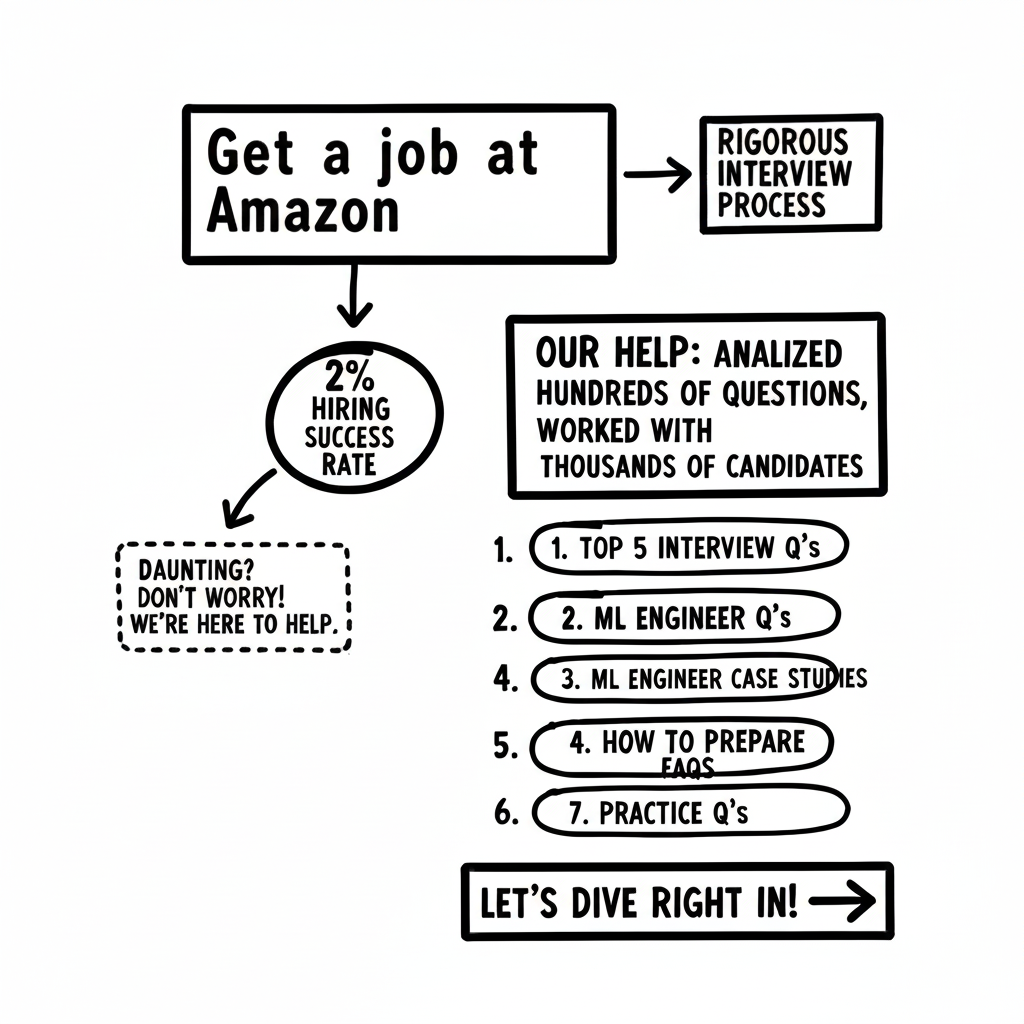
Here’s what we’ll cover:
- Top 5 Amazon interview questions
- Machine Learning Engineer interviews: Recent case studies (2025)
- How to prepare for an Amazon interview
- Amazon interview FAQs
- More Amazon interview questions
- Practice Amazon interview questions
Let’s dive right in!
1. Top 5 Amazon Interview Questions
We’ve worked with hundreds of Amazon candidates and former Amazon interviewers to identify the types of questions that are most frequently asked. These five questions are typical for Amazon interviews and you’ll need to be prepared for them. We’ll show you why interviewers ask them and how to answer them, with a detailed example answer for each question.
1.1 “Tell me about a time you went above and beyond for a customer.” (LP: Customer Obsession)
This is one of the most common Amazon behavioral questions, testing the company’s most important Leadership Principle.
Why interviewers ask this question:
This question directly tests Customer Obsession, Amazon’s first and most important Leadership Principle. They want to see if you work backward from the customer’s needs and if you are willing to dive deep to solve their problems, even if those problems aren’t immediately obvious. Amazon expects you to demonstrate that customer satisfaction drives your decision-making, not just meeting minimum requirements.
How to answer this question:
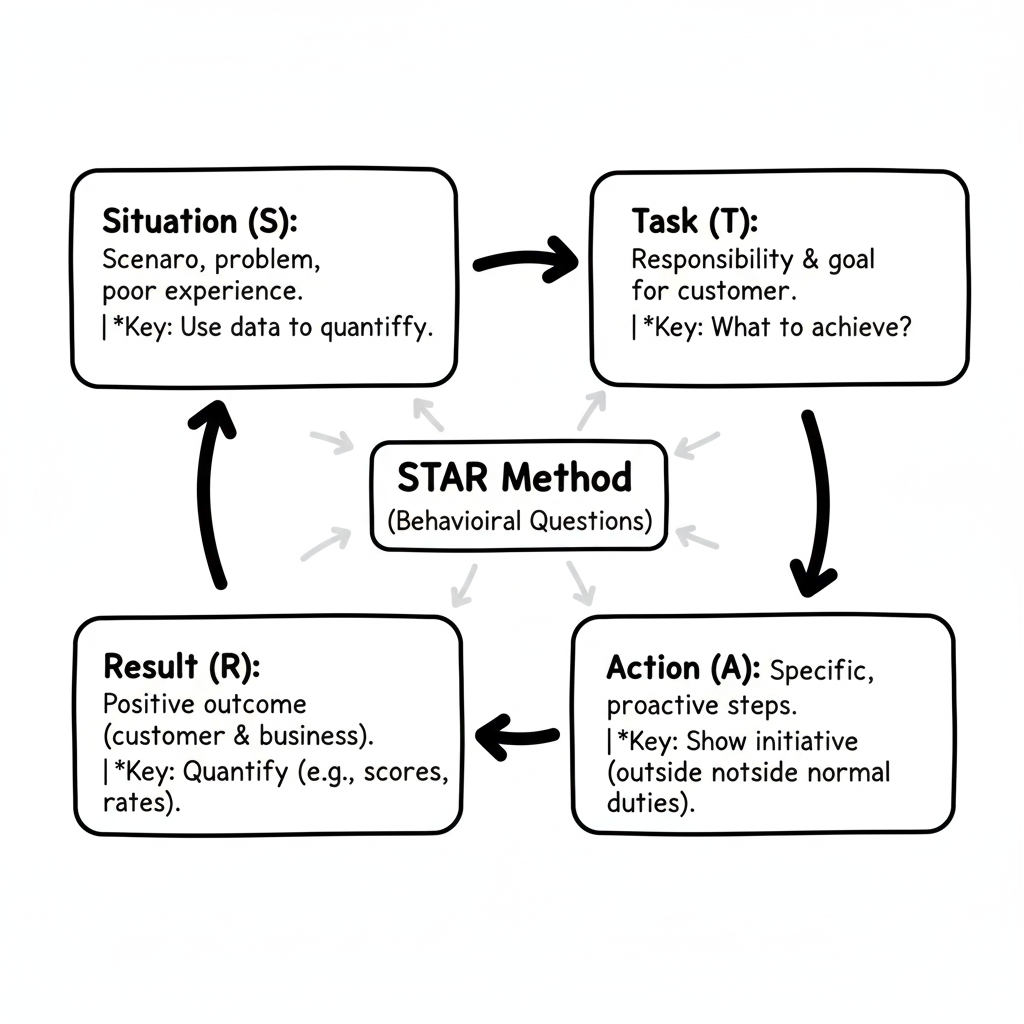
- Situation: Describe a scenario where a customer was facing a problem or having a poor experience. Use data if possible to quantify the issue.
- Task: Explain your responsibility—what was the goal you needed to achieve for the customer?
- Action: Detail the specific, proactive steps you took to address the issue. Emphasize actions that were outside your normal job duties and show initiative.
- Result: Quantify the positive outcome for the customer and the business (e.g., improved satisfaction scores, reduced support tickets, increased adoption rates).
Example Answer:
- Situation: “In my previous role as a backend engineer, I noticed through analytics that a newly launched API endpoint had a high error rate of 15%, even though our technical metrics showed the service was up. Customer-facing teams were receiving complaints about failed transactions.”
- Task: “My goal was to understand the root cause of these failures and advocate for a solution, even though the service team considered the issue ‘low priority’ since the service itself wasn’t down.”
- Action: “I spent two days analyzing error logs and discovered that the failures occurred when customers used a specific combination of parameters that our documentation said was valid. I realized our input validation was too strict. I created a detailed report showing that this affected 15% of API calls from our top three enterprise customers, then built a proof-of-concept fix. I presented this to my manager and the product team, emphasizing the revenue risk from these enterprise accounts.”
- Result: “The fix was prioritized and deployed within a week, reducing the API error rate from 15% to under 1%. Customer complaints dropped by 85%, and one enterprise customer specifically thanked us for the rapid resolution. This taught me that customer impact should always drive technical priorities, not just internal metrics.”
1.2 “Tell me about a time you disagreed with a manager.” (LP: Have Backbone; Disagree and Commit)
This behavioral question tests your ability to challenge decisions while maintaining commitment to final outcomes.
Why interviewers ask this question:
Amazon wants leaders at all levels who can challenge decisions respectfully when they believe something is wrong. The “Have Backbone; Disagree and Commit” principle means you should speak up with data and conviction, but once a decision is made, you must fully commit to making it succeed—even if it wasn’t your preferred approach.
How to answer this question:
Use the Start Method, making sure to show both the disagreement AND the commitment :
- Situation: Set the scene with a meeting or discussion where you and a manager had conflicting views on an important technical or strategic issue.
- Task: State your goal: to ensure the team made the best possible decision based on data and analysis.
- Action: Describe how you presented your opposing viewpoint using data, logic, and a respectful tone. Critically, explain the outcome—did they adopt your suggestion, or did they go another way?
- Result: If your idea was chosen, describe the positive result. If not, explain how you fully committed to the alternative plan and worked to ensure its success.
Example Answer:
- Situation: My manager proposed migrating our entire data pipeline to a new streaming architecture to improve latency. I was concerned because my analysis showed that our batch processing approach was sufficient for 90% of our use cases, and the migration would require six months of engineering time.”
- Task: “My task was to present a data-backed alternative that would achieve similar latency improvements with less risk and faster time-to-value.”
- Action: “I spent a weekend building a performance analysis that identified the actual bottlenecks. I discovered that optimizing our existing batch jobs and adding a lightweight streaming layer for only the 10% of latency-critical use cases would give us 80% of the benefits in one-third the time. I presented this analysis in our planning meeting, breaking down the cost-benefit of each approach. My manager appreciated the analysis but decided to proceed with the full migration, citing long-term architectural goals and team skill development.”
- Result: “Once the decision was made, I fully committed. I volunteered to lead the migration for our most complex data source and mentored two junior engineers through the process. The migration took seven months—one month over estimate—but achieved the latency goals. During a retrospective, my manager acknowledged that my optimization suggestions helped us avoid three months of additional work, and thanked me for both challenging the plan and then committing fully to executing it.”
1.3 “Design a URL shortening service like bit.ly“
This is one of the most common Amazon system design questions, asked at L4 (SDE II) level and above.
Why interviewers ask this question
Amazon operates some of the world’s most scalable systems, and they need engineers who can design distributed systems that handle millions of requests per second. This question tests your understanding of scalability, data storage, API design, and distributed systems concepts like caching, load balancing, and database sharding.

How to answer this question
Use a structured 4-step system design framework:
- Ask clarifying questions to understand requirements (scale, features, constraints)
- Design high-level architecture with main components and data flow
- Drill down on critical components (data model, algorithms, bottlenecks)
- Discuss trade-offs, scalability, and potential optimizations
Example Answer:
Step 1: Clarifying Questions
- Should URLs expire? (Yes, optional expiration)
- Do we need analytics? (Yes, basic click tracking)
- Custom short URLs? (Nice to have, but not required)
- What’s the expected scale? (Assume: 100M URLs created per month, 10B redirects per month)
Step 2: High-Level Design
- Three main components of the processing workflow:
- API Gateway: Handles POST requests to create short URLs and GET requests for redirects
- Application Servers: Generate short URLs and serve redirects
- Data Store: Two databases:
- Primary DB (e.g., PostgreSQL): Stores URL mappings with a unique ID counter
- Cache (e.g., Redis): Caches popular short URL mappings for fast lookups
- Request Flow:
- Data flow for URL creation: Client → Load Balancer → App Server → Generate unique ID → Encode to base62 → Store in DB → Return short URL.
- Data flow for redirect: Client → Load Balancer → Check Cache → If miss, query DB → Update cache → Return 301 redirect.
Step 3: Drill Down
- For generating short URLs, I’ll use a base62 encoding of a unique numeric ID:
- Use a distributed ID generator (like Twitter’s Snowflake) or a database auto-increment with sharding
- Base62 encoding (a-z, A-Z, 0-9) gives us 62^7 = 3.5 trillion possible URLs with just 7 characters
- This ensures uniqueness and short URL length
- For the database:
- Schema:
{id (bigint, PK), long_url (varchar), short_code (varchar, indexed), created_at (timestamp), expires_at (timestamp), click_count (int)} - Use database sharding by hashing the short_code to distribute load
- Index on short_code for fast lookups
- Schema:
- For caching:
- Use Redis with LRU eviction
- Cache the top 20% of URLs (by popularity), which likely handle 80% of traffic
- Set TTL to 24 hours for cache entries
Step 4: Scalability & Trade-offs
- To scale to 10B redirects per month:
- That’s ~4,000 redirects per second on average, with peaks potentially 10x higher
- Use horizontal scaling with multiple app servers behind a load balancer
- Redis can handle 100K+ ops/sec per instance; use Redis Cluster for distribution
- The database becomes the bottleneck for writes, so we use sharding
- Trade-offs:
- Using a counter for ID generation is simple but requires coordination; Snowflake IDs are more scalable but less compact
- scalable but less compact
- 301 (permanent) vs 302 (temporary) redirects: 301 helps with SEO and browser caching but makes analytics harder; I’d use 301 for expired URLs and 302 for active ones
- Consistency: For URL creation, strong consistency is needed (can’t create duplicates). For redirects, eventual consistency is acceptable
- For reliability, I’d add:
- Health checks and automatic failover for the database
- Multiple Redis replicas
- Set TTL to 24 hours for cache entries
1.4 “Given an array nums of n integers where n > 1, return an array output such that output[ i ] is equal to the product of all the elements of nums except nums[ i ].”
This is a classic Amazon coding question (LeetCode 238: Product of Array Except Self), frequently asked in phone screens and onsite interviews.
Why interviewers ask this question:
Amazon engineers solve complex algorithmic problems daily, and this question tests multiple critical skills: array manipulation, space optimization, and the ability to think through edge cases. The constraint that you cannot use division makes this more challenging and tests whether you can find creative solutions.
How to answer this question:
Use a 4-step coding framework:
- Clarify: Ask about constraints (Can I use division? What about negative numbers? How large is the array?)
- Plan: Explain your approach and analyze time/space complexity
- Implement: Write clean, bug-free code with proper variable names
- Test: Walk through test cases, including edge cases
Example Answer:
Step 1: Clarify
- Can I use division? (No)
- Can the array contain zeros? (Yes)
- What’s the expected time complexity? (Ideally O(n))
- Space complexity? (O(1) extra space is preferred, excluding the output array)
Step 2: Plan
- My approach:
- Use the output array itself to store intermediate results, avoiding extra space
- First pass (left to right): For each position i,
output[i]stores the product of all elements to the left of i - Second pass (right to left): Multiply each
output[i]by the product of all elements to the right of i
- Example: [1, 2, 3, 4]
- After left pass: [1, 1, 2, 6] (product of left elements)
- After right pass: [24, 12, 8, 6] (multiplied by right products)
- Complexity: Time O(n), Space O(1) excluding output array”
Step 3: Implement
def productExceptSelf(nums):
 n = len(nums)
 output = [1] * n
 # Left pass: output[i] = product of all elements to the left of i
 left_product = 1
 for i in range(n):
 output[i] = left_product
 left_product *= nums[i]
 # Right pass: multiply by product of all elements to the right of i
 right_product = 1
 for i in range(n - 1, -1, -1):
 output[i] *= right_product
 right_product *= nums[i]
 return output
Step 4: Test
- Test 1: [1, 2, 3, 4]
- Left pass: output = [1, 1, 2, 6]
- Right pass: output = [24, 12, 8, 6] ✓
- Test 2: [0, 1, 2, 3]
- Left pass: [1, 0, 0, 0]
- Right pass: [6, 0, 0, 0] ✓
- Test 3: [-1, 1, 0, -3]
- Left pass: [1, -1, -1, 0]
- Right pass: [0, 0, 3, 0] ✓
- Edge cases:
- Single zero: Works correctly, only that position is non-zero
- All zeros: All outputs are zero ✓
- Two elements [a, b]: Returns [b, a] ✓”
1.5 “Tell me about a time you had to work with limited resources.” (LP: Frugality)
This behavioral question tests the Frugality Leadership Principle, which is core to Amazon’s culture.
Why interviewers ask this question:
Frugality at Amazon means accomplishing more with less. The company wants engineers who can innovate and deliver impact without needing massive budgets, large teams, or expensive tools. This question reveals whether you’re resourceful, creative, and focused on efficiency—traits that are essential in Amazon’s cost-conscious, high-leverage culture.
How to answer this question:
Use the STAR method, emphasizing creativity and quantifiable resource savings :
- Situation: Describe a project where you faced significant constraints (tight budget, small team, limited tools, strict deadline)
- Task: State what you needed to deliver despite these limitations
- Action: Detail the creative, resourceful steps you took. Did you use open-source tools? Repurpose existing systems? Automate manual work? Be specific about the choices you made and why
- Result: Quantify the outcome—both what you delivered and the resources you saved (time, money, headcount)
Example Answer:
- Situation: “At my previous startup, we needed to implement a real-time fraud detection system for payment transactions. Our security vendor quoted $50,000 for a commercial solution, but our quarterly budget for new tools was only $10,000, and we had just two engineers available—myself and a junior developer.”
- Task: “My goal was to build an effective fraud detection system that could analyze 10,000 transactions per day and flag suspicious activity, all within our $10,000 budget and 6-week timeline.”
- Action: “Instead of buying a commercial solution, I researched open-source fraud detection libraries and found that I could combine AWS Lambda, DynamoDB, and the open-source library ‘scikit-learn’ to build a lightweight solution. I wrote a Python script that ran as a Lambda function triggered by each transaction, checking it against a rule-based model I trained on our historical data. For the database, I used DynamoDB’s on-demand pricing to avoid provisioning costs. I set up CloudWatch alerts for anomalies. For the rule engine, I analyzed our past fraud cases and encoded the patterns manually rather than using expensive ML training infrastructure. To maximize the junior engineer’s contribution, I had them build a simple dashboard using AWS QuickSight (which has a free tier) so our finance team could review flagged transactions.”
- Result: “We launched the system in 5 weeks, and it successfully detected 94% of fraudulent transactions based on our validation set—comparable to the commercial solution’s claimed accuracy. The total cost was $1,200 for the first year (Lambda, DynamoDB, and QuickSight costs), saving the company $48,800. The system scaled automatical
2. Machine Learning Engineer Interviews: Recent Case Studies (2025)
For those targeting Machine Learning Engineer roles at Amazon, here are detailed case studies from recent interviews (October-December 2025) across different Amazon teams. These examples showcase the specialized technical depth required for ML positions.
Case 1: Grand Challenge Team – Amazon’s Internal Incubator
Grand Challenge is Amazon’s internal incubator, similar to Google X, founded by former Google X Director Babak Parviz in 2014. The team focuses on AI applications in healthcare, with projects that are highly confidential externally. Despite the secretive nature of the work, interviewers and the hiring manager were friendly and approachable, creating a positive interview experience.
Interview Structure (3 rounds):
- Coding Round: The interview began with a deep dive into previous LLM projects, followed by fundamental LLM knowledge questions covering Transformer architecture, Mixture of Experts (MoE) structure, Collective Communication, and various Parallelism strategies. The coding portion involved solving LeetCode 215 (Kth Largest Element in an Array) using a max-heap approach.
- Leadership Principles Round: Focused on discussing project details and demonstrating alignment with Amazon’s Leadership Principles.
- System Design Round: Design an LLM quality validation system. The candidate approached this from three perspectives:
- Multi-level Validation: Layer-by-layer validation, tensor-level checks, logits verification, and token-level validation
- Diverse Validation Methods: LLM-as-a-judge evaluation, loss function analysis, and human annotation
- End-to-End System Architecture: Users send asynchronous commands to launch EC2 instances, Triton server and vLLM start up, run inference, collect LLM responses and upload to S3, then perform validation using the methods mentioned above
Case 2: Quick Suite Team – AWS RAG Service
Quick Suite is a packaged service offering from AWS that provides enterprise users with customized RAG (Retrieval-Augmented Generation) solutions. The team focuses on data integration and multimodal encoding work. Interviewers and the hiring manager were very friendly, resulting in a positive interview experience.
Interview Structure (2 rounds):
- Coding Round: Graph theory problem similar to LeetCode 399 (Evaluate Division), solvable using either BFS or DFS approaches.
- System Design Round: Design Amazon S3. The focus was on:
- API design for upload and download operations
- File splitting and chunking strategies
- Backend storage and backup systems
- Disaster recovery mechanisms for data center failures
Case 3: Technical Phone Screen – ML Fundamentals
This phone screen focused heavily on machine learning fundamentals and basic Python coding skills.
Interview Content:
- Coding: Simple Python for-loop problem accessible to anyone with basic Python knowledge
- ML Fundamentals Questions:
- Bias-variance tradeoff
- Overfitting and regularization (L1/L2)
- Gradient vanishing and activation functions
- Decision trees and random forests
- Attention mechanism computational complexity and optimization methods
- Differences between CNN and fully connected layers, and when to use CNNs
- Hyperparameter tuning approaches
- Weight initialization methods and their purposes (solving what problems)
Case 4: Annapurna Labs – AWS Chip Division
Annapurna Labs is the chip division of AWS. The interview difficulty was moderate, with all interviewers being friendly and creating a positive experience.
Interview Structure (4 rounds):
- Project Deep Dive + Leadership Principles: Detailed discussion of projects on Neuron chips, focusing on various kernel-level optimizations.
- Coding Round:
- LeetCode 124 (Binary Tree Maximum Path Sum)
- Two follow-ups: outputting the path and starting from any node
- Implementing a training loop in PyTorch
- ML Round 1:
- Different float types (FP32, FP16, BF16, etc.) and their advantages/disadvantages
- How to detect precision loss issues
- Designing ablation studies
- ML Round 2:
- Various parallelism strategies (data parallelism, model parallelism, pipeline parallelism, tensor parallelism) and their tradeoffs
- Communication collectives (AllReduce, AllGather, ReduceScatter, etc.)
- Alternating column and row parallelism strategies
3. How to Prepare for an Amazon Interview
Depending on the specific role you are interviewing for, Amazon will ask you any combination of coding, system design, and behavioral/leadership questions.
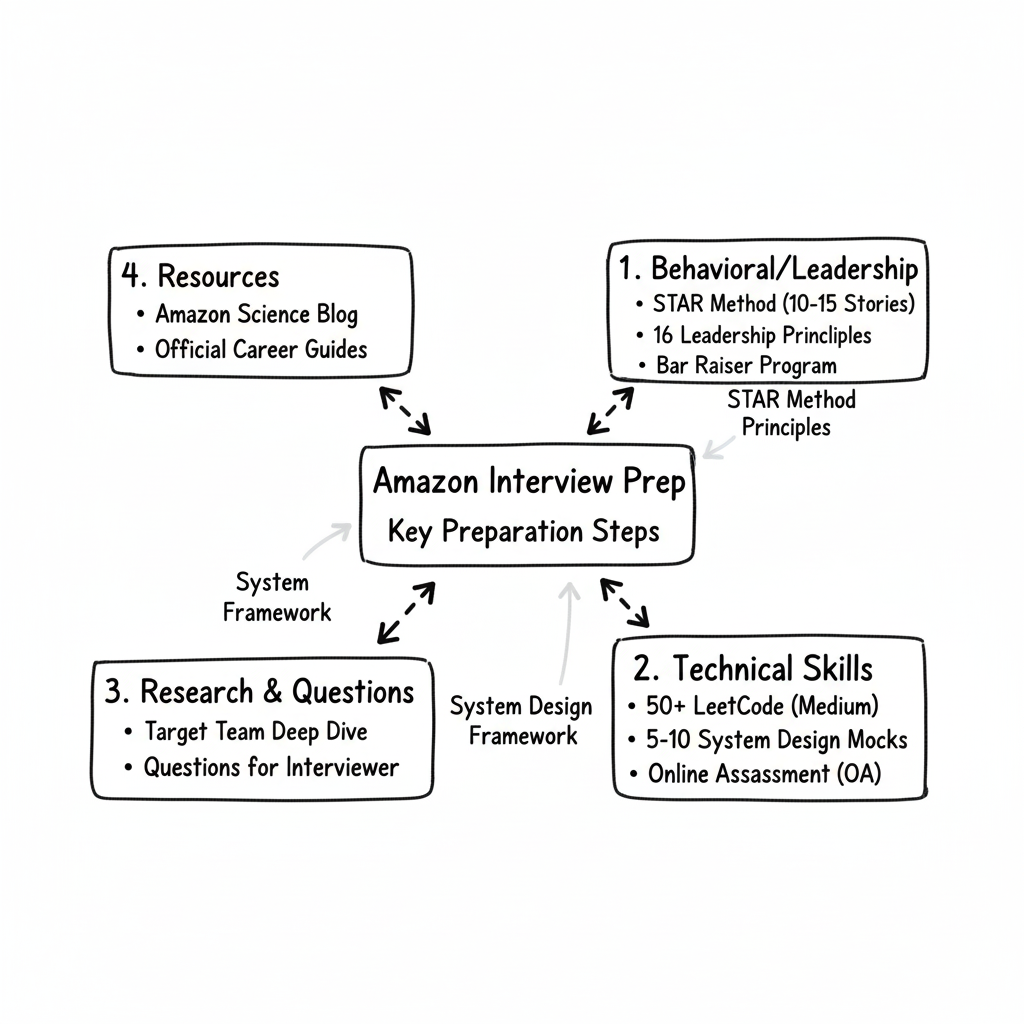
- Amazon-Specific Preparation Resources:
- Leadership Principles: Study all 16 LPs thoroughly and prepare STAR stories for each one.
- Bar Raiser Program: Understand that one interviewer will be a Bar Raiser—someone from another
- Online Assessment (OA): Practice the work simulation questions and coding challenges on platforms like HackerRank1
- Amazon’s Engineering Blog: Read about their technical challenges and solutions at Amazon Science
- Interview Process Guide: Review Amazon’s official preparation materials on their careers site.
- Role-Specific Guides:
- Key Preparation Steps:
- Master the STAR method for all behavioral questions
- Practice 50+ coding questions on LeetCode (focus on medium difficulty)
- Complete 5-10 system design mock interviews using the framework in section 1.3
- Prepare 10-15 detailed STAR stories covering all Leadership Principles
- Research your target team and prepare specific questions about their work
4. Amazon Interview FAQs
Here are answers to the most common questions about Amazon interviews.
4.1 How difficult is an Amazon interview?
Amazon interviews are considered very challenging. The coding questions typically range from LeetCode medium to hard difficulty, with the expectation that you solve them in 35-45 minutes including explanation and testing. The behavioral interviews are uniquely rigorous due to the Leadership Principles framework—you’ll face 5-6 behavioral rounds, each testing 2-3 LPs. The Bar Raiser adds an extra level of scrutiny. Success rates at the onsite stage range from 5-20% depending on the level and team.
4.2 What is a Bar Raiser at Amazon?
A Bar Raiser is a specially trained interviewer from a different team who joins your interview loop to ensure Amazon maintains high hiring standards. They have veto power over hiring decisions. Bar Raisers look for candidates who excel in multiple Leadership Principles and would raise the overall talent bar of the team. They typically ask the most challenging questions and probe deeply into your past experiences. Approximately 15% of Amazon employees are Bar Raisers.
4.3 How should I prepare for Amazon’s Leadership Principles?
Study all 16 Leadership Principles and prepare 2-3 detailed STAR stories for each one. Your stories should be real, specific, and demonstrate measurable impact. Focus especially on Customer Obsession, Ownership, Dive Deep, Bias for Action, and Deliver Results—these are the most frequently tested. Practice articulating your stories in under 3 minutes while including all STAR elements. Write down your stories and practice them out loud. Remember that most questions will test multiple LPs simultaneously.
4.4 What programming language should I use for Amazon coding interviews?
Amazon allows you to use any mainstream programming language (Python, Java, C++, JavaScript, etc.). Python is the most popular choice because of its concise syntax and rich standard library. Choose the language you’re most comfortable with and know deeply—you’ll be expected to write syntactically correct, efficient code without IDE assistance. Make sure you know the time and space complexity of common data structures and algorithms in your chosen language.
4.5 How long does the Amazon interview process take?
The Amazon interview process typically takes 4-8 weeks from application to offer. The timeline breaks down roughly as:
- Resume screening: 1-2 weeks
- Recruiter call: Scheduled within 1 week of resume approval
- Online Assessment: Must be completed within 5-7 days
- Technical phone screen: Scheduled 1-2 weeks after OA
- Onsite/Loop interview: Scheduled 2-3 weeks after phone screen
- Hiring decision: 1-2 weeks after onsite
The process can be faster (2-3 weeks) for urgent roles or slower (3+ months) if there are scheduling conflicts or if you’re applying to multiple teams.
5. More Amazon Interview Questions
We’ve analyzed 170+ interview questions reported by Amazon candidates on Glassdoor to identify the most frequently asked types: coding, system design, and behavioral/leadership questions. Below are additional questions for you to practice.
5.1 Amazon Coding and System Design Interview Questions
Here are additional coding and system design questions to practice with:
- Coding Questions:
- Reverse a linked list in groups of size k
- Kth Largest Element in an Array (LeetCode 215)
- Number of Islands (LeetCode 200)
- Binary Tree Maximum Path Sum (LeetCode 124)
- Two Sum (LeetCode 1)
- Merge Two Sorted Lists (LeetCode 21)
- Valid Parentheses (LeetCode 20)
- Longest Substring Without Repeating Characters (LeetCode 3)
- System Design Questions:
- Design a parking lot system
- Design Amazon S3
- Design a rate limiter
- Design Amazon’s recommendation system
- Design a distributed cache (like Memcached)
- Design a notification service
We recommend using the frameworks provided in section 1 to practice these questions systematically.
5.2 Amazon Leadership Questions
Amazon’s 16 Leadership Principles drive every interview. Here are additional behavioral questions organized by LP:
- Customer Obsession: Tell me about a time you had to make a decision between customer experience and business goals
- Ownership: Describe a time when you took on something significant outside your area of responsibility
- Invent and Simplify: Tell me about a time when you simplified a process
- Learn and Be Curious: Tell me about a time you learned a new skill to complete a project
- Hire and Develop the Best: Tell me about a time you mentored someone
- Insist on the Highest Standards: Describe a situation where you refused to compromise on quality
- Think Big: Tell me about a time you proposed a new approach or solution
- Bias for Action: Describe a time when you had to make a decision with incomplete information
- Dive Deep: Tell me about a time you identified a problem that others missed
- Earn Trust: Tell me about a time you had to build trust with a stakeholder. For each question, use the STAR method demonstrated in section 1.
6. Practice Amazon Interview Questions
To help you ace the process, we’ve identified three proven ways to practice for Amazon interviews.
6.1 Learn by yourself
Self-study is an essential first step. Start with the frameworks and example answers provided in section 1 of this guide. Use free resources like LeetCode,HackerRank, and Amazon’s official interview preparation materials13.
However, self-study has limitations. You can’t simulate the pressure of a live interview, you won’t get feedback on your communication style, and you can’t practice handling unexpected follow-up questions. That’s why most candidates combine self-study with other approaches.
6.2 Practice with peers
Practicing with friends or peers who are also preparing for interviews can be helpful. You can take turns being the interviewer and candidate, which helps you understand both perspectives.
The main challenges with peer practice are:
- Your peers may not know Amazon’s specific expectations or Leadership Principles
- They can’t give you company-specific feedback
- Neither of you may know the optimal solutions or evaluation criteria
- It’s hard to simulate the seniority and experience gap of a real interviewer
For these reasons, many candidates supplement peer practice with expert coaching.
6.3 Practice with experienced Amazon interviewers
In our experience, practicing with former Amazon interviewers makes the biggest difference in interview performance. Working with an expert coach allows you to:
- Get real-time feedback on your technical problem-solving approach
- Learn exactly how Amazon evaluates STAR stories and Leadership Principles
- Understand what strong vs. weak answers sound like
- Practice handling the Bar Raiser interview specifically
- Receive personalized guidance on your specific weaknesses
- Gain insights into team-specific expectations and culture
For these reasons, many candidates supplement peer practice with expert coaching.
7. Land Your Amazon Role with Jobright.ai
While mastering interview skills is essential, finding and applying to the right Amazon opportunities is equally critical to your success. Even the best-prepared candidate needs to discover roles that match their unique background and career goals.
Jobright.ai is an AI-powered job search copilot designed to streamline your Amazon job search and maximize your chances of landing interviews. Here’s how Jobright.ai can complement your interview preparation:
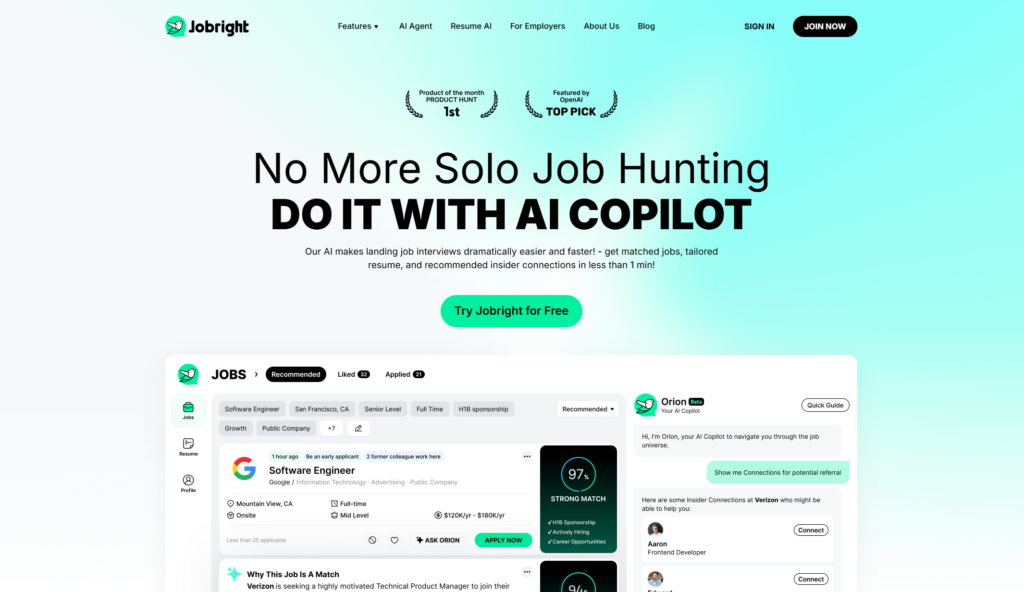
7.1 Discover Hidden Opportunities
Jobright.ai’s AI algorithms scan thousands of Amazon job postings across all divisions—AWS, Alexa, Prime, Amazon Web Services, Annapurna Labs, and more—to surface roles that match your specific skills, experience level, and career interests. Many of these positions aren’t widely advertised on traditional job boards.
7.2 Get Personalized Job Recommendations
Instead of manually searching through hundreds of listings, Jobright.ai learns from your profile and preferences to deliver tailored Amazon job recommendations. Whether you’re targeting SDE roles, ML Engineer positions, or Technical Program Manager opportunities, the platform identifies the best-fit roles for your background.
7.3 Optimize Your Resume for Amazon Roles
Jobright.ai’s AI analyzes specific Amazon job descriptions and provides actionable insights on how to tailor your resume to highlight the most relevant skills and experiences. This targeted approach significantly increases your chances of passing the initial resume screening.
7.4 Access Company and Team Insights
Get intelligence on specific Amazon teams, their tech stacks, recent projects, and interview focus areas. Understanding the context of each role helps you prepare more effectively and ask informed questions during your interviews.
7.5 Ready to Accelerate Your Amazon Job Search?
Visit Jobright.ai today to:
- Start your AI-powered job search for Amazon roles
- Get matched with opportunities that fit your profile
- Receive personalized application
- Track your progress toward landing your dream Amazon offer
Combine the interview preparation strategies in this guide with Jobright.ai’s intelligent job search platform to maximize your chances of success. Your Amazon career starts with finding the right opportunity—let Jobright.ai help you discover it.