
What Is a Good Resume Match Score? How to Interpret Your Results
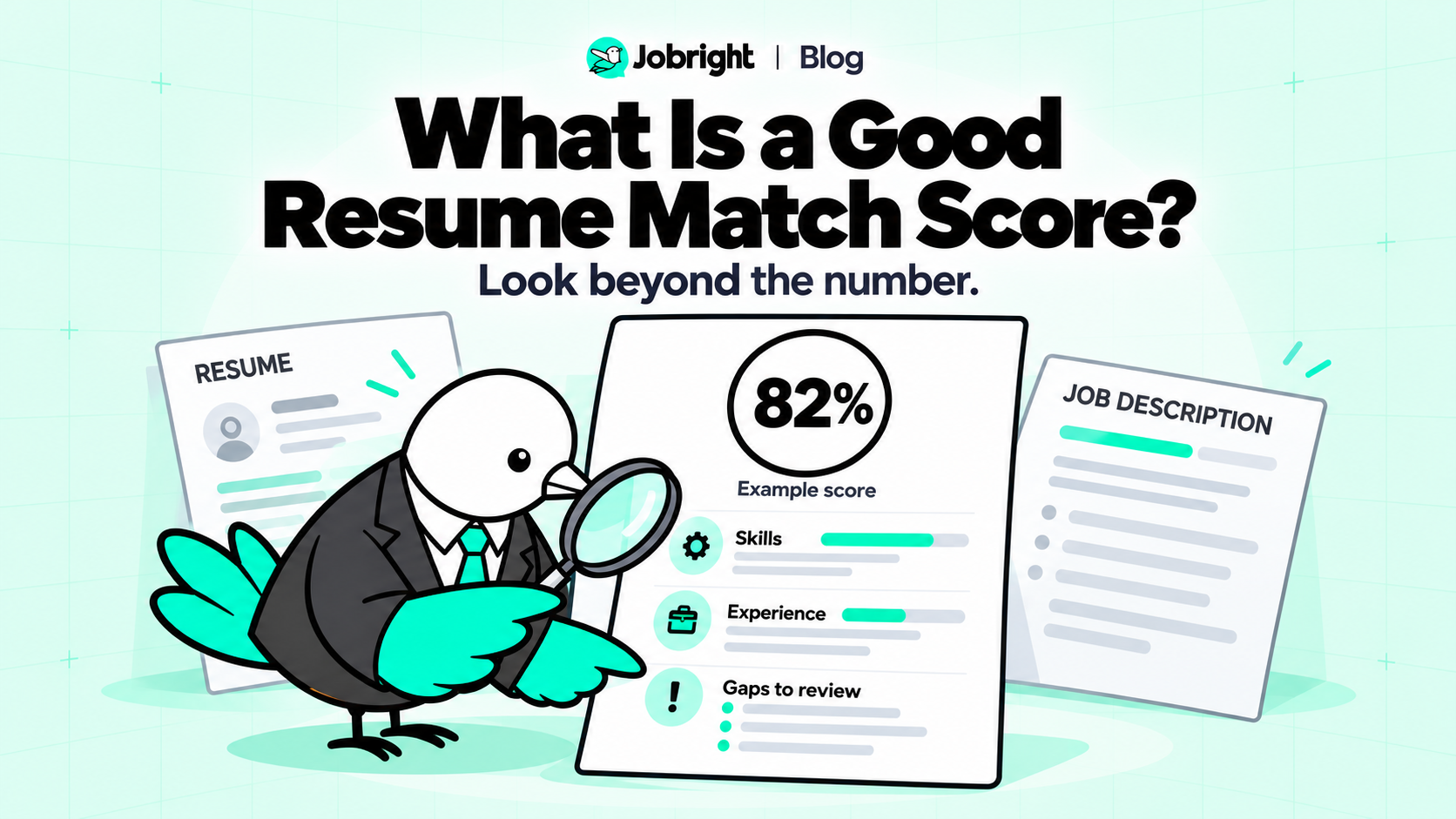
Table of Contents
Your resume checker returns a score of 78%. Another tool gives the same application a different result. Should you keep editing, apply now, or look for a better-fitting role?
There is no single resume match score you should treat as a pass mark across tools and employers. A useful result depends on what the tool measures, which requirements remain unresolved, and whether your resume accurately represents your qualifications.
Some tools publish their own targets. For example, Jobscan’s current website recommends a 75% match rate. That is guidance for its product—not proof that every employer uses the same cutoff.
The more useful question is not simply, “Is my score high enough?”
It is: “What does this report tell me to check before I apply?”
What Does a Resume Match Score Measure?
A resume match score summarizes a tool’s comparison between your resume and a particular job description.
Depending on the product, that comparison may consider qualifications, responsibilities, terminology, job titles, or other information.
The label alone does not tell you the scoring method.
For example, Huntr’s documentation describes a weighted assessment of qualifications, responsibilities, keywords, and job-title alignment. It also describes categories such as Poor, Fair, Good, and Great.
Do not assume another product uses those same factors, weights, or categories.
Before interpreting your result, check:
- What information did the tool analyze?
- Does the report explain what contributed to the result?
- Are required qualifications distinguished from preferences?
- Is the score about a specific job, or general resume quality?
- Does the provider explain what its recommended target means?
If the method is not documented, avoid inventing an explanation for the number.
Is a 75% or 80% Resume Match Score Good?
A 75% or 80% result may meet a particular tool’s recommended target. It does not, by itself, establish that your application is ready.
You still need to understand what remains missing.
| What the report shows | What to investigate | Practical next step |
|---|---|---|
| A result near the tool’s suggested target | Whether an important requirement remains unresolved | Review the underlying findings before deciding |
| A high result with a missing required qualification | Whether you actually meet that requirement | Confirm the facts; do not assume the total compensates for the gap |
| A lower result with relevant experience omitted from the resume | Whether the experience can be documented accurately | Add supported detail and review the comparison again |
| A lower result involving work you have not performed | Whether the role is suitable for your current background | Consider the gap rather than trying to solve it with wording |
| Conflicting results from different tools | Whether their inputs and methods differ | Compare explanations, not just totals |
This is an interpretation guide, not a validated scoring scale.
A score also is not an interview probability. An 80% match should not be read as an 80% chance of hearing from a recruiter.
Is a Resume Match Score the Same as an Employer’s ATS Score?
Do not assume a candidate-facing score reproduces an employer’s assessment.
To establish that connection, you would need evidence about the employer’s system, configuration, and evaluation criteria—not just a number from a separate tool.
Employer-side products can have their own settings. Greenhouse’s Talent Matching documentation, for example, describes criteria and weights defined by the hiring team. It states that this feature does not automatically advance or reject candidates.
That example does not describe every ATS or every screening process. It demonstrates why a consumer tool’s suggested target should not become a rule about all employers.
Use a resume match report to review your application. Do not treat it as access to the recruiter’s actual decision process.
Why Can Two Tools Give You Different Scores?
A percentage is meaningful only in the context of the assessment that produced it.
If two reports disagree, first check whether you gave them the same materials.
Different Inputs
You may have compared:
- Different versions of your resume.
- A complete job description in one tool and a shortened excerpt in another.
- An older posting and a revised one.
- A resume file in one tool and pasted text in another.
If the product displays extracted resume text, inspect it. Confirm that the relevant content is present before interpreting a missing-item finding.
Different Definitions of a Match
One report may focus on terminology. Another may place more emphasis on qualifications or responsibilities.
Even when products use similar labels, do not assume they calculate them identically.
Different Treatment of Context
A tool might recognize related experience in a bullet. Another might flag the requirement because the wording is less explicit.
Read the explanation and check it against your history. Neither result gives you permission to claim work you have not done.
A higher number is not enough evidence that one tool is more accurate.
How to Read Your Resume Match Report
Use the following order to decide what deserves attention. This is a practical review method, not a description of any product’s scoring formula.
1. Check Requirements That Could Change Your Application Decision
Start with explicitly required qualifications and practical conditions.
Examples include a required credential, a particular type of experience, or an on-site work arrangement you cannot meet.
A combined score should not distract you from an unresolved condition that matters to the role.
If the posting is unclear, record the question and seek clarification where possible.
2. Review the Evidence Behind Major Findings
For each important finding, locate the relevant sentence in the job description and the supporting information in your resume.
Ask:
- Does my resume already demonstrate this?
- Have I done the work but described it vaguely?
- Is the tool interpreting my experience more broadly than it should?
- Do I need to confirm a detail before changing anything?
A report can flag a potential issue. Your next step is to investigate it.
3. Separate Missing Wording From Missing Experience
Suppose a posting asks for incident response, while your resume says only “supported production services.”
That wording does not establish whether you participated in incidents, investigated alerts, or simply handled routine support.
If you performed the relevant work, explain it accurately.
If you did not, adding “incident response” would create a misleading claim rather than resolve the gap.
4. Turn Each Finding Into a Specific Action
Avoid an editing instruction such as “increase my score.”
Use a concrete action instead:
- Name the database used in the project.
- Explain your contribution to a production incident.
- Clarify that a technology was used only in coursework.
- Verify whether a credential is still current.
- Leave an unsupported qualification out.
For the full requirement-by-requirement process, see How to Match Your Resume to a Job Description.
Example: What an 82% Match Could Still Leave Unresolved
This is a fictional scenario. The score is illustrative, not a Jobright result, a tested calculation, or a prediction of hiring outcomes.
A software engineer receives an 82% match for a platform engineering role.
The posting asks for Python, AWS, participation in a production on-call rotation, and Terraform. Kubernetes is preferred.
The candidate’s background is:
- Professional Python development.
- AWS deployment experience.
- Terraform used in a personal infrastructure project.
- Occasional investigation of production issues, but no scheduled on-call rotation.
- No Kubernetes experience.
The total does not explain these differences by itself.
| Requirement | What the candidate can substantiate | What to do |
|---|---|---|
| Python | Used professionally | Keep the relevant development examples |
| AWS | Used for deployments | Describe the deployment work accurately |
| Terraform | Used only in a personal project | Keep the project context explicit |
| Production on-call rotation | Not part of the candidate’s responsibilities | Do not claim on-call experience; assess this requirement |
| Kubernetes, preferred | No experience | Leave it out rather than adding it to improve coverage |
The candidate could make a vague bullet clearer:
Investigated production error logs and worked with the service owner to reproduce and resolve reported issues.
That is appropriate only because the fictional candidate actually performed those tasks.
It should not become:
Owned production reliability and led the on-call rotation.
The first revision explains relevant experience. The second changes the scope of the claim.
After the accurate edit, the candidate still needs to consider the on-call requirement. Whether the score changes is secondary.
Use Jobright to Look Beyond the Total
Jobright’s Resume Job Matcher compares an existing resume with a specific job description. Its public page lists areas including overall match, experience and seniority, skills alignment, industry experience, and job keyword gaps.
Use those areas to organize your review.
A finding about skills calls for a different question than a finding about seniority. Knowing a technology does not automatically establish the level of ownership a role requires.
Compare the report with the original posting and your actual experience. Do not assume the tool knows an employer’s private evaluation criteria or verifies your work history.
Want to understand what needs attention before rewriting?
Compare your resume with the job description, then review the specific areas of alignment and potential gaps.
How to Improve a Match Without Chasing the Number
Improve the information a reader receives—not just the report’s total.
Make Supported Details Explicit
Replace vague language with the actual tool, task, or responsibility when that information is relevant and true.
Do not invent a metric because a bullet seems incomplete without one. A clear description of the work is better than an unsupported result.
Keep the Scope of Experience Visible
Professional experience, coursework, and personal projects can all provide useful information. They are not interchangeable.
Keep context clear so that a new keyword does not imply years of production experience.
Remove Changes That Make the Resume Less Credible
After editing, ask whether you can explain every claim in an interview.
Remove inflated ownership, unfamiliar technologies, altered employment titles, and results you cannot substantiate.
For guidance on terminology and repetition, see How Many Resume Keywords Should You Use?.
Compare Revisions Carefully
If you review the resume again, keep the job description and tool consistent. Save the earlier version and note what changed.
A score change can prompt further inspection. It does not prove an equivalent change in interview likelihood.
If the provider does not document repeatability, avoid assigning a specific cause to a small score difference without evidence.
When Should You Stop Optimizing Your Score?
Stop when the next proposed change would add repetition, distort your background, or provide no useful information.
A practical stopping checklist is:
- I checked the important findings, not just the total.
- The relevant experience I possess is understandable.
- I resolved factual questions before adding claims.
- Any remaining qualification gaps are recognized.
- Every change improves clarity or relevance.
- I reviewed the final resume as a document a person will read.
This is an editing checkpoint—not a guarantee that you should apply or will receive an interview.
If you are still unsure about the role itself, separate that decision from the score. Consider the actual responsibilities, stated requirements, and practical conditions.
Frequently Asked Questions
Is an 80% resume match score enough to apply?
It may meet a tool’s suggested target, but it is not a universal application threshold. Review the requirements behind the result, especially any explicitly required qualification that remains unresolved.
Is a 90% match better than an 80% match?
It is a higher result within that assessment. Without further evidence, you cannot translate the difference into an interview probability or conclude that the resume is more truthful or useful. Read what changed.
Can a high resume match score still lead to rejection?
Yes. A matching report does not establish the employer’s final assessment or guarantee an interview. A high total also does not resolve a requirement you genuinely do not meet.
Should I aim for a 100% resume match?
Do not pursue 100% at the expense of accuracy or readability. Leave out qualifications you do not possess, and stop adding terms when they no longer help explain your experience.
Why did my score stay the same after I improved my resume?
An edit can improve clarity without changing a particular tool’s assessment. Review whether the change communicates useful information. If you need to understand the calculation, consult the provider’s documentation rather than assuming the edit was ineffective.
Can I compare resume match scores for different jobs?
Use the underlying findings to understand each role. A higher result for one posting does not establish that it is the better career opportunity: responsibilities, requirements, and your own preferences may differ.
Final Takeaway
A good resume match score is useful only when you understand what sits behind it.
Read the tool’s explanation, investigate important gaps, and make changes that clarify real qualifications. Do not turn a suggested target into an employer-wide cutoff.
Use the score to decide what to check—not to decide what to invent.
1 thought on “What Is a Good Resume Match Score? How to Interpret Your Results”
Comments are closed.