
Is Auto Apply Safe? What to Know Before Using AI to Apply for Jobs
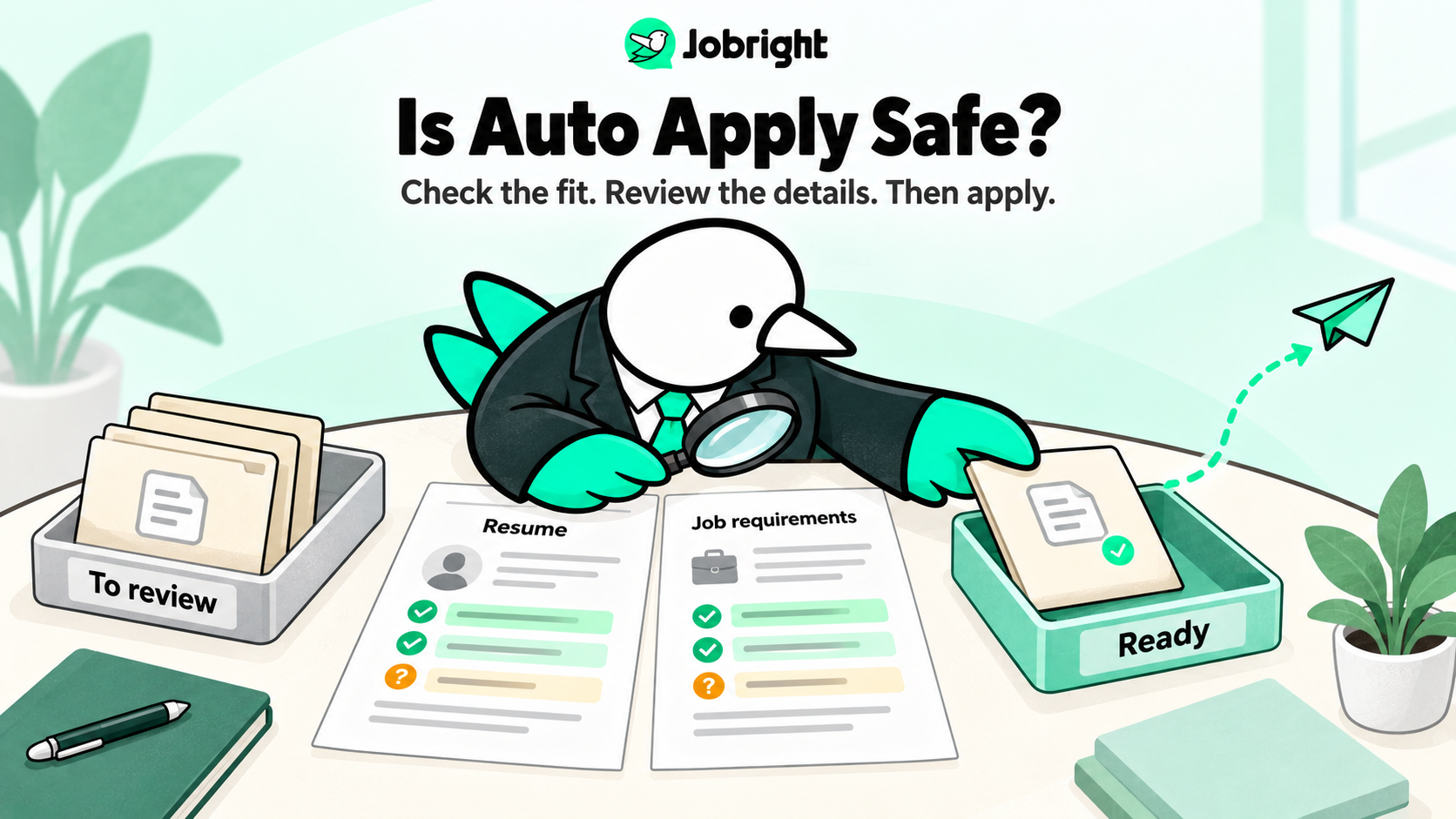
Table of Contents
AI auto apply can be safe to use, but safety depends on the tool, the access you give it, the quality of its job matching, and how much control you keep over each application.
A responsible auto-apply workflow should reduce repetitive work without sending inaccurate information, applying to unsuitable roles, or hiding what was submitted in your name. If you are asking, “Is an AI job application safe?” start by checking whether the tool only fills forms or can submit them, what data it stores, and where you can review its work.
Auto apply is safest when it automates repetitive work—not decisions about job fit, qualifications, or sensitive screening questions.
This guide explains how AI auto apply works, the risks to watch for, and how to decide whether it fits your job search.
What Is AI Auto Apply and How Does It Work?
AI auto apply refers to software that automates one or more parts of a job application. Depending on the product, the process may include:
- Job matching: The tool compares jobs with your resume, experience, preferences, location, and target role.
- Resume preparation: It may select an existing resume or help tailor one for the job description.
- Application autofill: It enters contact details, work history, education, and other saved information into the application form.
- Submission: Some tools stop for your review, while others can submit an application based on rules you approve.
- Tracking: The tool records the company, role, date, resume version, and application status.
Autofill and auto apply are not the same thing. Autofill reduces typing but normally leaves the final review and submission to you. A fully automated system may select jobs and submit applications with less involvement from you.
That distinction matters. The more decisions a tool makes independently, the more carefully you should review its matching rules, permissions, answers, and activity history.
| Feature | Autofill | Auto apply |
|---|---|---|
| Fills repetitive fields | Yes | Yes |
| Selects jobs | Usually no | May select jobs using your preferences |
| Submits applications | You normally submit | May submit automatically |
| User control | Higher at the point of submission | Depends on review and approval settings |
Is Auto Apply Safe? 5 Risks to Know
The main risks of AI auto apply are not mysterious. Most come from poor targeting, inaccurate information, excessive access, or a lack of visibility into what the tool submitted.
1. Applying to poorly matched jobs
A tool may prioritize volume over relevance. Broad filters can target the wrong seniority, location, salary, work authorization requirements, or core skills. Define your target titles and non-negotiable preferences, then review a sample of recommendations before enabling automation.
You can also use Jobright AI Job Match to review how your skills, experience, seniority, and preferences align with a role before deciding whether it deserves an application.
2. Submitting incorrect application answers
Applications often ask about relocation, work authorization, sponsorship, salary, clearance, or years of experience. An AI tool should not guess. Treat sensitive screening questions as review-required fields and confirm that saved answers can be corrected.
3. Sending a generic or mismatched resume
Using the same resume for every opening can hide relevant experience, while aggressive rewriting can introduce false skills or metrics. Good tailoring changes emphasis and wording without changing the facts. Revise only claims you can defend in an interview.
Before rewriting, use the Jobright Resume Job Matcher to see where your existing experience aligns and what may be missing. If the role is worth pursuing, use Resume Tailor to improve the presentation of your real experience.
4. Sharing more personal data than necessary
Job application tools may need resume data, profile details, browser permissions, or access to job sites. Review the privacy policy, permissions, retention terms, and deletion options. Do not put government identifiers, banking information, or passwords in a resume or reusable profile, and question access that is not necessary for applying.
5. Losing track of what was submitted
High-volume automation can make it difficult to remember what was submitted. Track the company, title, job description, date, resume version, and status. Review the list regularly and remove duplicates.
Auto-Apply Risk Checklist
| Concern | How to reduce the risk |
|---|---|
| Applying to unsuitable jobs | Check job fit and set clear role, location, seniority, and work-authorization filters before applying. |
| AI answers a screening question incorrectly | Review work authorization, sponsorship, salary, relocation, clearance, and experience answers before submission. |
| Resume is not aligned with the job description | Tailor only truthful experience and verify every generated change. |
| You do not know where you applied | Keep a searchable application record with the job description and resume version. |
| You are worried about privacy | Review permissions and privacy terms, minimize sensitive data, and use established account-security practices. |
| The same employer receives duplicate applications | Check your application history and exclude roles or companies already contacted. |
Does Auto Apply Actually Work?
Auto apply can reduce repetitive work, surface more openings, and complete standard fields faster. It does not automatically improve interview or offer rates; outcomes still depend on fit, qualifications, resume relevance, accuracy, timing, and competition.
Treat automation as an efficiency tool, not a substitute for strategy. Speed matters only when it produces accurate applications to relevant roles.
A practical way to judge whether auto apply works for you is to track:
- Relevant applications sent
- Applications requiring correction
- Recruiter responses and interviews
- Duplicate, expired, or unsuitable jobs
Review these signals every one or two weeks. If volume rises but relevant responses do not, tighten your targeting before sending more applications.
Can Auto Apply Hurt Your Job Search?
Auto apply can hurt your search when it produces activity without judgment. Indiscriminate applications can create duplicates, target roles you never wanted, and obscure which jobs actually fit.
Speed also cannot fix a mismatched resume or an incorrect screening answer. A tool should never invent experience, skills, certifications, education, work authorization, salary expectations, or willingness to relocate. When information is missing, it should ask you or pause.
Review outcomes regularly so automation does not weaken your learning loop. The roles that respond—or consistently do not—should help you improve your targeting.
When Should You Use Auto Apply?
Auto apply is most useful when your target is clear and the applications are reasonably standardized.
Auto apply may be a good fit when:
- You know your target roles, locations, and seniority level.
- Your resume already represents your experience accurately.
- You repeatedly apply to similar roles.
- You can set exclusions, review history, and correct saved answers.
- Repetitive forms are taking time away from networking and interview preparation.
Use more manual control when:
- You are changing careers and job fit requires careful explanation.
- You are targeting a small list of high-priority employers.
- The role requires a portfolio, writing sample, long-form questions, or customized cover letter.
- Work authorization, licensing, clearance, or location requirements are complex.
- The questions depend heavily on the specific team or position.
- You are still testing which roles fit your background.
Many job seekers benefit from a hybrid approach: use AI to find jobs, compare fit, tailor truthful materials, and autofill routine fields, then manually review strategic applications and sensitive questions.
How to Use AI Auto Apply Safely
Before Choosing an Auto-Apply Tool, Check:
- Can you review, pause, or cancel future submissions?
- Does it show which jobs, answers, and documents were submitted?
- Can you correct saved answers and require review for sensitive questions?
- Can it detect or help prevent duplicate applications?
- Can you delete your stored data and account?
- Does it explain why it needs each browser or account permission?
If these controls are unclear, test the tool with a small batch—or choose a more supervised workflow.
Use the following checklist once you have selected a tool:
Before applying
- Define target titles, seniority, location, salary, remote preferences, and exclusions.
- Confirm your resume, employment dates, education, contact details, and skills are current.
- Review the tool’s privacy policy, permissions, data handling, and deletion controls.
- Confirm whether it provides autofill, one-click, or automated submission, and set review-required fields.
For each application batch
- Review job fit and confirm the selected resume matches the role.
- Verify work authorization, sponsorship, location, compensation, and experience answers.
- Do not allow AI to invent skills, metrics, job titles, dates, or responsibilities.
- Skip suspicious, duplicate, expired, or incomplete listings and save what was submitted.
After applying
- Review application history and track responses, interviews, and rejections.
- Adjust matching rules based on actual outcomes.
- Pause automation if application quality drops or unfamiliar submissions appear.
- Remove outdated data and permissions you no longer need.
Auto Apply vs. Manual Apply: Which Is Better?
Neither method is always better. The right choice depends on the role and how much customization it requires.
| Factor | AI auto apply | Manual apply |
|---|---|---|
| Speed | Faster for repeated fields and similar roles | Slower, especially with long forms |
| User control | Varies by tool and review settings | High control over every answer and document |
| Personalization | Can scale basic tailoring, but still requires verification | Easier to customize deeply for one employer |
| Error risk | Saved errors can repeat across applications | Errors are less likely to repeat automatically, but manual mistakes still happen |
| Best use case | Clearly defined targets and standardized applications | High-priority, complex, specialized, or relationship-driven roles |
| Tracking | Strong when the tool logs every submission | Requires a separate tracker or consistent manual updates |
A strong job search often uses both. Automate low-value repetition, but keep manual attention for decisions that affect fit, accuracy, and your professional story.
How Jobright Helps You Apply to Better-Matched Jobs
Safe automation begins before the application form. You first need to decide whether a job fits your background and goals.
Jobright supports a more deliberate application flow:
- Find relevant roles: AI Job Match ranks opportunities using your target role, preferences, resume, experience, skills, seniority, and industry background.
- Verify alignment: Resume Job Matcher compares your resume with a specific job description and surfaces potential gaps.
- Tailor truthfully: Resume Tailor helps improve how your existing experience is presented without changing the underlying facts.
- Reduce repetitive work: AI Job Agent can streamline matching, resume preparation, form completion, submission, and tracking.
Review your preferences and saved information, and keep additional control over sensitive or role-specific questions.
Find Better-Matched Jobs Before You Apply
Start with jobs that fit your experience before automating applications. Review why each role may be a match, then decide which opportunities deserve your time.
Final Takeaway: Should You Use Auto Apply?
Use auto apply if it helps you submit accurate applications to relevant jobs while keeping you informed and in control. Do not use it as permission to apply indiscriminately or stop reviewing what is submitted in your name.
The safest approach is straightforward:
Find relevant jobs → verify fit → tailor truthfully → review important answers → submit → track results.
Automation should remove repetitive work. It should not replace your judgment.
FAQs About AI Auto Apply
Is auto apply safe for job seekers?
Auto apply can be safe when a tool has clear permissions, accurate saved information, relevant filters, visible application records, and review controls. Risks increase when it applies broadly, guesses important answers, or hides what it submitted. Review its privacy terms and test a small batch before expanding its use.
Does auto apply actually work?
Auto apply can reduce the time needed to find jobs and complete repetitive forms. It does not guarantee interviews or offers. Judge it by application quality and recruiter responses—not only by the number of applications sent.
Can employers detect AI auto apply?
There is no universal detection rule shared by all employers or application systems. Employers may notice inaccurate answers, generic materials, duplicates, or claims that do not match your experience. Focus on submitting truthful, relevant information you can confidently discuss—not on trying to conceal AI use.
Should I use AI to apply for jobs?
Use AI assistance when your target roles are clear and repetitive work is slowing you down. Keep more manual control for high-priority roles, career changes, complex eligibility questions, portfolios, and custom responses. A hybrid process usually offers the best balance.
Is it safe to upload my resume to an AI tool?
It can be, but review the provider’s privacy policy, retention terms, deletion options, and permissions first. Remove unnecessary information such as a full street address. Never include banking details, passwords, or government identification numbers in a general resume upload.
Can auto apply hurt your job search?
Yes, if it sends irrelevant applications, repeats incorrect answers, uses the wrong resume, or creates duplicates. Reduce these risks with narrow targeting, truthful tailoring, review-required fields, application tracking, and regular quality checks.