
Should I Apply for This Job? 7 Signs You’re a Good Fit
Table of Contents
You find a job that looks promising. The title fits. The company looks interesting. Then you scroll down to the requirements.
Five years of experience. A tool you’ve barely used. A skill you don’t have. A long list of “preferred qualifications.”
Suddenly, you’re asking yourself:
Should I apply for this job if I don’t meet every requirement?
In most cases, you don’t need to check every box to be a good candidate. What matters more is whether your experience, skills, and career goals align with the parts of the job that actually matter.
Here’s how to figure out whether a job is worth your application.
Do You Need to Meet Every Job Requirement?
Usually, no.
Job descriptions often describe an employer’s ideal candidate, not the only person they’ll consider.
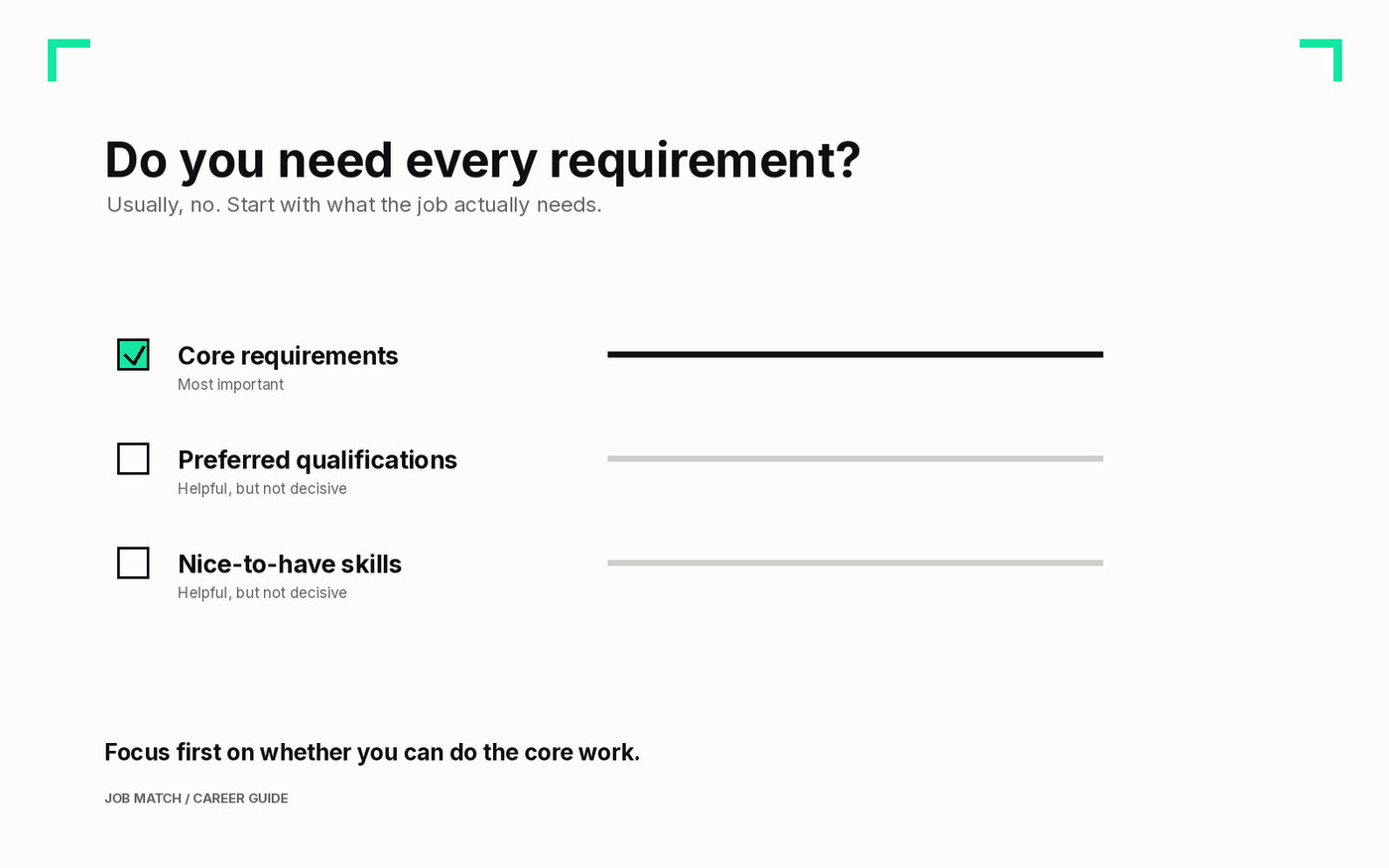
Instead of counting how many bullet points you match, separate the qualifications into three categories.
Core requirements
These are the qualifications most closely connected to actually doing the job, such as:
- Relevant work experience
- Core technical or functional skills
- Required licenses or certifications
- Work authorization
- Experience with the role’s main responsibilities
Missing several core requirements can make a role a stretch.
But being slightly short on years of experience or missing one skill doesn’t necessarily mean you shouldn’t apply.
Preferred qualifications
When a job description says “preferred,” “a plus,” or “nice to have,” treat it differently from a hard requirement.
You might see:
- MBA preferred
- SaaS experience is a plus
- Familiarity with Salesforce preferred
- Python experience is a bonus
These can make someone more competitive, but missing them doesn’t automatically make you unqualified.
Nice-to-have skills
Job descriptions can become wish lists.
Employers may include every tool, skill, methodology, and type of experience they would ideally like a candidate to have.
Very few applicants will match all of them.
Focus first on whether you can do the core work of the role.
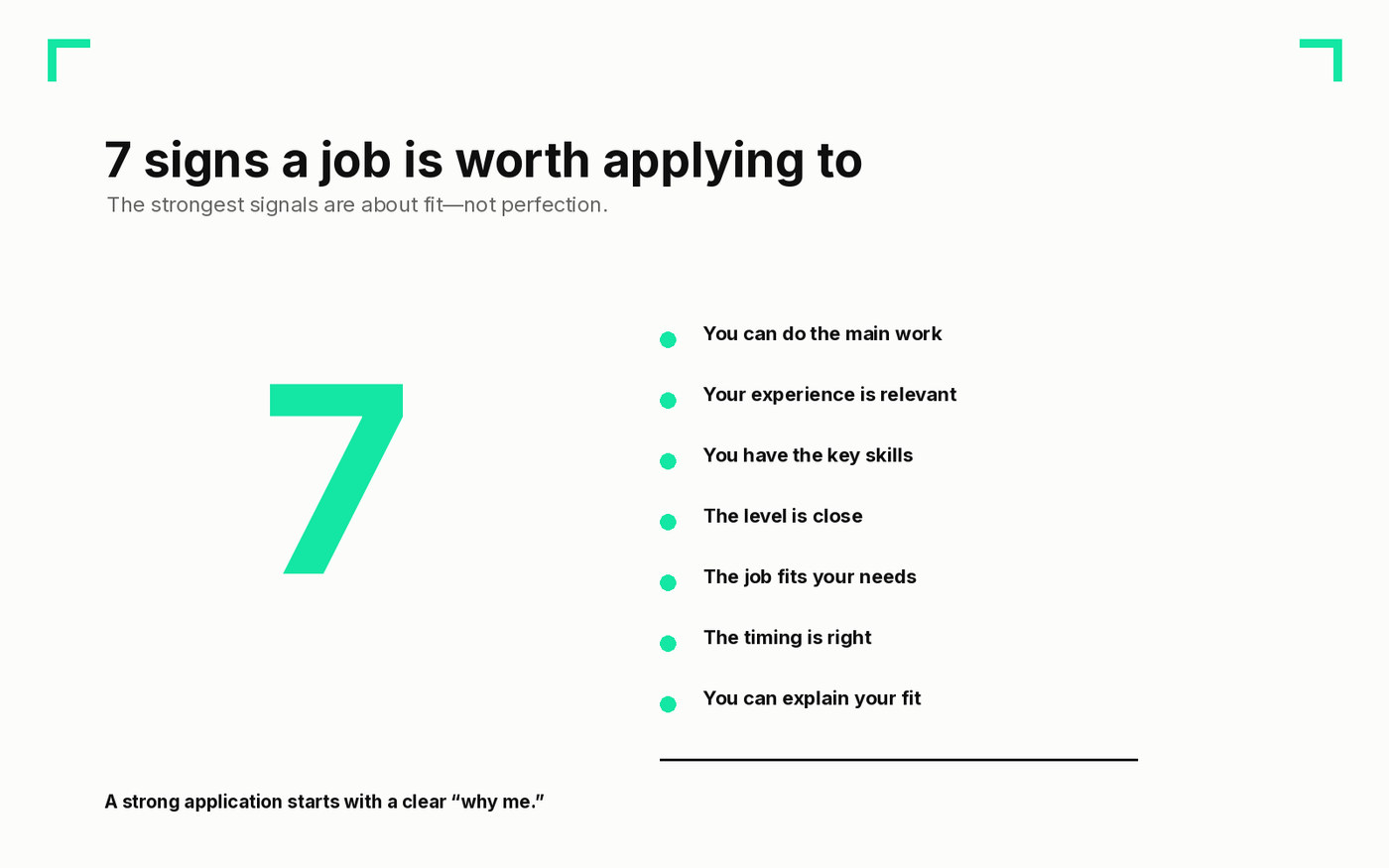
7 Signs a Job Is Worth Applying To
Before spending time on an application, look for these signals.
1. You can do most of the main responsibilities
Start with the responsibilities section rather than the qualifications list.
Ask yourself:
Could I realistically perform most of this work after a reasonable onboarding period?
If yes, that’s a strong reason to keep considering the job.
2. Your experience is relevant, even if your job title is different
Companies use different titles for similar work.
A Growth Manager at one company might have responsibilities similar to a Performance Marketing Manager somewhere else.
Instead of comparing job titles alone, look at:
- Problems you’ve solved
- Projects you’ve owned
- Tools you’ve used
- Teams you’ve worked with
- Results you’ve delivered
Relevant experience matters more than having an identical title.
3. You meet the most important skills
Look at which skills appear repeatedly throughout the job description.
If a role repeatedly mentions SQL, data analysis, experimentation, and stakeholder management, those probably matter more than a tool mentioned once at the bottom of the page.
The question isn’t:
“How many keywords do I match?”
It’s:
“Do I have the skills this person will actually use?”
4. You’re reasonably close to the experience level
Don’t automatically reject yourself because a role asks for five years of experience and you have four.
Years of experience are often used as a rough signal for capability.
A bigger concern is a major seniority gap.
For example, applying for a role that requires leading a large organization when you’ve never managed a team is very different from being one year short of an experience requirement.
5. The job fits your practical requirements
A job can match your resume and still be a bad fit for you.
Check things like:
- Location
- Remote, hybrid, or onsite requirements
- Salary
- Employment type
- Work authorization or sponsorship
- Seniority
- Industry
- Career direction
A good match works both ways: you fit the job, and the job fits what you want.
6. The opportunity is still worth your time
Timing matters too.
A highly relevant job posted recently may deserve more attention than an older listing with a large applicant pool.
When you’re deciding where to spend your time, consider not only whether you’re qualified, but also whether you have a realistic opportunity to get noticed.
7. You can explain why you’re a fit
Try finishing this sentence:
“I’m a strong candidate for this job because…”
If you can immediately point to two or three relevant skills, experiences, or accomplishments, that’s a good sign.
If the only reason is that the job looks interesting, you may want to keep searching for a stronger match.
Should I Apply If I Only Meet 60% or 70% of the Requirements?
There’s no universal percentage that tells you whether you should apply.
Not all requirements carry the same weight.
Imagine two candidates:
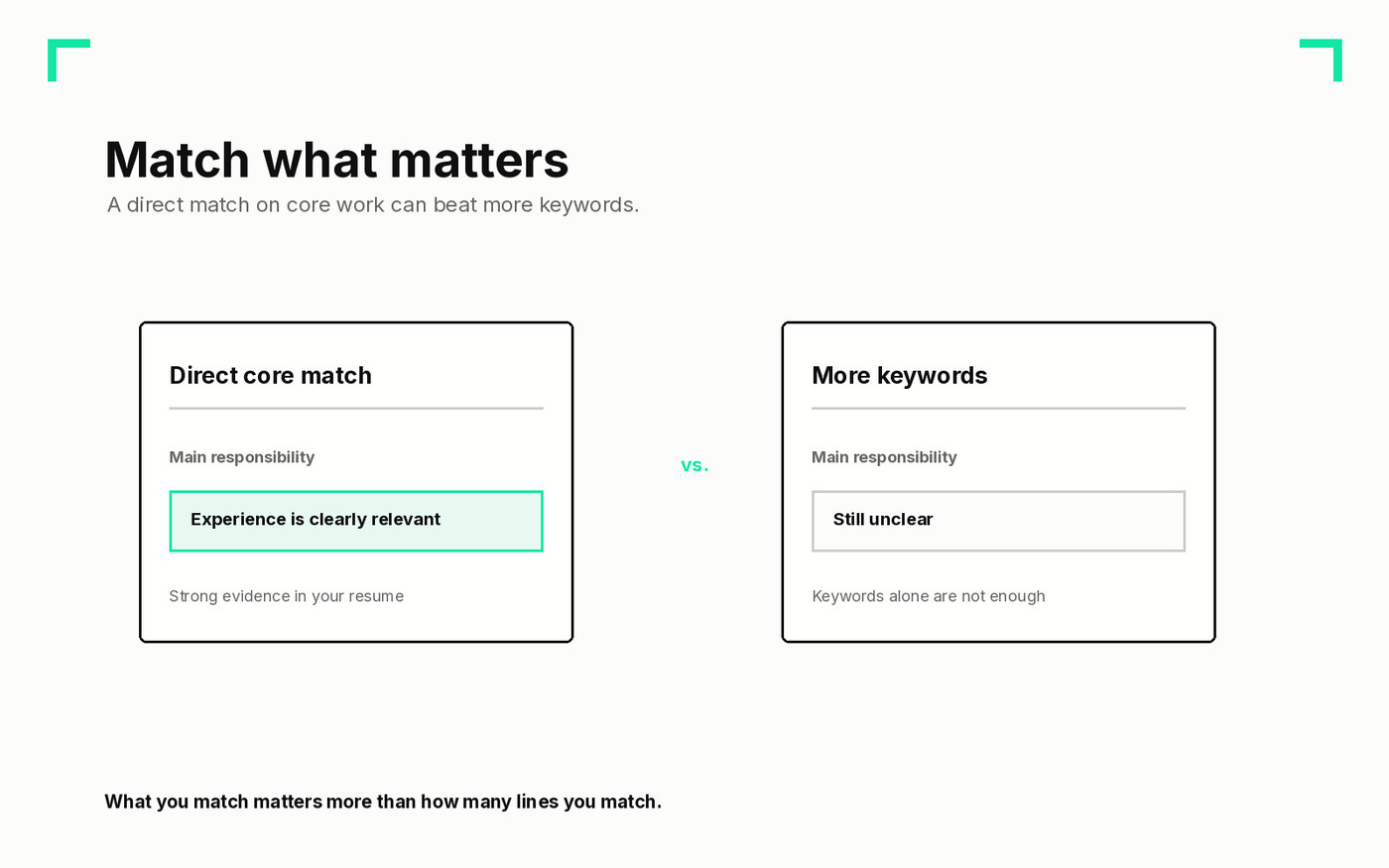
Candidate A matches 7 out of 10 requirements but has direct experience doing the core work.
Candidate B matches 9 out of 10 listed keywords but lacks experience with the role’s main responsibility.
Candidate A may still be the stronger fit.
That’s why simply counting keywords—or trying to hit an arbitrary percentage—can be misleading.
A useful job match should consider what you match, not just how many things you match.
How to Tell If You’re Qualified for a Job
You can evaluate a job manually by comparing the posting with your background across a few important areas:
Experience: Have you done similar work before?
Skills: Do you have the core skills required for the role?
Seniority: Does the scope of the position fit your current experience?
Education and certifications: Are you missing anything that’s truly required?
Location and work authorization: Can you realistically work in the role?
Career preferences: Does this opportunity actually fit what you want next?
Resume evidence: Does your resume clearly show why you’re qualified?
Doing this for one job isn’t difficult.
Doing it for dozens—or hundreds—of jobs is where job searching starts to become exhausting.
Stop Guessing Which Jobs Are a Good Match
Instead of manually comparing your resume with every job description, AI job matching can help surface opportunities that are more relevant to your background.
Jobright uses your experience and job preferences to recommend jobs and show how closely each opportunity matches your profile.
With Jobright AI Job Match, you can see a Match Score alongside recommended jobs, helping you quickly understand which opportunities may deserve more of your attention.
You can also use signals such as:
- Your job match
- Experience requirements
- Job location
- Work arrangement
- Recently posted opportunities
- Early applicant opportunities
- H-1B sponsorship information where available
- Hidden Jobs
- Other job preferences
Instead of opening hundreds of listings and deciding from scratch, you can start with jobs already matched to your profile.
Job Match Score vs. ATS Score: What’s the Difference?
These two scores answer different questions.
An ATS resume score generally focuses on your resume—how well it can be read by hiring systems and how closely it aligns with a particular job description.
A job match score focuses on the opportunity itself:
How well does this job fit your background and preferences?
Both can matter during a job search.
Job matching helps you decide where to focus your time.
Resume and ATS optimization help you present your experience more effectively once you’ve found a job worth applying to.
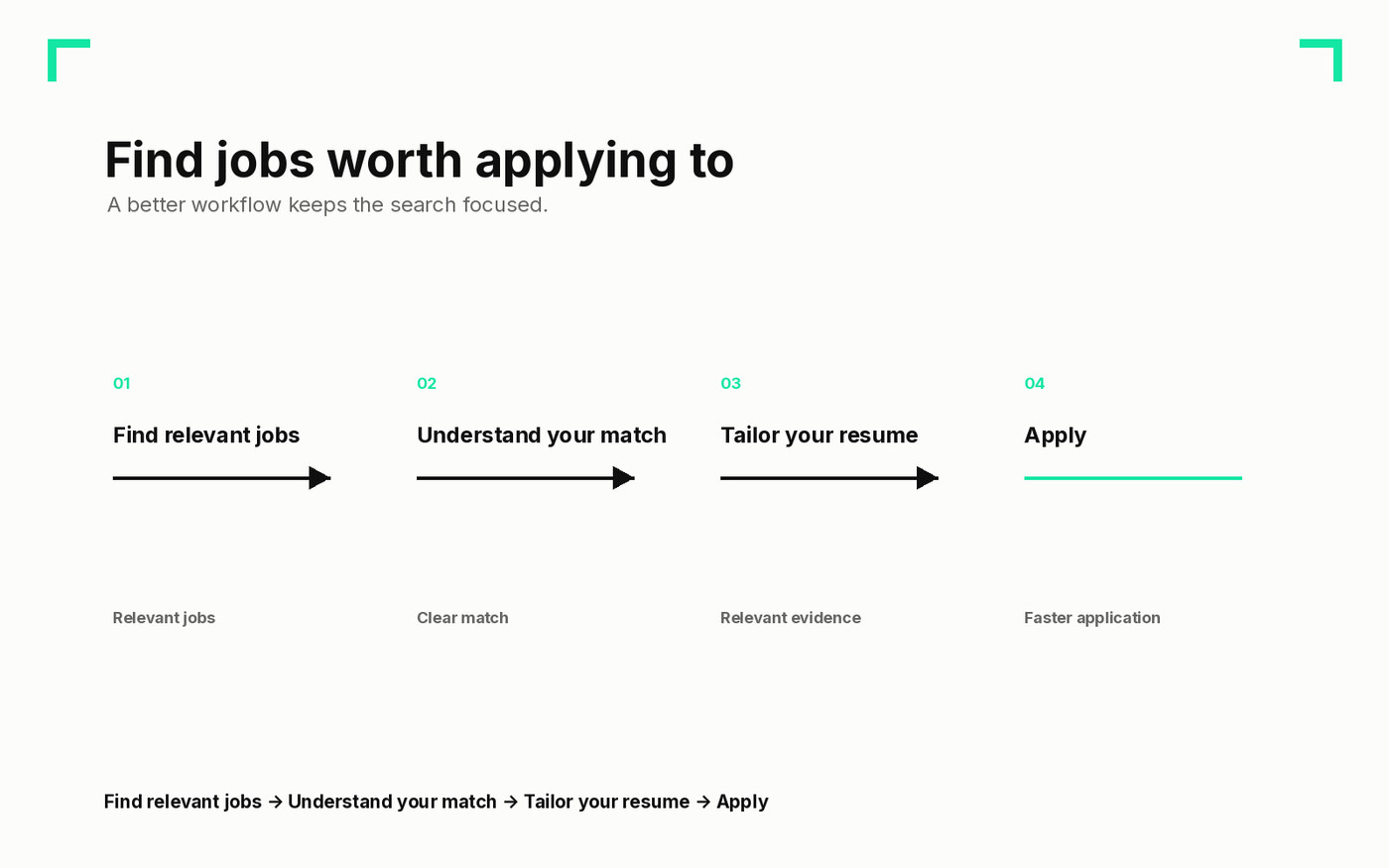
A stronger workflow looks like this:
Find relevant jobs → Understand your match → Tailor your resume → Apply
Rather than:
Find hundreds of jobs → Apply everywhere → Hope something works
What If You’re a Good Fit but Your Resume Doesn’t Show It?
This is one of the most common problems in job searching.
You might have the right experience, but your resume describes it differently from the job posting.
For example, a company may ask for:
“Cross-functional stakeholder management.”
Your resume might say:
“Worked with engineering, design, and marketing teams to launch new features.”
The experience is relevant, but the connection may not be immediately obvious.
That’s where resume tailoring can help.
The goal isn’t to copy keywords from the job description or invent experience you don’t have. It’s to make your real, relevant experience easier for recruiters and hiring systems to understand.
Once you’ve found a strong-match job, review your resume and make sure the most relevant skills and accomplishments are clear before you apply.
Should You Apply to More Jobs or Better-Matched Jobs?
Applying to more jobs can create more opportunities—but only if those applications are relevant.
Sending the same resume to hundreds of loosely related jobs can take time without necessarily improving your chances of getting interviews.
A better approach is to prioritize:
Relevant jobs + strong match + clear resume + faster application
This doesn’t mean you should only apply to “perfect” matches.
It means spending more of your time on opportunities where your background gives you a realistic chance.
AI can help reduce the repetitive work involved in that process.
Jobright can recommend relevant opportunities, show your Match Score, help you optimize your resume, and use Autofill to reduce repetitive application forms.
That means less time deciding where to apply—and less time typing the same information over and over again.
Find Jobs Worth Applying To
You don’t need to meet every qualification to apply for a job.
You also don’t need to apply to every job you find.
The goal is to find the opportunities where your skills, experience, preferences, and career goals line up well enough to make the application worth your time.
Instead of asking:
“Do I meet 100% of the requirements?”
Ask:
“Is this one of the better opportunities for someone with my background?”
That’s a much more useful question.
Frequently Asked Questions
Should I apply for a job if I don’t meet all the requirements?
Yes, in many cases. Job descriptions often describe an ideal candidate. If you meet most of the core requirements and can perform the main responsibilities, the job may still be worth applying to.
Is it worth applying if I meet only 70% of the requirements?
It can be. There is no universal percentage that determines whether you’re qualified. Meeting the most important requirements is usually more meaningful than matching every minor skill or keyword.
How do I know if I’m qualified for a job?
Compare your experience, core skills, seniority, education, work authorization, location, and preferences with the job description. Job matching tools can help make this comparison faster across many opportunities.
What is AI job matching?
AI job matching compares information about your experience, skills, and job preferences with available opportunities to surface jobs that may be more relevant to you.
What is a job match score?
A job match score is an estimate of how closely a job aligns with your profile based on factors such as your background, experience, and job requirements. It should be used as a decision aid rather than a guarantee that you’ll receive an interview.
Is a job match score the same as an ATS score?
No. A job match score helps evaluate how well an opportunity fits your profile. An ATS score generally focuses on how effectively your resume can be parsed or aligned with a specific job description.
Should I tailor my resume for every job?
You don’t need to completely rewrite your resume for every application. For jobs you seriously want, however, you should make sure your most relevant skills and accomplishments are clear and aligned with the role.
Should I apply to as many jobs as possible?
Volume can help, but relevance matters. Prioritizing jobs that fit your experience and preferences—and then making those applications stronger—can be a more efficient approach than applying indiscriminately.